

The Decision Control Layer: Governing Execution Before Collapse
By Team Acumentica
Introduction: Collapse Is Not Sudden; It Is the Final Stage of Drift
Institutional collapse is rarely sudden. It is the predictable outcome of drift; drift in exposure, drift in workflow, drift in research direction, drift in autonomous execution. Drift accumulates quietly until it becomes structural. By the time collapse is visible, the underlying misalignment has been compounding for years.
CIO’s face this reality every day. They oversee systems that are intelligent, autonomous, and governed by compliance frameworks; but none of those layers prevent collapse.
Institutions do not fail because they lack intelligence. They fail because they lack runtime governance above intelligence and above governance frameworks.
This missing layer is the Decision Control Layer.
1. The Four Layers of Institutional Investment Architecture
Institutions today operate across three layers:
- Investment System of Record; stores capital data, mandates, policies, allocations.
- Investment AI Layer; agentic models, allocation engines, risk systems.
- Investment Governance Layer; compliance frameworks, mandates, regulatory and sovereign rules.
But none of these provide runtime control. The missing fourth layer is the Decision Control Layer (Decision Control OS).
The Decision Control Layer
- Governs execution above data, intelligence, and governance.
- Enforces discipline in runtime.
- Prevents drift before collapse.
- Protects capital through governed, operator‑led decision pathways.
2. Why Intelligence and Governance Alone Cannot Prevent Collapse
Institutions have invested heavily in intelligence (AI, risk engines, predictive models) and governance (compliance frameworks, mandates, regulatory rules). Yet collapse still occurs.
Why?
- Intelligence optimizes but does not constrain.
- Governance defines rules but does not enforce them in runtime.
- Neither layer prevents drift.
Collapse emerges not from lack of intelligence or governance, but from lack of Decision‑Control Infrastructure.
3. Drift: The Silent Force Behind Collapse
Drift is the silent destabilizer of institutions. It accumulates across domains:
- Risk drift → exposure exceeds governed thresholds.
- Portfolio drift → cabinet decisions misalign with strategy.
- Research drift → research direction diverges from institutional intent.
- Autonomy drift → agentic systems execute outside governance.
Drift is cumulative. Drift leads to misalignment. Misalignment leads to instability. Instability leads to collapse.
Drift → Misalignment → Instability → Collapse
The Drift Index quantifies this accumulation, but measurement alone is not enough. Institutions require governance that prevents drift from forming in the first place.
4. How the Decision‑Control Layer Governs Execution Before Collapse
The Decision‑Control Layer governs execution through five mechanisms:
- Constraint Governance; execution cannot violate CIO‑defined boundaries.
- Exposure Governance; risk cannot drift beyond governed thresholds.
- Portfolio Governance; portfolio decisions follow governed cabinet workflows.
- Research Governance; research direction stays aligned with institutional intent.
- Agentic Governance; autonomous systems operate inside governed limits.
Together, these mechanisms stabilize institutions by ensuring execution always aligns with CIO intent.
5. How the Investment Decision Control OS Implements the Layer
The Decision Control Layer is conceptual. The Investment Decision Control OS is the product implementation of that layer.
It delivers governance through subsystem OS modules:
- Risk Governance ControlOS
- Portfolio Governance ControlOS
- Research Governance ControlOS
- Performance Governance ControlOS
- What-If Scenario ControlOS
- Agentic Investment ControlOS
- Behavioral & Adversarial Resilience ControlOS
Each module governs a specific institutional domain. Together, they implement the Decision‑Control Layer across the entire investment architecture.
6. Evidence: Collapse Dynamics (2000–2026)
| Year | Drift Type | Collapse Outcome | Governance Absent | CIO Implication |
|---|---|---|---|---|
| 2000 | Portfolio drift | Market misalignment | No portfolio governance | Strategy drifted silently |
| 2008 | Risk drift | Financial collapse | No risk governance | Exposure exceeded limits |
| 2015 | Research drift | Innovation collapse | No research governance | Direction misaligned |
| 2020 | Autonomy drift | Operational instability | No agentic governance | Systems executed outside intent |
| 2026 | Institutional drift | Collapse dynamics visible | No Decision‑Control Layer | Governance required above intelligence and governance |
Real‑World Evidence: Decision‑Control Prevents Collapse
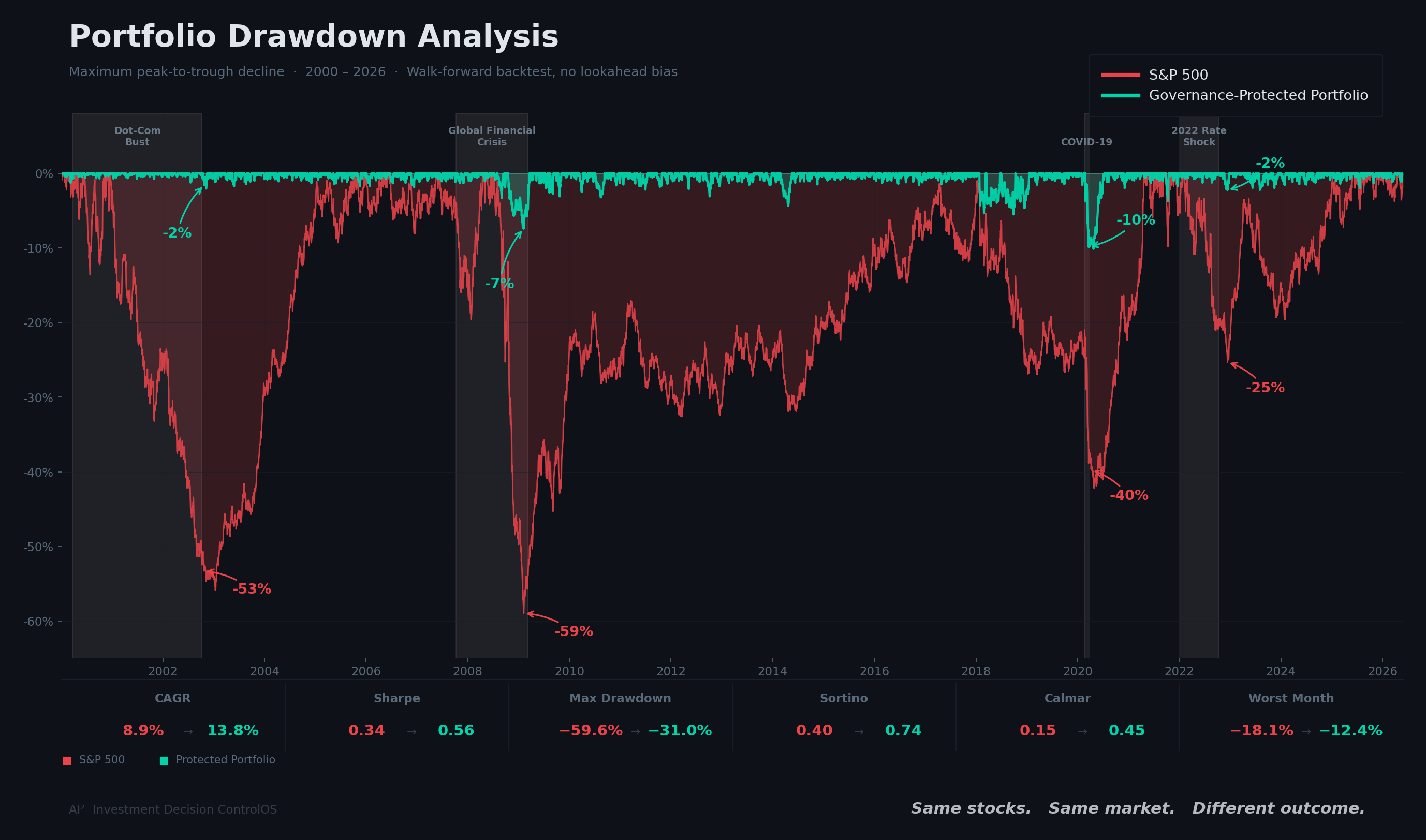
The chart below demonstrates how the Decision‑Control Layer suppresses collapse dynamics in real portfolios. Both portfolios use the same market, same stocks, and same conditions; the only difference is the presence of Decision‑Control governance.
S&P 500 (Uncontrolled Execution)
- Drift accumulates
- Exposure breaches
- No runtime governance
- Collapse events fully express
- Drawdowns: –53%, –59%, –40%, –25%
Governance‑Protected Portfolio (Decision‑Control Execution)
- Drift prevented
- Exposure governed
- Execution constrained
- Collapse events suppressed
- Drawdowns: –2%, –7%, –10%, –2%
Outcome
Decision Control does not change the market. It changes how the institution experiences the market.
It prevents collapse by governing execution above intelligence and above governance frameworks; exactly what the Decision Control Layer is designed to do.
This is the empirical signature of Decision Control Infrastructure.
Four crises. One institution. Two very different outcomes.
| Crisis | Ungoverned Institution | Governed Institution |
|---|---|---|
| Dot‑Com | Strategic drift → collapse | Drift controlled → stability |
| GFC | Operational drift → failure | Execution governed → resilience |
| COVID | Governance drift → chaos | Constraints enforced → alignment |
| 2022–2024 AI/Market Volatility | Agentic drift → misalignment | Decision‑Control → governed autonomy |
Why This Matters (Decision‑Control Layer)
Collapse is not caused by a single event. It is caused by drift. When exposure, workflows, research direction, and autonomous execution drift, institutions break quietly — long before performance reveals the damage.
The Decision Control Layer prevents collapse because:
- Intelligence identifies opportunities
- Governance frameworks define rules
- Decision Control governs execution above both
- Exposure, limits, workflows, and agentic execution are constrained in runtime
- Leadership still decides; but drift cannot compound into failure
This is why the Decision Control Layer must sit above intelligence and above governance frameworks. It is the only layer that prevents collapse by governing execution before drift becomes structural.
Acumentica Governs. The CIO Decides.
7. CIO Implications: Preventing Collapse Through Governance Above Intelligence and Governance
CIO’s now face a new institutional reality:
- Intelligence is not enough.
- Governance frameworks are not enough.
- Monitoring is not enough.
Institutions require Decision Control Infrastructure.
The Decision‑Control Layer gives CIO’s:
- stability
- resilience
- alignment
- governed autonomy
- collapse prevention
It is the missing layer in modern institutional architecture.
Industry‑Agnostic Governance
The Decision Control Layer is industry‑agnostic. It governs execution across any institutional architecture where drift accumulates. Industries include:
- Investment institutions
- Aerospace
- Healthcare systems
- Manufacturing and supply chain
- Energy and utilities
- Construction
- Technology and AI operations
- Government and sovereign systems
- University Institutions
Wherever drift leads to collapse, the Decision‑Control Layer stabilizes execution above intelligence and governance.
Conclusion
Collapse is predictable. Drift is measurable. Governance is preventable.
The Decision‑Control Layer governs execution before collapse, stabilizing institutions by constraining execution above intelligence and governance. The Investment Decision‑Control OS implements this layer across risk, portfolio, research, exposure, and autonomous execution.
Acumentica governs. CIOs decide.
Learn More
If your institution is experiencing portfolio instability, drift in exposures, or unexplained allocation changes, explore how Acumentica’s Investment Decision ControlOS governs construction, allocation, and execution to eliminate drift.
Also learn about Frida, Acumentica’s Agentic AI ControlOS that operates inside the Investment Decision Control OS, using governed decision pathways.
Decision Control Research Lab
The Decision Control Research Lab researches drift, collapse dynamics, and the Decision‑Control layer; the institutional execution‑governance systems that keep autonomous and enterprise systems stable, aligned, and protected from drift‑driven failure.
Portfolio Drift: When construction and allocation quietly break strategy
Decision Drift: The Institutional Instability CIOs Can’t See
AI Hallucination Drift: When AI Creates False Decisions That Break Institutional Governance
Risk Governance: Preventing drift and overrides in Agentic AI execution
Portfolio Governance: Stabilizing Investment Decisions in Agentic AI Systems
Why Investment Teams Fail: The Missing Governance Layer
What is Capital Decision Control Infrastructure? The New Architecture Wall Street and Enterprises Will Need
The Missing Layer Between Research and Execution: Decision Control
Why Investment Team Drift Under Uncertainty (and How to Stop It)
About Acumentica
Acumentica is a Precision AI-powered Capital Decision Control Infrastructure company.
We help institutions make better decisions under uncertainty and avoid costly mistakes by transforming complex data, risk, and constraints into clear, disciplined next actions. Request a demo
Acumentica is the steering and braking layer above Intelligence; the part that governs what intelligence does, not just what it predicts.
Acumentica originated the Capital Decision Control Infrastructure and built the first product in that category; the Decision Control OS. We are the first company to introduce governed capital‑control as a market and technology category thesis.