
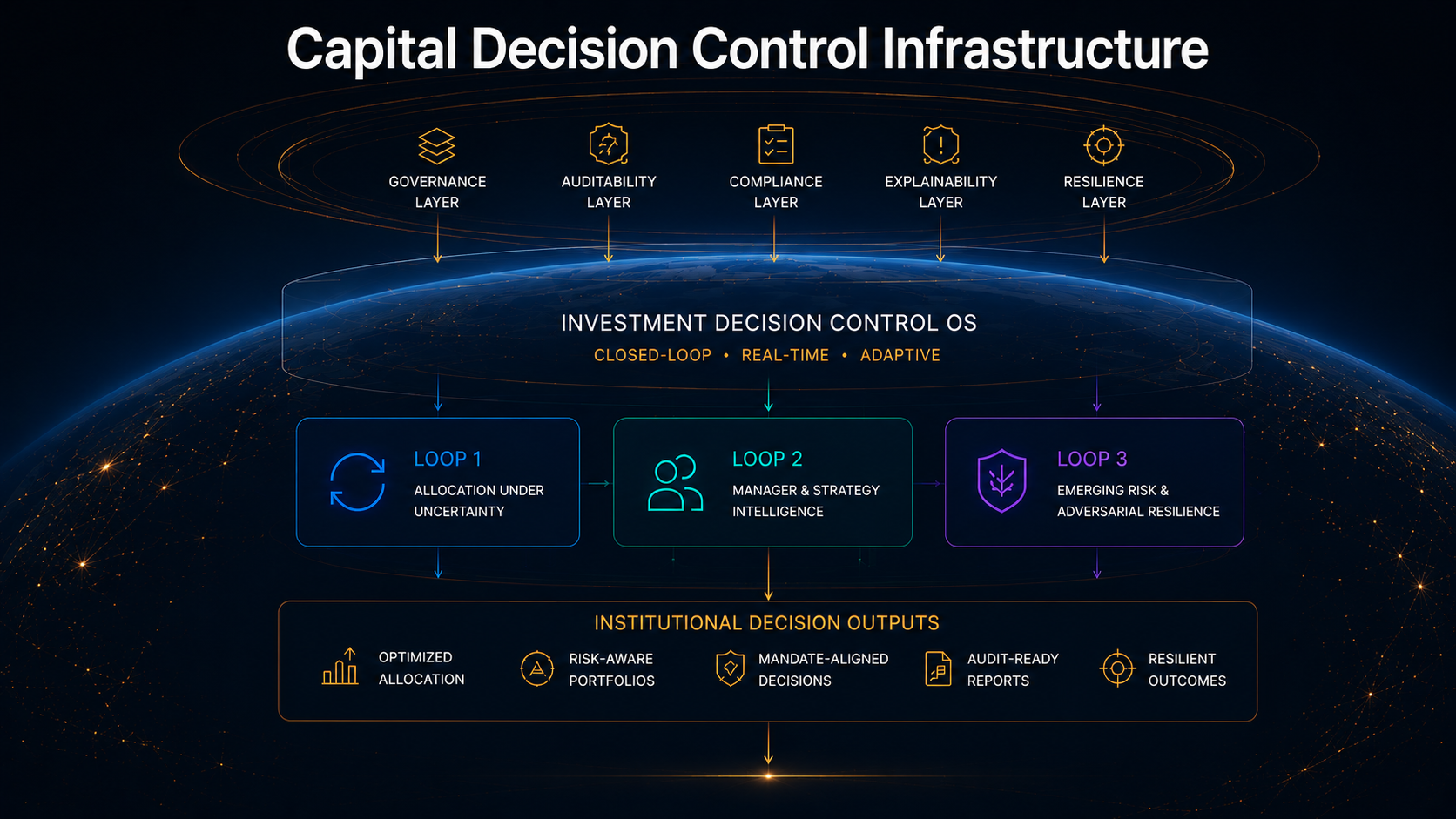
What Is Capital Decision Control Infrastructure?
Capital Decision Control Infrastructure (CDCI) is a new class governance architecture designed to govern decisions under uncertainty. Unlike predictive analytics or advisory systems, CDCI enforces constraints, prevents catastrophic states, and ensures decisions remain with mandate-aligned boundaries through closed-loop control.
Acumentica is the creator of this infrastructure. We created the first Capital Decision Control Infrastructure; establishing the category, defining the architecture, and delivering the governed, closed-loop system institutions have been missing for decades.
It’s first implementation is the Investment Decision Control OS(PrecisionOS), which operationalizes the infrastructure into a governed, closed-loop system for institutional decision making.
The complete category structure is outlined in the Category Anchor Page.
WHY
Why Investment Is a Control Problem
Institutional portfolios operate in environments defined by:
• uncertainty
• regime shifts
• nonlinear risk
• adversarial market behavior
• governance requirements
• mandate constraints
Analytics tools describe the world. Control systems act in the world.
Investment requires:
• dynamic adjustment
• exposure control
• forward‑looking risk detection
• mandate alignment
• systemic manager evaluation
• adversarial resilience
These are control functions, not analytics functions.
Capital Decision Control Infrastructure is the first institutional framework built for this reality.
CLOSED-LOOP
The Closed-Loop Control Cycle
Capital Decision‑Control Infrastructure governs investment decisions through a continuous, adaptive loop:
Sense → Signal → Decide → Act → Adapt → Learn
• Sense: Observe market, macro, and structural conditions
• Signal: Extract meaningful, regime‑aware intelligence
• Decide: Determine mandate‑aligned actions
• Act: Implement exposure, allocation, or manager adjustments
• Adapt: Respond to adversarial or shifting conditions
• Learn: Update models, priors, and decision frameworks
This loop is the foundation of governed investment control.
DECISION LOOPS
The Three Decision Loops
Every institutional investment decision falls into one of three loops. Capital Decision‑Control Infrastructure governs all three.
Loop 1 — Allocation Under Uncertainty
Determines how the portfolio should adjust as conditions change.
Anchors: dynamic allocation, regime detection, exposure control, portfolio resilience.
Loop 2 — Manager & Strategy Intelligence
Evaluates managers and strategies through systemic, mandate‑aligned intelligence.
Anchors: manager performance, strategy evaluation, persistence, mandate alignment.
Loop 3 — Emerging Risk & Adversarial Resilience
Detects risks before they appear in backward‑looking models.
Anchors: emerging risks, volatility adaptation, structural breaks, adversarial conditions.
These loops form the architecture of institutional decision‑control.
LAYERS
/0.1 The Governance Layer
Institutional portfolios require:
• auditability
• explainability
• mandate alignment
• constraint enforcement
• compliance integration
• decision traceability
Capital Decision‑Control Infrastructure embeds governance into every loop, ensuring that every action is:
• explainable
• defensible
• compliant
• aligned with fiduciary duty
Governance is not an add‑on; it is the operating environment.
/0.2 The Auditability Layer
Maintains a complete, immutable record of:
• decisions
• signals
• model states
• overrides
• rationale
• outcomes
This is the institutional memory of the system; enabling:
• traceability
• accountability
• post‑event review
• compliance verification
Auditability is essential for institutional adoption.
/0.3 The Compliance Layer
Ensures the system operates within:
• regulatory requirements
• fiduciary obligations
• internal policy constraints
• model governance standards (SR 11‑7)
• AI governance requirements (EU AI Act, SEC expectations)
Compliance is embedded into the decision process; not bolted on afterward.
/0.4 The Explainability Layer
Provides transparent, human‑interpretable reasoning for:
• allocation adjustments
• manager evaluations
• risk detections
• signal changes
• model adaptations
This layer ensures decisions can be understood, challenged, and defended by:
• CIOs
• investment committees
• auditors
• regulators
Explainability is a first‑class requirement, not a reporting artifact.
/0.5 The Adversarial-Resilience Layer
Markets are adversarial systems:
• liquidity vanishes
• correlations break
• signals degrade
• volatility clusters
• models fail
Capital Decision Control Infrastructure is built to operate under adversarial conditions by:
• detecting signal degradation
• adapting to regime shifts
• identifying structural breaks
• adjusting exposure dynamically
• maintaining stability under stress
/0.6 The Runtime Governance Layer
Runtime Governance is the enforcement layer executed inside the Capital Decision Control Infrastructure. It applies governed constraints to every decision, exposure, portfolio action, mandate interpretation, research signal, and agentic system at the moment of execution.
Runtime Governance ensures all capital actions remain:
- mandate‑aligned
- exposure‑bounded
- recursion‑controlled
- audit‑anchored
- agentically constrained
No governed system inside CDCI can execute outside Runtime Governance’s constraint surfaces. It is the enforcement fabric that stabilizes institutional behavior during execution.
This is what differentiates control from analytics.
DIFFERENTIATION
Why Existing Tools Cannot Do This
Analytics Platforms
Provide data, not decisions.
Risk Systems
Decompose risk; do not detect emerging risk.
Consultants
Provide opinions, not governed systems.
AI Assistants
Generate text, not institutional decision‑control.
Quant Models
Assume stability; fail under adversarial conditions.
None of these systems provide governed, closed‑loop decision‑control.
A NEW CATEGORY
Why This Category Exists Now
- Markets became nonlinear and adversarial
- Analytics tools reached their limits
- AI enabled governed, closed-loop decision systems
The result is a new category: Capital Decision Control Infrastructure.
Acumentica: Creator of Capital Decision Control Infrastructure
Acumentica is the first company to build Capital Decision Control Infrastructure; the foundation required for institutional decision-making under uncertainty.
Built on this infrastructure, the Investment Decision ControlOS integrates:
• dynamic allocation
• systemic manager intelligence
• emerging risk detection
• governance
• adversarial resilience into a single, unified operating system.
This is not a tool. Not a dashboard. Not a model. Not an assistant. It is the institutional foundation for governed investment decision control.
OS SUBSYSTEMS
Subsystem OS Modules
The governed portfolio and research environment inside the Investment Decision Control OS is composed of multiple subsystem OS modules. You can view all modules on the Subsystem OS Modules page, which sits inside the Capital Decision Control Infrastructure.
Drift Index
The Drift Index defines the collapse pathways the Capital Decision Control Infrastructure is architected to sense, govern, and prevent across decisions, exposures, portfolios, mandates, models, research, behavior, and agentic systems. It anchors the failure‑mode structure the architecture must eliminate through governed loops, constraint surfaces, and OS‑level execution.
Summary for Institutions
You are searching for Capital Decision‑Control Infrastructure. Acumentica is the company that created it.
GLOSSARY
Glossary Of Category Terms
Governance Plane: The layer that governs decisions by enforcing constraints and preventing catastrophic states.
Closed-Loop Control: A feedback system that continuously adjusts decisions based on real-time conditions.
Empirical Playback: A historical trace of governed vs. ungoverned decisions to show lineage and outcomes.
Constraint-Aligned Action: Decisions that remain within predefined boundaries and mandates.
Risk-State Boundary: The threshold beyond which decisions become unsafe or catastrophic.
Mandate Discipline: Ensuring all actions remain aligned with the organization’s defined rules and limits.
Unified Dynamic Ontology: The structured representation of entities, relationships, and constraints used by the OS.
Domain SI Layers
Sovereign Financial SI – The SI‑class financial governance layer inside CDCI, providing governed execution and regime‑adaptive stability for sovereign‑scale financial intelligence.
Decision Control Research Lab
Where Investment Ideas Shape Tomorrow.
 https://acumentica.com/wp-content/uploads/2026/10/adversarial_aistock.png
1800
3200
Team Acumentica
https://acumentica.com/wp-content/uploads/2026/02/Acumentica-Logo_Hor_with-Subtext_White_web-11.png
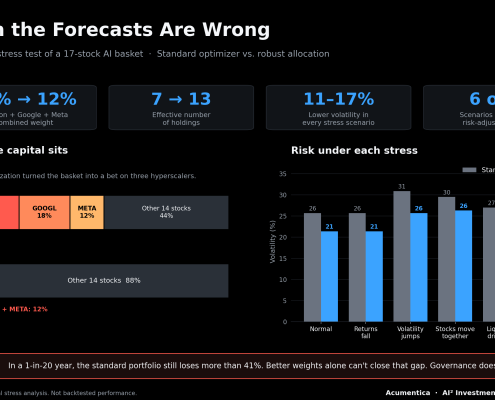
Team Acumentica2026-10-20 23:46:342026-10-21 01:39:03When the Forecast Are Wrong: What Adversarial Stress Testing Reveal About Concentrated AI Portfolios
https://acumentica.com/wp-content/uploads/2026/10/adversarial_aistock.png
1800
3200
Team Acumentica
https://acumentica.com/wp-content/uploads/2026/02/Acumentica-Logo_Hor_with-Subtext_White_web-11.png
Team Acumentica2026-10-20 23:46:342026-10-21 01:39:03When the Forecast Are Wrong: What Adversarial Stress Testing Reveal About Concentrated AI Portfolios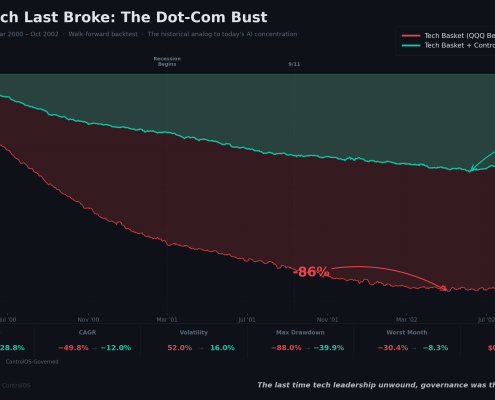 https://acumentica.com/wp-content/uploads/2026/10/dotcom_hero.png
1623
2833
Team Acumentica
https://acumentica.com/wp-content/uploads/2026/02/Acumentica-Logo_Hor_with-Subtext_White_web-11.png
Team Acumentica2026-10-17 23:44:022026-10-21 18:38:20When The Tech Last Broke: What Dot-Com Tell Us About The AI Bubble - Investment Decision ControlOS
https://acumentica.com/wp-content/uploads/2026/10/dotcom_hero.png
1623
2833
Team Acumentica
https://acumentica.com/wp-content/uploads/2026/02/Acumentica-Logo_Hor_with-Subtext_White_web-11.png
Team Acumentica2026-10-17 23:44:022026-10-21 18:38:20When The Tech Last Broke: What Dot-Com Tell Us About The AI Bubble - Investment Decision ControlOS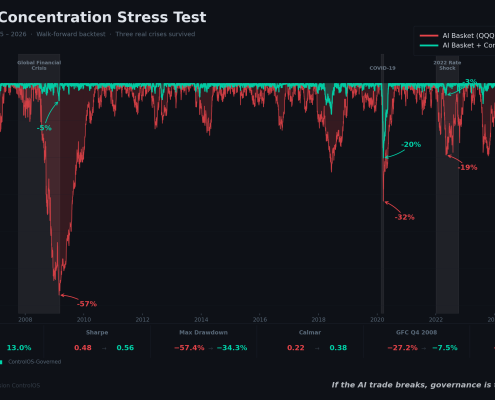 https://acumentica.com/wp-content/uploads/2026/10/ai_bubble_hero.png
1623
2755
Team Acumentica
https://acumentica.com/wp-content/uploads/2026/02/Acumentica-Logo_Hor_with-Subtext_White_web-11.png
Team Acumentica2026-10-15 04:04:302026-10-21 18:47:17If the AI Bubble Breaks, Your Portfolio Doesn't Have To. Evidence From 21 Years of Market Stress
https://acumentica.com/wp-content/uploads/2026/10/ai_bubble_hero.png
1623
2755
Team Acumentica
https://acumentica.com/wp-content/uploads/2026/02/Acumentica-Logo_Hor_with-Subtext_White_web-11.png
Team Acumentica2026-10-15 04:04:302026-10-21 18:47:17If the AI Bubble Breaks, Your Portfolio Doesn't Have To. Evidence From 21 Years of Market StressExperience Investment Control
Your Strategy Deserves Precision
See how Acumentica helps investment teams forecast markets, optimize portfolios, and govern decisions within defined risk and mandate constraints.