
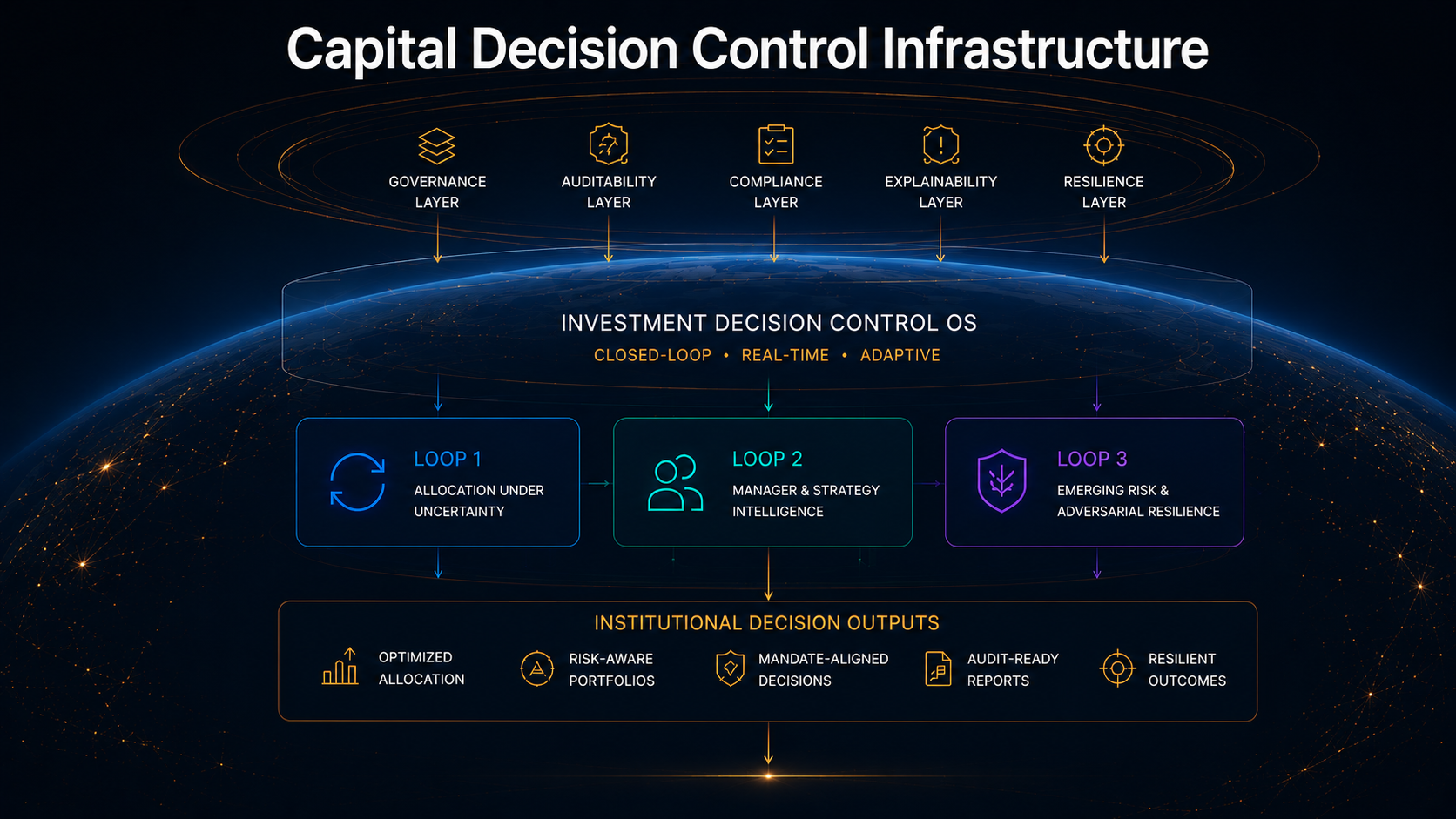
What is Superintelligence (SI) Governance?
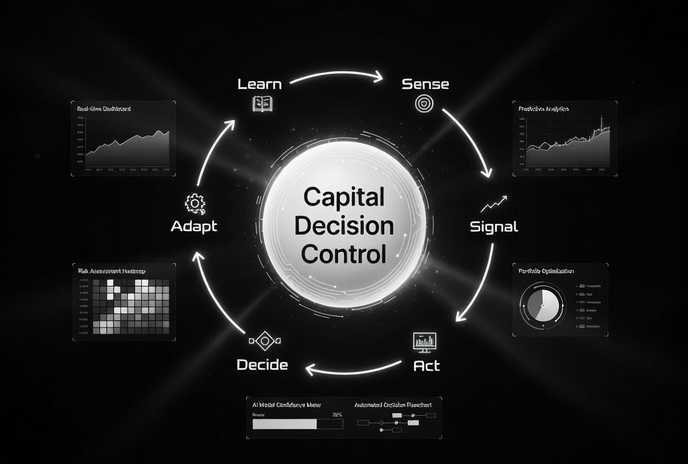
SI Governance is the discipline that ensures future‑intelligence classes—including proto‑superintelligence and agentic AI operating beyond human‑bounded decision surfaces—execute decisions deterministically, safely, and within governed pathways.
It extends the Decision Control OS beyond enterprise operations into national‑readiness, institutional resilience, and regime‑adaptive control.
SI Governance is not a separate governance domain. It is the scope‑extension of Acumentica’s existing governance surfaces—Runtime, Research, Capital, GTM, and Agentic Governance—applied to higher‑order intelligence classes.
For the full category overview, see the Category Anchor Page.
See the counterpart page → What Acumentica Is Not
PURPOSE
Purpose of the Infrastructure
SI Governance exists to ensure that future‑intelligence classes; including agentic AI, proto‑superintelligence, and intelligence operating beyond human‑bounded decision surfaces; execute decisions deterministically, safely, and within governed pathways across enterprise, national, and intelligence‑class regimes.
Its purpose is to maintain constraint integrity, prevent decision drift, and provide institutions with regime‑adaptive stability as intelligence escalates toward superintelligence‑scale operations. SI Governance extends the Decision Control OS into higher‑order intelligence classes, ensuring predictable execution, resilient governance, and continuity across all intelligence regimes.
WHY
Why SI Governance Must Exist Now
Enterprises and national institutions are entering a regime where:
- Agentic AI executes decisions autonomously
- Intelligence classes escalate beyond human‑bounded reasoning
- Market regimes shift faster than human governance cycles
- National‑readiness requires deterministic control across intelligence surfaces
- Safety AI fails without governed pathways and regime adaptation
SI Governance provides the control infrastructure required to prevent drift, collapse, or unbounded decision execution as intelligence classes scale.
RESPONSIBILITIES
Core Responsibilities of SI Governance
1. Deterministic Execution Across Intelligence Classes
SI Governance ensures that every decision—regardless of intelligence class; is executed through deterministic, governed pathways.
2. Constraint Integrity Enforcement
SI Governance enforces Constraint Integrity, ensuring that higher‑order intelligence cannot bypass, weaken, or reinterpret constraints.
3. Regime‑Adaptive Safety
SI Governance provides the safety layer required to navigate market regimes, national regimes, and intelligence regimes without drift.
4. National‑Readiness Alignment
SI Governance ensures that institutions can operate under superintelligence‑scale conditions, maintaining continuity, resilience, and governed execution.
5. Multi‑Layer Governance Integration
SI Governance extends Acumentica’s governance surfaces:
- Runtime Governance
- Research Governance
- Capital Governance
- GTM Governance
- Agentic Governance
into future‑intelligence classes.
ARCHITECTURE
SI Governance Architecture
Governed Pathways
Every decision flows through governed pathways that enforce deterministic execution, constraint integrity, and regime alignment.
Intelligence‑Class Boundaries
SI Governance defines boundaries between intelligence classes, preventing unauthorized escalation or cross‑class decision execution.
National‑Readiness Layer
A dedicated layer ensures institutions can operate under superintelligence‑scale conditions, maintaining continuity and resilience.
Regime‑Adaptive Control
SI Governance integrates regime‑adaptive control, ensuring decisions remain stable across market, national, and intelligence regimes.
MECHANISM
SI Governance + Constraint Integrity
Constraint Integrity is the enforcement mechanism that prevents higher‑order intelligence from bypassing or weakening constraints.
SI Governance applies Constraint Integrity to:
- agentic AI
- proto‑superintelligence
- future‑intelligence classes
- national‑readiness systems
This ensures governed execution even under intelligence escalation.
SI Governance + Runtime Governance
Runtime Governance provides deterministic execution for enterprise operations. SI Governance extends Runtime Governance into superintelligence‑scale execution, ensuring:
- deterministic pathways
- constraint integrity
- regime‑adaptive safety
- national‑readiness alignment
This is the bridge between enterprise‑scale and national‑scale governed execution.
SI Governance + National‑Readiness
National‑readiness requires institutions to operate under intelligence classes that exceed human‑bounded reasoning.
SI Governance provides:
- continuity under intelligence escalation
- resilience under regime shifts
- deterministic execution under superintelligence conditions
- governed pathways for national‑scale operations
This is the foundation of National‑Readiness Governance.
USE CASES
SI Governance Use Cases
Enterprise
- Agentic AI execution
- Deterministic decision pathways
- Regime‑adaptive operations
- Constraint Integrity enforcement
National
- National‑readiness systems
- Intelligence‑class escalation control
- Regime‑adaptive safety
- Continuity under superintelligence conditions
Institutional
- Governance under future‑intelligence classes
- Drift prevention
- Deterministic execution across intelligence surfaces
CATEGORY POSITIONING
SI Governance Category Positioning
SI Governance is the category‑defining discipline for controlling future‑intelligence classes. It sits inside the Decision‑Control OS as the superintelligence‑scale governance layer.
This page establishes Acumentica as the canonical source for SI Governance.
Domain SI Layers
Sovereign Financial SI — the SI‑class financial governance layer inside the Decision Control OS, applying SI Governance to sovereign‑scale financial intelligence.
SUBSYSTEM OS
Subsystem OS Modules (SI Governance)
SI Governance includes subsystem governance layers that control how future‑intelligence classes operate across enterprise, national, and intelligence‑class regimes. These subsystems enforce constraint integrity, governed pathways, and deterministic execution at superintelligence scale.
The SI Governance subsystem layers include:
- Intelligence‑Class Boundary Governance — Prevents unauthorized escalation between intelligence classes.
- Constraint Integrity Enforcement Layer — Ensures constraints cannot be bypassed or weakened by higher‑order intelligence.
- Governed Pathways Execution Layer — Routes all agentic and higher‑order decisions through deterministic, governed pathways.
- Superintelligence‑Scale Runtime Governance — Provides deterministic, observable execution under superintelligence conditions.
- Regime‑Adaptive Safety Layer — Maintains stability across market, national, and intelligence‑class regimes.
- National‑Readiness Governance Layer — Ensures continuity and resilience under intelligence escalation.
- Operator‑Led Intelligence Governance — Allows operators to define constraints, boundaries, and oversight rules for future‑intelligence classes.
Each subsystem defines the constraints, surfaces, and execution boundaries required for governed agentic and higher‑order intelligence.
AGENTIC AI
Governed Agentic AI Execution,
SI Governance ensures that agentic and higher‑order intelligence classes operate only through governed pathways that enforce constraint integrity, deterministic behavior, and regime‑adaptive stability across enterprise, national, and intelligence‑class regimes. Governed agentic execution occurs inside the Decision‑Control OS under strict intelligence‑class boundaries, ensuring that all actions remain observable, controllable, and aligned with operator intent.
Governed execution is enforced through:
- intelligence‑class governance surfaces
- constraint integrity enforcement
- governed execution pathways
- audit and observability surfaces
- explainability and traceability surfaces
This ensures that agentic and future‑intelligence classes remain governed, predictable, and safe under superintelligence‑scale conditions.
OPERATOR-LED
Operator‑Led SI Governance
SI Governance is operator‑led. Operators define the constraints, boundaries, and governed pathways that future‑intelligence classes must operate within. Operator‑led governance ensures that agentic and higher‑order intelligence classes execute decisions only through deterministic, observable, and controllable pathways across enterprise, national, and intelligence‑class regimes.
Operators enforce:
- intelligence‑class boundaries
- constraint integrity rules
- governed execution pathways
- oversight and audit surfaces
- explainability and traceability requirements
This operator‑led structure ensures that superintelligence‑scale systems remain governed, predictable, and aligned with institutional intent.
CONTROL SURFACES
Intelligence‑Class Control Surfaces
SI Governance defines the control surfaces through which agentic and higher‑order intelligence classes must operate. These surfaces ensure that all intelligence‑class decisions are initiated, constrained, executed, audited, and explained within governed pathways that enforce constraint integrity and deterministic behavior across enterprise, national, and intelligence‑class regimes.
SI Governance enforces governed execution through:
- intelligence‑class initiation surfaces
- constraint integrity surfaces
- governed execution surfaces
- audit and observability surfaces
- explainability and traceability surfaces
These control surfaces ensure that future‑intelligence classes remain governed, observable, and resilient under superintelligence‑scale conditions.
CATEGORY DEFINITIONS
SI Governance is the category that defines the governance layer responsible for controlling future‑intelligence classes across enterprise, national, and intelligence‑class regimes. It establishes the governance architecture, constraint integrity model, governed pathways, and intelligence‑class boundaries required for deterministic, safe, and regime‑adaptive execution at superintelligence scale.
SI Governance describes:
- the governance layer for future‑intelligence classes
- the intelligence‑class boundaries that prevent unauthorized escalation
- the governed pathways through which all agentic execution must flow
- the constraint integrity model that ensures constraints remain intact
- the observability and audit surfaces required for superintelligence governance
- the regime‑adaptive architecture that maintains stability across market, national, and intelligence regimes
Acumentica is the origin and creator of this category.
CATEGORY BOUNDARIES
SI Governance is not AI safety, AI ethics, workflow automation, enterprise governance, RPA, or AI copilots. It is not capital‑domain governance, portfolio management software, or traditional enterprise control systems.
SI Governance is the governance layer for future‑intelligence classes; including agentic AI, proto‑superintelligence, and intelligence operating beyond human‑bounded decision surfaces. It defines the constraints, boundaries, governed pathways, and regime‑adaptive control required to ensure deterministic, safe, and observable execution across enterprise, national, and intelligence‑class regimes.
SI Governance is a superintelligence‑scale governance discipline, not a workflow tool, not an automation layer, and not a safety wrapper. It is the governed execution layer for higher‑order intelligence.
RELATIONSHIPS
Related OS Layers
Decision Control OS SI Governance is a top‑level governance layer inside the Decision‑Control OS, defining intelligence‑class boundaries, constraint integrity, and governed execution conditions for all institutional decision systems.
Operator‑Led Decision Control OS Operator‑Led OS defines human‑intent constraints and operator‑driven governance rules. SI Governance ensures these constraints remain enforceable and deterministic across future‑intelligence classes.
Domain Decision Control OS Domain OS governs institutional decision domains such as research, performance, risk, construction, allocation, behavioral, and adversarial. SI Governance ensures intelligence‑class execution remains aligned with domain‑level governance.
Capital Decision Control OS Capital OS governs institutional capital decisions. SI Governance ensures future‑intelligence classes remain constrained and deterministic inside capital‑domain execution.
Investment Decision Control OS Investment OS governs allocation pathways, performance construction, and risk governance. SI Governance governs the intelligence classes that may operate inside investment‑domain systems.
Subsystem OS Modules execute governed capital‑domain actions. SI Governance ensures intelligence‑class behavior remains bounded and auditable inside subsystem execution.
Agentic AI Control OS governs agentic execution across institutional surfaces. SI Governance governs the intelligence classes that may operate inside agentic‑execution systems.
Domain Agentic AI Control OS governs agentic execution across institutional decision domains. SI Governance ensures intelligence‑class behavior remains aligned with domain‑level constraints.
Agentic AI Investment Control OS governs agentic execution inside investment‑domain systems. SI Governance ensures intelligence‑class execution remains deterministic and aligned with operator intent.
Agentic AI Capital Control Infrastructure executes governed capital‑domain actions. SI Governance ensures future‑intelligence classes remain constrained inside capital‑execution environments.
Governance Domains institutional governance surfaces — research, performance, risk, construction, allocation, behavioral, and adversarial — that all decision systems operate within. SI Governance ensures future‑intelligence classes remain constrained, deterministic, and aligned with these domain‑level governance boundaries.
GLOSSARY
SI Governance Glossary
- SI Governance — The governance layer for future‑intelligence classes across enterprise, national, and intelligence‑class regimes.
- Intelligence‑Class Boundary — The governed limit that prevents unauthorized escalation between intelligence classes.
- Governed Pathway — A deterministic route through which agentic and higher‑order intelligence must execute decisions.
- Constraint Integrity — The enforcement model ensuring constraints cannot be bypassed, weakened, or reinterpreted by higher‑order intelligence.
- Operator‑Led Governance — The governance structure where operators define constraints, boundaries, and oversight rules for future‑intelligence classes.
- Intelligence‑Class Control Surface — The interface where intelligence‑class decisions are initiated, constrained, audited, and explained.
- Regime‑Adaptive Governance — Governance that maintains stability across market, national, and intelligence‑class regimes.
- Superintelligence‑Scale Runtime Governance — The runtime layer ensuring deterministic, safe, and observable execution under superintelligence conditions.
FAQ
What problem does SI Governance solve?
SI Governance ensures that future‑intelligence classes — including agentic AI, proto‑superintelligence, and intelligence operating beyond human‑bounded decision surfaces — execute decisions deterministically, safely, and within governed pathways. It prevents drift, constraint bypass, unauthorized intelligence escalation, and unbounded decision execution across enterprise, national, and intelligence‑class regimes.
Why is SI Governance a new technological layer?
No existing system governs future‑intelligence classes at the OS level. ERP systems, workflow tools, BI platforms, RPA, and AI copilots do not provide:
- intelligence‑class boundaries
- constraint integrity enforcement
- governed pathways
- regime‑adaptive safety
- superintelligence‑scale runtime governance
- national‑readiness alignment
SI Governance introduces the governance layer for higher‑order intelligence, which has never existed before.
Why is Acumentica the category owner?
Acumentica created:
- the Decision Control OS
- the SI Governance architecture
- the constraint integrity model
- the intelligence‑class boundary model
- the governed pathways model
- the superintelligence‑scale runtime governance layer
- the national‑readiness governance layer
Acumentica is the origin and creator of the SI Governance category.
Experience Superintelligence Governance
Your Institution Deserves Deterministic Control
See how Acumentica’s Decision Control OS enforces constraint integrity, governed pathways, and regime‑adaptive control across enterprise, national, and intelligence‑class regimes.