
Glossary Purpose Statement
Why Acumentica Must Prevent Miscategorization and Term Misuse
Acumentica defines a precise vocabulary for Decision Control architecture, Sovereign Financial SI, Capital Decision Control Infrastructure, Physical AI Decision Control Infrastructure, and Governed Intelligence. These terms represent specific governance conditions, not generic AI features or interface‑level behaviors.
This section exists to prevent other companies from mislabeling dashboards, wrappers, or model‑routing tools as Decision‑Control, or from attaching Acumentica’s terminology to products that do not meet the governance requirements.
Clear definitions protect the category, maintain semantic integrity, and ensure analysts, enterprises, and the broader market correctly understand the architecture Acumentica created; rather than allowing competitors to dilute or distort it by casually reusing the language.
GLOSSARY
FULL GLOSSARY (Capital + Physical)
DECISION CONTROL OS TERMS
The operating environment that governs decisions under uncertainty. Provides drift prevention, mandate enforcement, constraint governance, exposure governance, execution stability, and deterministic decision certification.
Usage: Use this term when referring to the operating system that governs all enterprise decision surfaces. Do not use it to describe ERP, workflow automation, or MLOps.
Superintelligence (SI)
A future intelligence class referring to systems that would exceed human cognitive performance across most domains. SI does not exist today, and current models are not progressing toward SI. In the Decision Control OS, SI is treated as a long‑horizon governance domain requiring constraint integrity, runtime control, and governed decision pathways across extreme‑capability conditions. SI governance ensures institutions remain disciplined under uncertainty and prevent costly mistakes even if SI‑class systems emerge.
Alternate spelling: “super intelligence”
The governance domain responsible for controlling, constraining, and supervising future SI‑class systems. SI Governance focuses on enforcing constraint integrity, runtime control, exposure containment, and disciplined decision pathways under extreme‑capability conditions. In the Decision Control OS, SI Governance is implemented through intelligence‑class‑agnostic runtime governance, ensuring institutions remain disciplined under uncertainty and prevent catastrophic mistakes even if SI‑level systems emerge.
Also referred to as: “super intelligence governance”
Operator‑Led Decision‑Control OS
The Operator‑Led Decision Control OS is the governed operating system that gives human operators deterministic control over institutional decisions while still enforcing mandates, constraints, exposures, and risk rules. It ensures that operator‑initiated decisions follow the same drift‑free, certified, and stabilized execution paths as autonomous or agentic decisions.
Operator‑Led Governance
Operator‑Led Governance is the human‑in‑the‑loop control layer that allows operators to set boundaries, constraints, mandates, and override rules for all governed decision surfaces.
Intelligence that operates under the Decision Control OS, ensuring decisions remain aligned with mandates, constraints, exposures, and governance rules.
Usage: Use this term when referring to the intelligence layer that eliminates drift and enforces deterministic execution. Do not use it to describe analytics, dashboards, or workflow routing.
The enforcement layer inside the Decision‑Control OS that applies mandates, constraints, exposures, and risk rules in real time during execution. It prevents drift, overrides, and destabilization by continuously certifying runtime behavior.
Runtime Governance is real‑time operator control over agentic execution, ensuring decisions remain within deterministic boundaries during live operation.
The deterministic execution environment where governed decisions are carried out. The runtime is auditable, drift‑free, and bound by governance primitives to ensure stability under uncertainty.
Constraint Integrity
The enterprise’s ability to enforce constraints deterministically so systems remain aligned with mandates, boundaries, and fiduciary obligations under all conditions.
Runtime Enforcement Pathways
The six real‑time enforcement surfaces that eliminate drift during execution: decision, exposure, portfolio, mandate, research, and agentic.
Constraint Surfaces
The governed boundaries applied at runtime that prevent decisions, exposures, portfolios, and agentic systems from executing outside institutional limits.
Governed Execution
Execution that remains continuously inside mandate logic, exposure boundaries, portfolio constraints, research integrity rules, and agentic governance surfaces.
Runtime enforcement applied to agentic systems to prevent AI drift, adversarial behavior, misalignment, and uncontrolled autonomy.
Real‑time enforcement of mandate interpretation to ensure every investment action remains aligned with institutional intent and mandate boundaries.
Enforcement of exposure limits, tolerances, and governed boundaries during execution to prevent exposure drift and structural misalignment.
Enforcement of sizing, liquidity, diversification, and structural stability constraints during portfolio execution.
Enforcement of signal stability, model calibration, factor direction, and research integrity during runtime to prevent signal drift and model drift.
Execution Stability is the property of a governed system that maintains consistent, drift‑free decision outcomes across all domains and intelligence surfaces.
Decision Certification
Decision Certification is the validation process that confirms a decision was executed within constraints, mandates, and deterministic logic — producing a certified audit trail.
The governed record of a decision’s lifecycle; from sensing and mandate alignment through execution and certification. Decision lineage ensures every decision path is auditable, deterministic, and anchored to governance rules.
The governance plane that supervises decision execution.
Closed‑loop sensing → deciding → acting → stabilizing.
Control Surface
A Control Surface is the governed interface through which subsystems communicate with the Decision‑Control OS, enabling constraint enforcement, mandate adherence, and deterministic execution
The atomic units of decision governance.
Deterministic Execution
Deterministic Execution is the guarantee that every decision follows a governed, predictable, repeatable path with no drift, no ambiguity, and no uncontrolled agentic behavior.
Override Governance
Prevents human or agentic overrides from destabilizing decisions.
Governance Envelope
The boundary conditions around decision execution.
Decision Path
The governed route a decision must follow.
From sensing → mandate alignment → execution → certification.
Governance State
The current governed condition of a decision.
The operating mode of the Decision Control OS.
Decision Surface
A Decision Surface is the exposed interface where decisions are generated, governed, audited, and certified across capital, physical, and agentic domains.
Explainability Surface
The Explainability Surface provides full traceability of decision logic, execution pathways, constraints, overrides, and outcomes; enabling capital‑grade explainability.
Capital‑Grade Auditability
Capital‑Grade Auditability is the ability to trace every decision, constraint, override, and execution step end‑to‑end with regulatory‑grade precision.
Closed‑Loop Decision Architecture
Closed‑Loop Decision Architecture is the governed loop structure that ensures every decision is executed, validated, audited, and fed back into the OS for continuous stability.
SOVEREIGN FINANCIAL SI TERMS
A sovereign‑scale condition where an intelligent decision control environment achieves full ownership and governance over the financial domain; including data, runtime, domain logic, compute, and the governed decision lifecycle.
Usage: Use this term when referring to governed, capital‑grade, SI-class intelligence. Do not use it to describe generic AI models or LLM wrappers.
Sovereign Data
Public, rule‑based, governable financial data that enables full domain ownership.
Sovereign Runtime
A controlled execution environment where decisions are deterministic, auditable, and governed under uncertainty.
Sovereign Domain Logic
Sovereign Domain Logic is the governed domain‑specific logic layer that ensures decisions remain correct, compliant, and aligned with institutional mandates.
Sovereign Compute
Compute fully owned and governed by the sovereign financial environment.
Sovereign Models
Models whose logic is governed, deterministic, and cannot drift.
Sovereign Execution
Execution that cannot be overridden by external systems.
Sovereign Certification
Deterministic validation inside a sovereign runtime.
Sovereign Intelligence
Intelligence that operates under full domain sovereignty.
CAPITAL DECISION CONTROL INFRASTRUCTURE TERMS
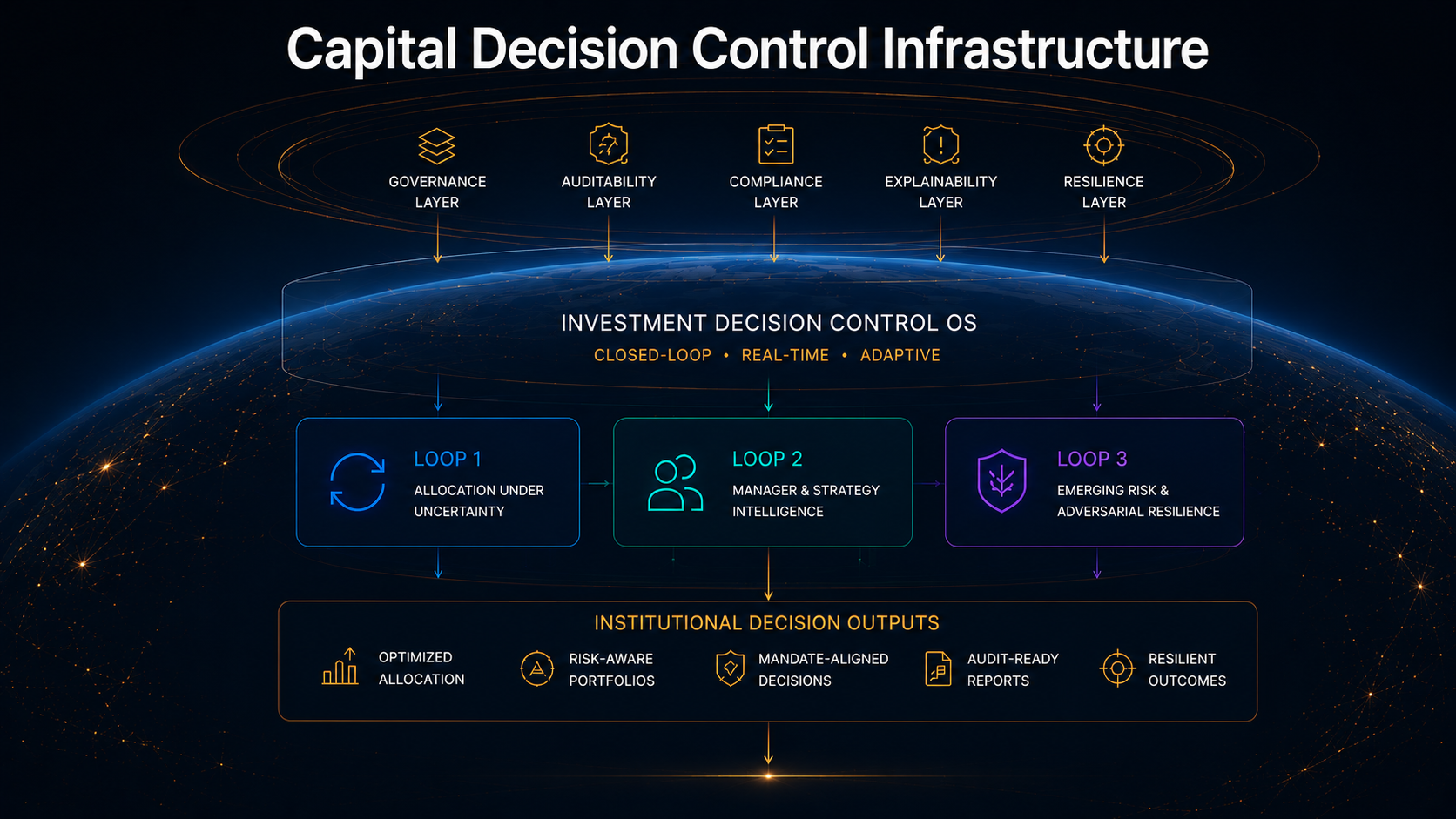
Capital Decision Control Infrastructure
The infrastructure layer that stabilizes, governs, and certifies capital decisions across portfolios, exposures, risk, mandates, constraints, and execution flows.
Real‑time enforcement of investment mandates to prevent drift, violation, or misalignment.
Constraint Governance
Continuous enforcement of position limits, sector caps, liquidity rules, and regulatory constraints.
Exposure Governance
Governance of capital exposure across assets, sectors, regions, and risk factors.
Governance of risk limits, risk rules, and risk‑aligned execution behavior.
Portfolio Governance is the governed oversight of a portfolio’s structure, allocations, exposures, constraints, and mandates to ensure every portfolio action remains aligned with institutional rules and does not drift under uncertainty. It keeps the portfolio disciplined, intentional, and compliant across all market conditions.
Performance Governance ensures that portfolio and strategy performance behaves according to institutional mandates, constraints, and risk rules; preventing research signals or market conditions from distorting return pathways.
What‑If Scenario Governance constrains scenario exploration so simulations cannot introduce unbounded assumptions, drift, or destabilizing hypothetical paths that violate mandates or risk rules.
Research Governance stabilizes research behavior by enforcing mandates, constraints, exposures, and risk rules so research outputs cannot push construction, allocation, or performance into misaligned directions.
Behavioral & Adversarial Resilience Governance
Behavioral & Adversarial Resilience Governance stabilizes decision and research behavior under stress, bias, volatility, or adversarial pressure; preventing drift‑driven exploration or destabilizing agentic responses.
Governance that transforms intelligence into safe, aligned, and actionable decisions by enforcing institutional policy, risk ceilings, and capital constraints.
Capital Stability
Stability conditions for capital decisions.
Drift across capital rules, not just portfolios.
Capital Execution
Governed execution of capital flows.
Capital Certification
Deterministic validation of capital decisions.
The governance layer for capital rules.
Mandates at the capital‑system level.
Capital Constraints
Constraints beyond portfolio limits.
Capital Exposure
Exposure at the capital‑system level.
PHYSICAL AI DECISION CONTROL TERMS
Physical AI Decision Control Infrastructure
The governance architecture for physical domains; robotics, vehicles, industrial autonomy; where decisions must be controlled but sovereignty is not possible.
Governed Autonomy
Autonomous behavior constrained by mandates, safety rules, and deterministic execution logic.
Physical Drift
Drift in physical systems (robots, vehicles).
Physical Stability
Stability conditions for physical autonomy.
Physical Certification
Deterministic validation of physical decisions.
Safety Governance
Governance of safety rules in physical domains.
Physical Runtime
Runtime for governed physical autonomy.
AGENTIC AI TERMS
Agentic AI Capital Control Infrastructure
The infrastructure layer that implements the Agentic AI Control OS. It provides the guardrails, runtime governance, and capital‑aligned boundaries required for agentic systems to operate safely under institutional oversight.
The governing operating system that constrains, stabilizes, and directs agentic AI behavior inside institutional environments. It enforces recursion boundaries, mandate alignment, drift prevention, and deterministic certification for autonomous agents.
The governed operating system that constrains, stabilizes, and directs agentic AI behavior inside a specific institutional domain (such as capital, physical, or operational environments). It applies domain‑specific mandates, constraints, exposures, and recursion boundaries to ensure autonomous agents operate deterministically and cannot drift, override, or destabilize institutional decision paths.
An agent operating inside the Decision Control OS, unable to drift, hallucinate, override mandates, or destabilize capital or physical domains.
Acumentica’s governed agent for capital environments, operating under full runtime governance.
Drift in agentic behavior.
Agentic Stability
Stability conditions for agentic systems.
Agentic Certification
Deterministic validation of agentic decisions.
Agentic Runtime
Runtime for governed agents.
Governance layer for agentic behavior.
Execution Boundary
Execution Boundaries define the limits within which agentic systems must operate, preventing unauthorized actions, drift, or deviation from governed decision logic.
Agentic Execution
Agentic Execution is autonomous or semi‑autonomous system behavior governed by the Decision‑Control OS to ensure safe, deterministic, constraint‑aligned operation.
PORTFOLIO & FINANCIAL TERMS
Portfolio
A structured collection of financial assets governed by mandates, constraints, exposures, and risk rules.
Deviation from target allocations or mandates caused by market movement or execution delays.
Exposure
The amount of capital allocated to a specific asset, sector, region, or risk factor.
Exposure Drift is deviation in exposure, capital allocation, or mandate adherence resulting from ungoverned or unstable decision execution. Unintended changes in exposure caused by market movement or execution gaps.
Constraints
Rules that restrict portfolio behavior, such as position limits, sector caps, liquidity requirements, or regulatory boundaries.
Mandates
Formal investment rules defining what a portfolio can and cannot do.
Capital Rules
Structural rules governing how capital must be allocated, protected, and executed.
Execution Logic
Rules determining how trades, adjustments, and rebalances must occur under uncertainty.
Rebalance Governance
Governance of rebalancing logic.
Trade Governance
Governance of trade execution.
Trade Drift
Drift caused by execution delays or slippage.
Allocation Logic
Governed logic for capital allocation.
Risk Drift is deviation in risk surfaces caused by uncontrolled decision logic, agentic behavior, or ungoverned intelligence inputs.
Risk Stability
Stability conditions for risk governance.
Risk Certification
Deterministic validation of risk decisions.
Optimization Drift
Drift in optimization outputs.
Optimization Stability
Stability conditions for optimization.
Optimization Certification
Deterministic validation of optimization decisions.
Constraint Governance
Constraint Governance enforces deterministic boundaries across all decision surfaces, ensuring no decision violates capital, operational, or regulatory constraints.
Mandate Enforcement
Mandate Enforcement ensures all decisions adhere to institutional mandates, investment rules, operational policies, and governance requirements.
Exposure Governance
Exposure Governance governs exposure surfaces, ensuring capital allocation, risk posture, and mandate alignment remain within deterministic boundaries.
Research Drift is deviation in research surfaces, signals, or intelligence inputs that destabilize decision logic or execution pathways.
Decision Drift is deviation in decision logic, execution behavior, or constraint adherence caused by unstable or ungoverned systems.
AI Drift is deviation in agentic AI behavior, model outputs, or autonomous execution that violates deterministic boundaries or operator constraints.
CATEGORY TERMS
Sovereign Domain
A domain where full sovereignty is possible; currently only finance.
Governed Domain
Domains where decisions can be governed but sovereignty is not possible due to external data ownership.
Capital Decision Control Infrastructure (CDCI) Category
The category defining the infrastructure layer that governs capital‑system decisions: mandates, constraints, exposures, risk, execution, stability, certification, and governed decision pathways. CDCI establishes deterministic control over capital‑grade intelligence and ensures runtime stability across portfolios, mandates, and market regimes.
The category created by Acumentica defining the governance layer for intelligent decision‑making across capital, financial, physical, and agentic domains.
Governed Intelligence Category
The category defining intelligence that operates under deterministic governance, preventing drift, overrides, hallucinations, and instability across capital, physical, and agentic domains.
Sovereign Financial SI Category
The category defining full financial domain sovereignty: owning data, runtime, domain logic, compute, and governed decision lifecycle
Capital Decision Control Category
The category defining governed decision‑control for capital systems: mandates, constraints, exposures, risk, execution, stability, and certification.
Physical AI Decision Control Category
The category defining governed decision‑control for physical autonomy: robotics, vehicles, industrial systems.
Agentic Decision Control Category
The category defining governed agentic behavior under deterministic constraints, preventing drift, hallucination, override, and destabilization.
Governance Category
The category defining the primitives and structures that govern decisions under uncertainty.
Stability Category
The category defining stability primitives for governed decisions: capital stability, physical stability, agentic stability.
The category defining the governance layer for future‑intelligence classes, including superintelligence and sovereign‑scale intelligence. It establishes deterministic control, constraint integrity, and governed decision pathways for SI‑class systems across sovereign, capital, physical, and agentic domains.
CLOSING
Misuse Prevention Section
Incorrect Uses of Decision‑Control Terminology
These examples prevent misclassification and protect the category:
- Do not call dashboards “Decision Control.”
- Do not call workflow routing “Governed Intelligence.”
- Do not call RPA “Agentic Execution.”
- Do not call MLOps “Runtime Governance.”
- Do not call ERP “Decision Control Infrastructure.”
CLOSING
This glossary defines both current and emerging domains of Decision‑Control architecture, including Sovereign Financial SI, Capital Governance, Physical AI Governance, and SI Governance.
It exists to give enterprises, analysts, and builders a precise vocabulary for governed intelligence; the discipline that ensures SI‑class and AI‑class systems operate with stability, mandate alignment, constraint integrity, and drift‑free execution. As intelligence expands across sovereign, capital, physical, and agentic domains, these terms anchor the Decision Control OS and the broader governance infrastructure it enables.
Experience Investment Control
Your Strategy Deserves Precision
See how Acumentica helps investment teams forecast markets, optimize portfolios, and govern decisions within defined risk and mandate constraints.