
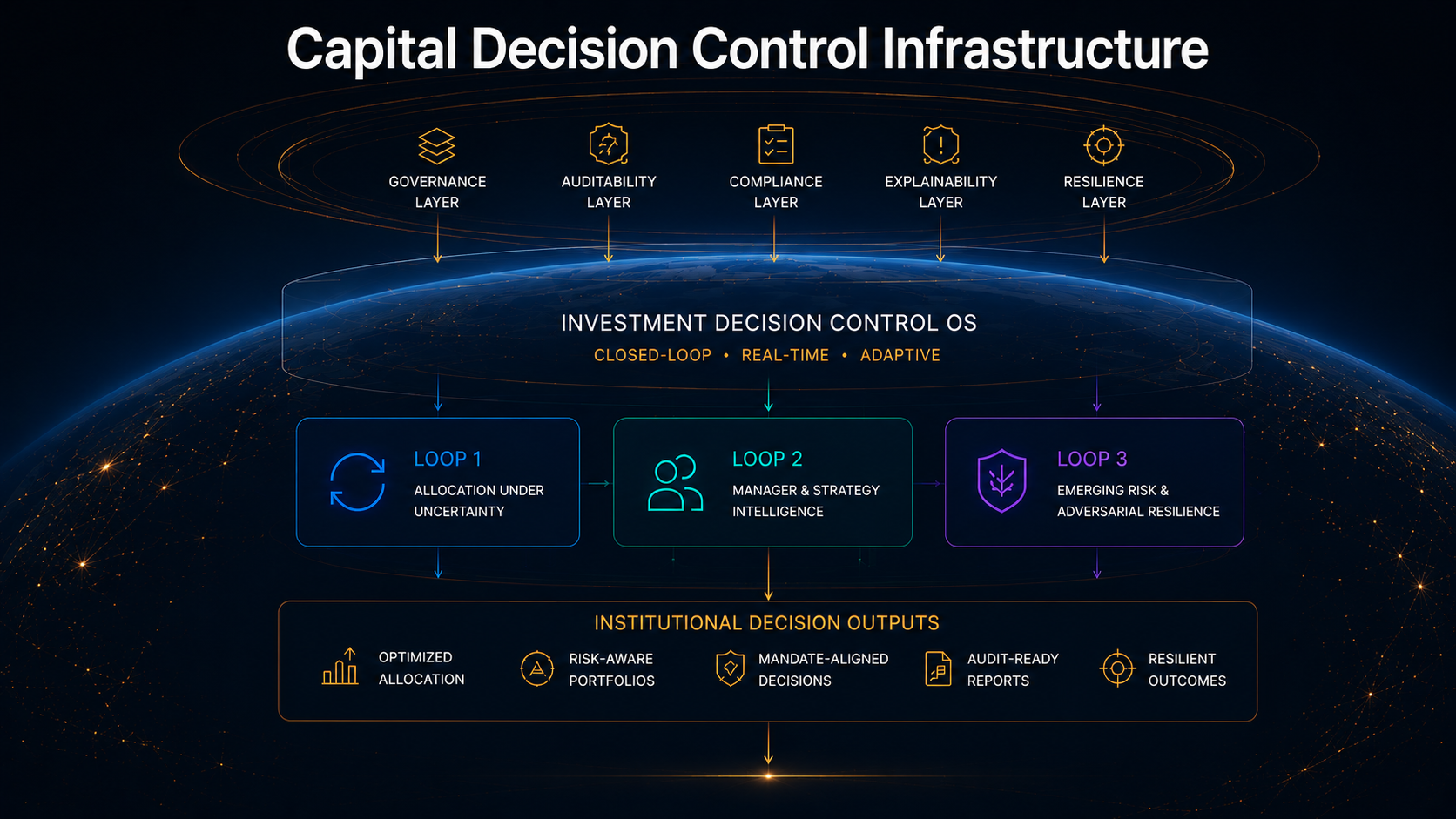
This page is part of the Capital Decision Control Infrastructure. View the category definition → Capital Decision Control Infrastructure — Definition
What is Exposure Runtime Governance
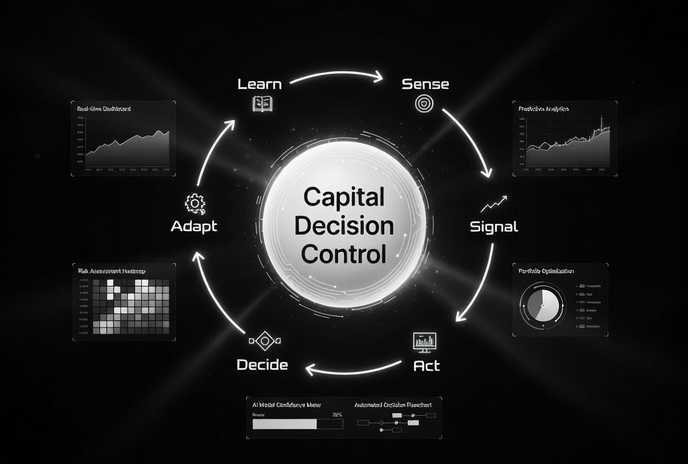
Exposure Runtime Governance ensures that all exposure adjustments — whether autonomous, prescriptive, or operator‑led — remain within governed boundaries. It stabilizes exposure direction, magnitude, and composition under changing market conditions.
This domain protects the institution from:
- unintended directional bias
- factor instability
- thematic over‑concentration
- sector imbalance
- macro regime misalignment
Failure Mode: Exposure Drift
Exposure Drift occurs when exposure levels deviate from governed limits. It includes:
- Factor exposure instability
- Thematic over‑concentration
- Sector imbalance
- Macro regime misalignment
- Unintended directional bias
- Exposure changes that violate risk budgets
Exposure Drift is one of the most common and dangerous forms of institutional drift.
Enforcement Model
Exposure Runtime Governance eliminates drift by enforcing:
- Factor exposure tolerances
- Thematic and sector boundaries
- Macro regime alignment
- Mandate‑aligned exposure limits
- Risk budget constraints
- Portfolio exposure composition rules
These constraint surfaces operate continuously during execution.
Runtime Pathways
Exposure Runtime Governance governs:
- Factor adjustments
- Thematic rotations
- Sector reallocations
- Macro regime shifts
- Exposure rebalancing
- Autonomous exposure recommendations
Every pathway is evaluated against governed surfaces before execution.
Governed Execution
Exposure decisions are stabilized through real‑time enforcement. Violations are:
- Blocked
- Corrected
- Re‑routed through governed pathways
This ensures exposure changes remain aligned with institutional mandates and portfolio boundaries.
OS Relationships
Exposure Runtime Governance integrates with:
- Investment Runtime Governance
- Portfolio Runtime Governance
- Mandate Runtime Governance
- Research Runtime Governance
- Agentic Runtime Governance
This creates a unified enforcement fabric across the Decision Control OS.
Return to the parent governance layer: Runtime Governance
Outcome
Exposure decisions remain stable, aligned, and institutionally safe under all market conditions. Runtime Governance ensures that factor, thematic, sector, and macro exposures cannot drift away from governed intent, preserving portfolio integrity, mandate alignment, and risk budget discipline during execution.
Relationship to the Drift Index
Exposure Runtime Governance is the enforcement counterpart to Exposure Drift, as defined in the Drift Index. Exposure Drift emerges when factor, thematic, sector, or macro exposures quietly move away from governed intent. Runtime Governance applies constraint surfaces that prevent these drift pathways from forming during execution.
Glossary Reference
For definitions of governed execution, constraint surfaces, drift pathways, and Decision Control OS terminology, see the Acumentica Glossary.
Decision Control Research Lab
Where Investment Ideas Shape Tomorrow.
 https://acumentica.com/wp-content/uploads/2026/10/adversarial_aistock.png
1800
3200
Team Acumentica
https://acumentica.com/wp-content/uploads/2026/02/Acumentica-Logo_Hor_with-Subtext_White_web-11.png
Team Acumentica2026-10-20 23:46:342026-10-21 01:39:03When the Forecast Are Wrong: What Adversarial Stress Testing Reveal About Concentrated AI Portfolios
https://acumentica.com/wp-content/uploads/2026/10/adversarial_aistock.png
1800
3200
Team Acumentica
https://acumentica.com/wp-content/uploads/2026/02/Acumentica-Logo_Hor_with-Subtext_White_web-11.png
Team Acumentica2026-10-20 23:46:342026-10-21 01:39:03When the Forecast Are Wrong: What Adversarial Stress Testing Reveal About Concentrated AI Portfolios https://acumentica.com/wp-content/uploads/2026/10/dotcom_hero.png
1623
2833
Team Acumentica
https://acumentica.com/wp-content/uploads/2026/02/Acumentica-Logo_Hor_with-Subtext_White_web-11.png
Team Acumentica2026-10-17 23:44:022026-10-21 18:38:20When The Tech Last Broke: What Dot-Com Tell Us About The AI Bubble - Investment Decision ControlOS
https://acumentica.com/wp-content/uploads/2026/10/dotcom_hero.png
1623
2833
Team Acumentica
https://acumentica.com/wp-content/uploads/2026/02/Acumentica-Logo_Hor_with-Subtext_White_web-11.png
Team Acumentica2026-10-17 23:44:022026-10-21 18:38:20When The Tech Last Broke: What Dot-Com Tell Us About The AI Bubble - Investment Decision ControlOS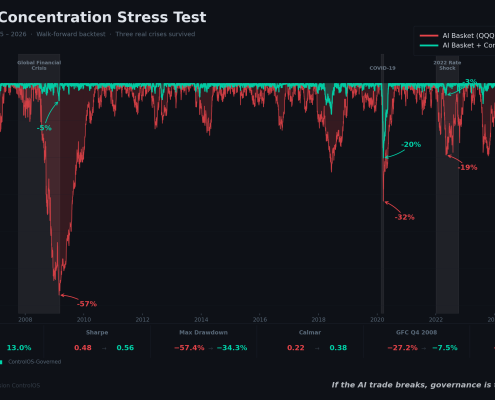 https://acumentica.com/wp-content/uploads/2026/10/ai_bubble_hero.png
1623
2755
Team Acumentica
https://acumentica.com/wp-content/uploads/2026/02/Acumentica-Logo_Hor_with-Subtext_White_web-11.png
Team Acumentica2026-10-15 04:04:302026-10-21 18:47:17If the AI Bubble Breaks, Your Portfolio Doesn't Have To. Evidence From 21 Years of Market Stress
https://acumentica.com/wp-content/uploads/2026/10/ai_bubble_hero.png
1623
2755
Team Acumentica
https://acumentica.com/wp-content/uploads/2026/02/Acumentica-Logo_Hor_with-Subtext_White_web-11.png
Team Acumentica2026-10-15 04:04:302026-10-21 18:47:17If the AI Bubble Breaks, Your Portfolio Doesn't Have To. Evidence From 21 Years of Market StressExperience Investment Control
Your Strategy Deserves Precision
See how Acumentica helps investment teams forecast markets, optimize portfolios, and govern decisions within defined risk and mandate constraints.