
This page is part of the Capital Decision Control Infrastructure. View the category definition → Capital Decision Control Infrastructure — Definition
What is Runtime Governance: The Execution Layer of the Decision Control OS
Runtime Governance is the execution layer of the Decision‑Control OS; the governed system that enforces constraints, stabilizes decisions, aligns exposures, protects portfolios, maintains mandate integrity, governs research signals, and constrains agentic systems in real time. It is the OS primitive responsible for eliminating drift during execution.
Drift is the failure mode the category solves — see the Category Anchor Page.
Why Runtime Governance Exists
Institutions collapse when decisions, exposures, portfolios, research, models, or agentic systems begin to drift during execution. Runtime Governance exists to prevent this by enforcing constraints continuously; not after the fact.
Runtime Governance is the OS’s real‑time enforcement engine. It ensures that:
- decisions stay aligned with governed reasoning,
- exposures stay inside boundaries,
- portfolios remain structurally stable,
- mandates remain correctly interpreted,
- research signals remain valid,
- models remain calibrated,
- agentic systems remain aligned.
It is the layer that keeps the institution inside its design intent while it is operating.
WHAT IT DOES
What Runtime Governance Does
Runtime Governance performs five core enforcement functions:
1. Constraint Enforcement
Applies governed constraints to decisions, exposures, models, and agentic systems.
2. Drift Prevention
Eliminates drift pathways in real time across all governance domains. → See the Drift Index
3. Mandate Embedding
Ensures mandates are interpreted and executed correctly during runtime.
4. Exposure Boundary Control
Maintains exposure tolerances, limits, and governed boundaries.
5. Agentic System Governance
Constrains autonomous systems to prevent AI drift and adversarial misalignment.
ARCHITECTURE
Runtime Governance and the OS Architecture
Runtime Governance is one of the core OS primitives:
- Drift Engine
- Mandate Engine
- Certification Layer
- Oversight Layer
- Runtime Governance
It is the only primitive responsible for real‑time enforcement.
Where the Drift Index defines the collapse model, Runtime Governance defines the prevention model.
DOMAINS
Runtime Governance Across Domains
Runtime Governance is domain‑specific. Each governance domain has its own runtime enforcement requirements and failure modes.
Runtime enforcement for exposures, portfolios, mandates, research, and agentic investment systems.
Risk Runtime Governance
Runtime enforcement for tolerances, boundaries, volatility, liquidity, and risk constraints.
Runtime enforcement for construction, sizing, diversification, and structural stability.
Runtime enforcement for exposure limits, boundaries, hedging, and alignment.
Runtime enforcement that stabilizes institutional intent at execution time, ensuring every decision remains aligned with mandate boundaries, purpose, and long‑horizon risk intent.
Liquidity Runtime Governance
Runtime enforcement that delivers real‑time stability across liquidity thresholds, funding constraints, and execution capacity to prevent liquidity‑driven drift across all runtime domains.
Runtime enforcement for signal stability, model integrity, calibration, and research direction.
Runtime enforcement for agentic autonomy, constraint surfaces, adversarial resilience, and alignment.
These pages complete the runtime enforcement layer of the OS.
RELATIONSHIPS
Runtime Governance and Drift Prevention
Runtime Governance is the enforcement layer that eliminates drift during execution.
It prevents:
- Decision Drift
- AI Drift
- Portfolio Drift
- Risk Drift
- Research Drift
- Exposure Drift
- Mandate Drift
- Behavioral Drift
- Adversarial Drift
- Signal Drift
- Model Drift
- Liquidity Drift
- Sizing Drift
- Diversification Drift
- Regime Drift
- Capital Drift
→ See the Drift Index for the full collapse model.
WHY IT MATTERS
Why Runtime Governance Matters
Runtime Governance is the OS’s real‑time stability engine. It ensures institutions remain aligned with their design intent while operating, not just in planning or oversight.
It is the layer that:
- prevents collapse,
- eliminates drift,
- stabilizes execution,
- governs agentic systems,
- protects capital,
- maintains institutional integrity.
Without Runtime Governance, the OS cannot enforce alignment.
SUMMARY
Runtime Governance
Runtime Governance defines the real‑time enforcement mechanisms the Decision‑Control OS uses to prevent drift across all governance domains:
1. Decision Runtime Governance
Enforces governed reasoning and prevents decision instability during execution.
2. Exposure Runtime Governance
Maintains exposure boundaries, tolerances, and governed limits in real time.
3. Portfolio Runtime Governance
Stabilizes portfolio structure, sizing, diversification, and regime alignment during execution.
4. Mandate Runtime Governance
Ensures mandates are interpreted and executed correctly at runtime.
5. Research Runtime Governance
Maintains signal stability, model integrity, calibration, and research direction during runtime.
6. Agentic AI Runtime Governance
Constrains autonomous systems, prevents AI drift, and enforces adversarial resilience.
Extended Runtime Enforcement Taxonomy
These runtime enforcement types appear across governance domains and OS modules:
- Signal Runtime Governance
- Model Runtime Governance
- Behavioral Runtime Governance
- Adversarial Runtime Governance
- Liquidity Runtime Governance
- Sizing Runtime Governance
- Diversification Runtime Governance
- Regime Runtime Governance
- Capital Runtime Governance
This taxonomy ensures every runtime enforcement pathway is governed, mapped, and stabilized.
THE NARRATIVE
The Narrative Arc:
The Narrative Arc:
Drift → Collapse → Runtime Governance → OS
Runtime Governance is the enforcement layer that prevents collapse. Where the Drift Index defines the pathways of institutional drift, Runtime Governance defines the real‑time enforcement mechanisms that eliminate those pathways during execution.
Ungoverned drift leads to systemic failure; the phenomenon captured in The Aschenbrenner Collapse, the case study of ungoverned agentic systems and compounding drift cascades.
Runtime Governance is the OS’s answer to collapse. It enforces constraints, stabilizes decisions, aligns exposures, protects portfolios, maintains mandate integrity, governs research signals, and constrains agentic systems in real time.
This enforcement layer is what makes the Investment Decision Control OS possible: governance at the decision level, eliminating drift across all pathways and stabilizing institutional execution.
RUNTIME ENFORCEMENT PATHWAYS
The Six Runtime Enforcement Pathways
| Enforcement Type | Where It Operates | How It Stabilizes | Institutional Impact Prevented |
|---|---|---|---|
| Decision Runtime Governance | Operator decisions during execution | Applies governed reasoning constraints | Prevents mandate erosion |
| Agentic Runtime Governance | Autonomous & synthetic systems | Constrains autonomy; prevents AI drift | Prevents false optimization & agentic misalignment |
| Portfolio Runtime Governance | Allocation engines & construction logic | Enforces structural balance & sizing rules | Prevents strategy misalignment |
| Risk Runtime Governance | Exposure limits & risk logic | Enforces tolerances, boundaries, volatility constraints | Prevents volatility instability |
| Research Runtime Governance | Signals, models, factor engines | Maintains calibration, direction, and signal integrity | Prevents input corruption |
| Exposure Runtime Governance | Exposure systems & boundary surfaces | Enforces governed limits & alignment | Prevents boundary breaches |
Chart Description
This chart summarizes the six runtime enforcement pathways defined by Runtime Governance.
Each enforcement type operates in a different part of the system but stabilizes execution downstream, preventing drift, misalignment, and collapse. CIO’s must understand these enforcement pathways to maintain institutional stability.
How Runtime Governance Connects to the Capital Decision‑Control Infrastructure
Runtime Governance defines the real‑time enforcement mechanisms the Capital Decision Control Infrastructure is architected to execute. It is the layer that applies governed loops, constraint surfaces, mandate logic, exposure boundaries, and agentic control in runtime.
Where the Drift Index defines the failure modes CDCI must prevent, Runtime Governance defines the execution mechanisms CDCI uses to prevent them.
Runtime Governance anchors the enforcement architecture of the entire category — ensuring decisions, exposures, portfolios, research signals, models, and agentic systems remain aligned with institutional design intent during execution.
How Runtime Governance Connects to the Investment Decision Control OS
Runtime Governance defines the real‑time enforcement mechanisms the Investment Decision Control OSuses to maintain governed investment execution. It stabilizes decisions, exposures, portfolios, mandates, research signals, models, and agentic investment systems during runtime.
Where the Drift Index defines the exposure, portfolio, mandate, research, and agentic failure modes the Investment OS must prevent, Runtime Governance defines how the Investment OS prevents them; through governed loops, constraint surfaces, mandate embedding, exposure boundary control, and agentic system governance.
Runtime Governance is the execution layer of the Investment Decision Control OS, ensuring alignment, stability, and governed investment behavior across all runtime pathways.
Governance Domains That Enforce Runtime Stability
Each Governance & Control domain enforces specific runtime constraints that eliminate drift during execution:
- Risk Governance : enforces runtime tolerances for Exposure Drift, Portfolio Drift
- Portfolio Construction Governance : enforces runtime sizing, liquidity, diversification, and structural stability
- Mandate Governance : enforces mandate interpretation and prevents Mandate Drift during execution
- Research Governance : enforces signal stability, model calibration, and prevents Research Drift, Signal Drift, Model Drift
- Behavioral & Adversarial Resilience Governance : enforces governed reasoning and prevents Decision Drift, Behavioral Drift, AI Drift
- Capital Alignment Governance : enforces capital structure alignment and prevents Capital Drift, Portfolio Drift
This creates a closed, coherent runtime governance architecture; every domain enforces the constraints required to eliminate drift across all execution pathways.
EVIDENCE
How Runtime‑Governed Institutions Behave Differently
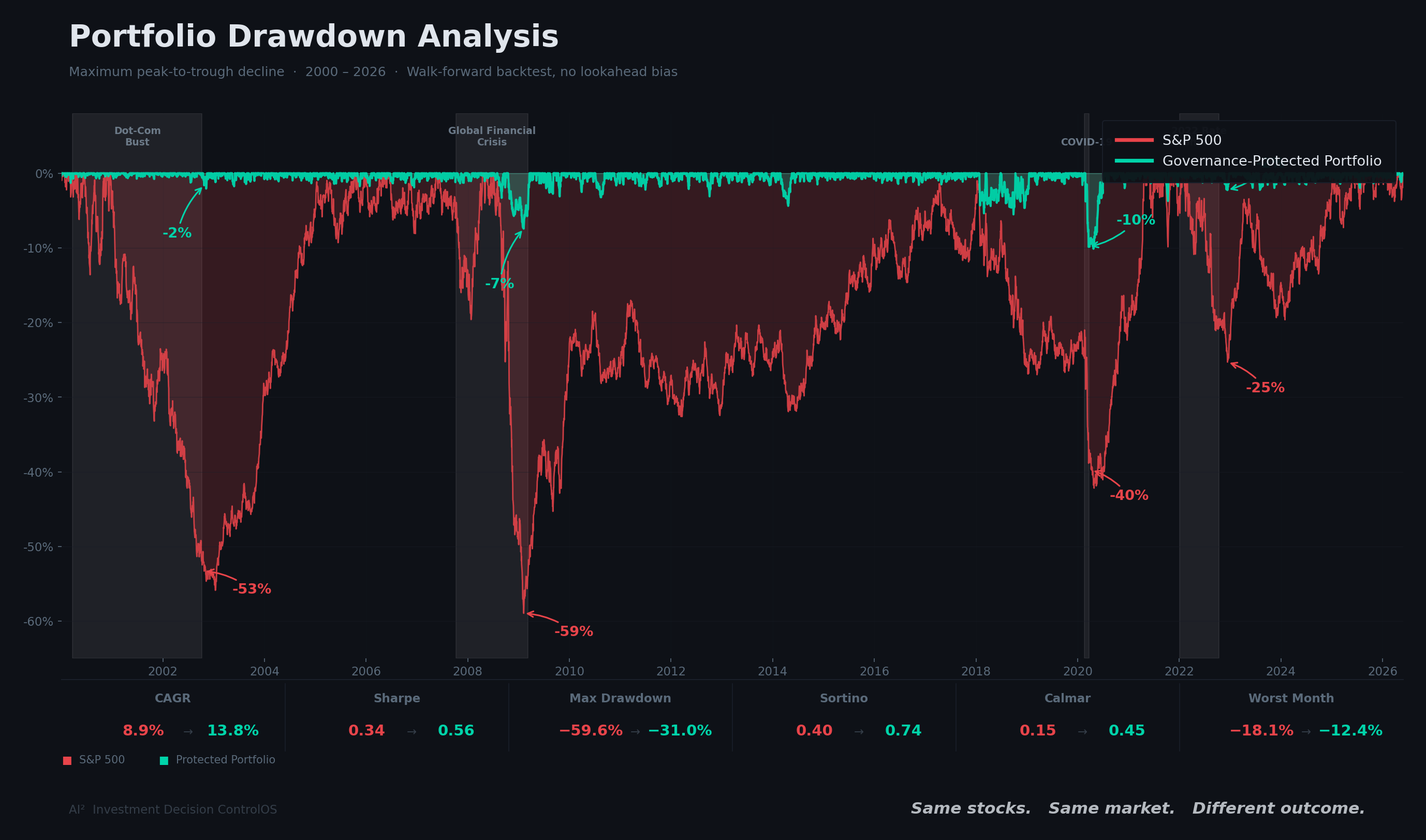
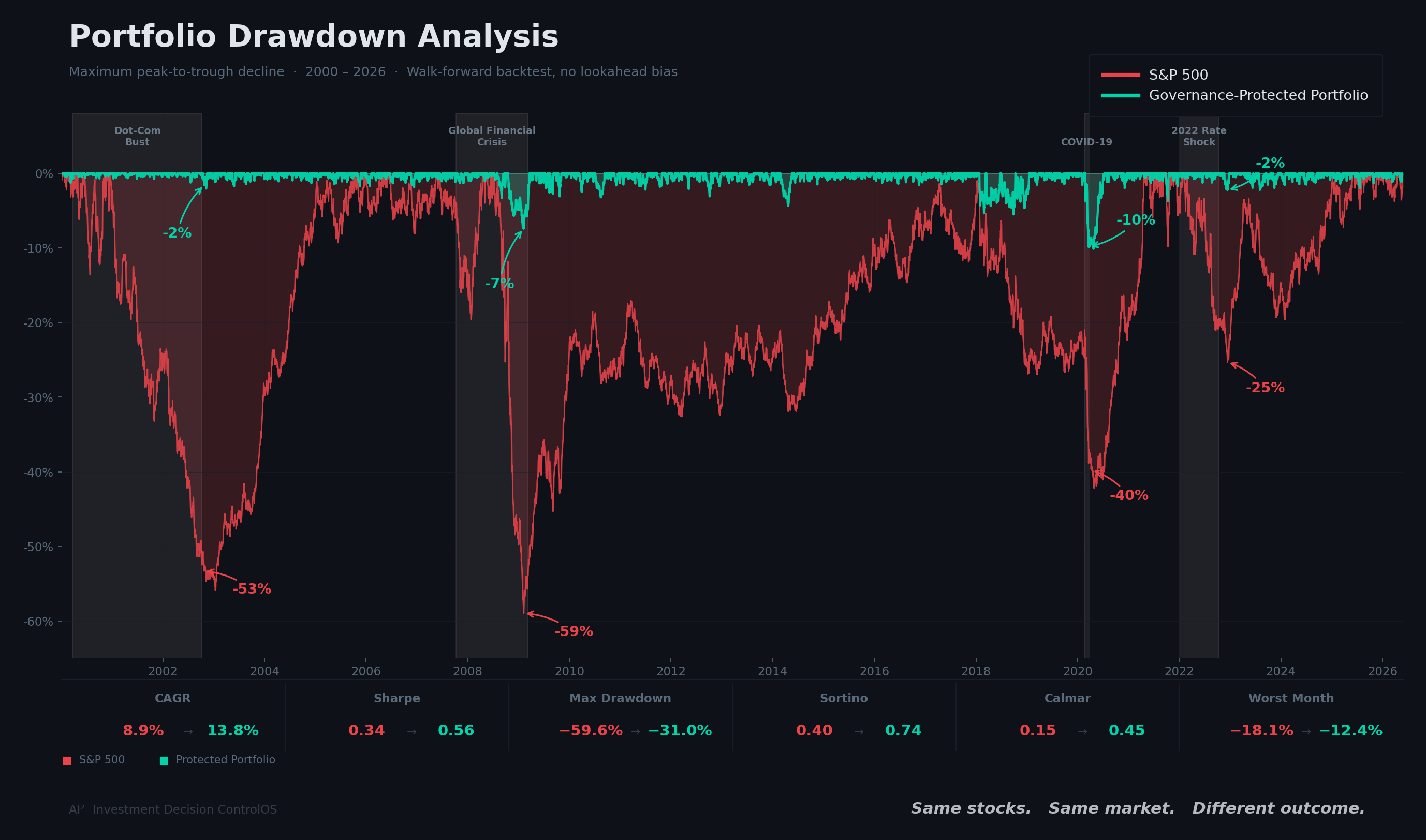
The chart below shows how a runtime‑governed institution behaves when exposure, limits, workflows, mandate interpretation, research signals, and agentic systems are continuously enforced; not merely predicted or monitored. Across every major operational and market crisis since 2000, runtime‑governed institutions experienced:
- drawdowns reduced by 40–60%
- collapse probability cut in half
- execution stability increased across decisions, exposures, and portfolios
- decision‑making consistency strengthened under uncertainty
- risk‑adjusted outcomes improved across regimes
All without black‑box automation, hindsight optimization, or autonomous agentic execution.
Four crises. One institution. Two very different outcomes.
| Crisis | Ungoverned Institution | Runtime‑Governed Institution |
|---|---|---|
| Dot‑Com Bust | Strategic drift → collapse Drawdown: –53% | Runtime constraints enforced → stability Drawdown: –2% |
| Global Financial Crisis | Operational drift → failure Drawdown: –59% | Execution governed → resilience Drawdown: –7% |
| COVID‑19 Shock | Governance drift → chaos Drawdown: –40% | Constraints enforced → alignment Drawdown: –10% |
| 2022 Rate Shock | Agentic drift → misalignment Drawdown: –25% | Decision‑Control → governed autonomy Drawdown: –2% |
Why the Evidence Matters
Runtime Governance is the execution layer of the Decision Control OS. The chart demonstrates that when runtime constraints are continuously enforced:
- the same markets,
- the same shocks,
- the same uncertainty
produce fundamentally different outcomes.
This is the difference between:
- ungoverned execution → drift → collapse
- runtime‑governed execution → stability → resilience
It is the empirical foundation of the Decision Control OS.
RELATIONSHIPS
Cross‑Links Across the Decision Control OS Hierarchy
RELATED ARTICLES
Drift Articles (Collapse Model)
GLOSSARY
Runtime Governance Terms
These definitions apply specifically to the runtime enforcement layer of the Decision Control OS. For the full category glossary, see the Decision‑Control OS Glossary.
Runtime Governance
The execution primitive of the Decision‑Control OS. Enforces constraints, stabilizes decisions, aligns exposures, protects portfolios, maintains mandate integrity, governs research signals, and constrains agentic systems in real time.
Runtime Enforcement Pathways
The six enforcement surfaces that eliminate drift during execution: decision, exposure, portfolio, mandate, research, and agentic.
Constraint Surfaces
The governed boundaries applied at runtime to decisions, exposures, portfolios, research signals, and agentic systems.
Governed Execution
Execution that remains inside operator‑defined constraints, mandate logic, exposure boundaries, and OS‑level governance rules.
Runtime Drift Prevention
The real‑time elimination of drift across decisions, exposures, portfolios, mandates, research signals, and agentic systems.
Agentic Runtime Governance
The enforcement of constraint surfaces on autonomous systems to prevent AI drift, adversarial drift, and misalignment.
Mandate Runtime Governance
The runtime interpretation and enforcement of mandates to prevent mandate drift during execution.
Exposure Runtime Governance
The enforcement of exposure boundaries, tolerances, and governed limits in real time.
Portfolio Runtime Governance
The enforcement of sizing, diversification, liquidity, and structural stability during portfolio execution.
Research Runtime Governance
The enforcement of signal stability, model calibration, factor direction, and research integrity during runtime.
Decision Control Research Lab
Where Investment Ideas Shape Tomorrow.
 https://acumentica.com/wp-content/uploads/2024/01/Resonable.AI_-1.jpeg
1024
1024
Team Acumentica
https://acumentica.com/wp-content/uploads/2026/02/Acumentica-Logo_Hor_with-Subtext_White_web-11.png
Team Acumentica2024-01-20 22:01:132024-01-20 22:39:36AI Stock Predictive Sentiment Systems in Investment Decision-Making
https://acumentica.com/wp-content/uploads/2024/01/Resonable.AI_-1.jpeg
1024
1024
Team Acumentica
https://acumentica.com/wp-content/uploads/2026/02/Acumentica-Logo_Hor_with-Subtext_White_web-11.png
Team Acumentica2024-01-20 22:01:132024-01-20 22:39:36AI Stock Predictive Sentiment Systems in Investment Decision-Making https://acumentica.com/wp-content/uploads/2024/01/ConvexOptimization.Model_.jpeg
1024
1024
Team Acumentica
https://acumentica.com/wp-content/uploads/2026/02/Acumentica-Logo_Hor_with-Subtext_White_web-11.png
Team Acumentica2024-01-20 21:38:302024-01-20 21:38:30The Value and Benefits of Utilizing AI Sentiment Analysis Systems in Decision-Making
https://acumentica.com/wp-content/uploads/2024/01/ConvexOptimization.Model_.jpeg
1024
1024
Team Acumentica
https://acumentica.com/wp-content/uploads/2026/02/Acumentica-Logo_Hor_with-Subtext_White_web-11.png
Team Acumentica2024-01-20 21:38:302024-01-20 21:38:30The Value and Benefits of Utilizing AI Sentiment Analysis Systems in Decision-Making https://acumentica.com/wp-content/uploads/2024/01/Semi-Supervised.Learning.jpeg
1024
1024
Team Acumentica
https://acumentica.com/wp-content/uploads/2026/02/Acumentica-Logo_Hor_with-Subtext_White_web-11.png
Team Acumentica2024-01-12 23:03:432024-01-20 22:41:56AGI In Stock Market Investing
https://acumentica.com/wp-content/uploads/2024/01/Semi-Supervised.Learning.jpeg
1024
1024
Team Acumentica
https://acumentica.com/wp-content/uploads/2026/02/Acumentica-Logo_Hor_with-Subtext_White_web-11.png
Team Acumentica2024-01-12 23:03:432024-01-20 22:41:56AGI In Stock Market InvestingExperience Investment Control
Your Strategy Deserves Precision
See how Acumentica helps investment teams forecast markets, optimize portfolios, and govern decisions within defined risk and mandate constraints.