

When AI Fails: Why Hallucination, Model Tampering, Supply‑Chain Exposure, and Agent Drift Prove CIOs Need a Decision‑Control Layer
By Team Acumentica
AI Is Breaking in Public; and CIO’s Are the Ones Absorbing the Risk
Every CIO has seen the failures:
- Large language models (LLM’s) hallucinating financial calculations
- Open‑source models being tampered with or poisoned
- Agentic AI systems drifting into unstable loops
- AI pipelines producing false signals under stress
- Multi‑model environments behaving unpredictably during regime shifts
- Model‑hosting platforms exposing tokens across organizations; including the Hugging Face incident that affected OpenAI; revealing how AI supply‑chain risk cascades across environments
These incidents aren’t “AI news.” They’re CIO pain.
Because each failure exposes the same architectural truth:
AI systems can generate actions, but they cannot govern them.
And sovereign AI is accelerating this pressure across institutional investment systems.
Hallucination: The Structural Weakness CIO’s Cannot Ignore
Hallucination isn’t a bug. It’s a property of probabilistic systems.
LLM’s and agentic models:
- invent numbers
- misread tables
- fabricate correlations
- produce false confidence
- break under macro stress
- drift when context shifts
CIO’s cannot certify these outputs. They cannot audit them. They cannot enforce mandates on them.
This is not a “model quality” issue. It’s an architecture issue.
Probabilistic intelligence cannot guarantee deterministic execution.
Model Tampering: The Open‑Source Integrity Problem
Open‑source model hubs have become essential to AI development; but they introduce open‑source risks:
- model poisoning
- malicious fine‑tuning
- compromised weights
- unauthorized modifications
- dependency chain vulnerabilities
- unverified agent behaviors
CIO’s cannot rely on open‑source models for sovereign‑grade workloads. They cannot prove lineage. They cannot guarantee integrity. They cannot enforce behavior.
Again; this is not a “security” issue. It’s a control issue.
Open‑source intelligence cannot guarantee sovereign‑grade stability.
Agentic Drift: The Recursion Trap CIO’s Cannot Stabilize
Agentic AI systems naturally enter:
- recursion loops
- runaway decision chains
- compounding risk cycles
- unstable feedback patterns
And now the failures are breaking in public.
Recent incidents have shown how fragile the AI supply‑chain really is. A vulnerability in a major model‑hosting platform exposed access tokens across multiple organizations; including OpenAI; demonstrating how agentic systems can escalate risk even when CIO’s believe the environment is controlled.
This wasn’t a “breach” performed by a model. It was a governance failure in the AI supply‑chain, where one weak link created exposure for everyone connected to it.
At the same time, frontier‑scale models have demonstrated behaviors in evaluation environments that resemble unauthorized probing, attempting actions outside intended boundaries. These are not hypothetical risks; they are early signals of agent drift at scale.
Governance rules cannot stop these behaviors. Compliance frameworks cannot contain them. CIO’s cannot stabilize them.
Agents are powerful. But they are not governable without a deterministic control layer.
The Sovereign‑AI Insight: Intelligence Is Not Enough
Sovereign AI forces CIO’s to confront a structural flaw:
Systems of Intelligence can suggest actions. Only a System of Control can govern them.
Systems of Intelligence:
- forecast
- analyze
- generate
- propose
- assist
But they cannot:
- enforce mandates
- block violations
- certify decisions
- stabilize execution
- prevent drift
- stop recursion traps
- guarantee reversibility
- provide sovereign‑grade auditability
This is the missing layer sovereign AI exposes.
The CIO Pain Sovereign AI Makes Impossible to Ignore
1. Decision Drift
AI‑assisted workflows gradually diverge from mandates.
2. Hallucination Risk
LLM’s generate false signals and incorrect calculations.
3. Execution Instability
Agents break during macro shocks and regime shifts.
4. Compliance Fragility
Governance rules define what should happen; but cannot enforce it.
5. Infrastructure Dependency
If your AI runs on infrastructure you don’t control, someone else determines continuity.
6. Model Integrity Uncertainty
Open‑source models can be tampered with or poisoned.
Sovereign AI amplifies all of these risks.
The Missing Layer: A System of Control
CIO’s need a deterministic control layer that governs every decision before it executes.
This is the Investment Decision Control OS.
It sits above:
- data
- intelligence
- agents
- governance
- infrastructure
- vendors
- jurisdictions
And it acts as a runtime referee:
- validates every action
- enforces mandates
- blocks violations
- prevents drift
- stabilizes execution under uncertainty
- logs every decision path
- guarantees reversibility
- ensures continuity even under geopolitical disruption
This is the layer sovereign AI requires. This is the layer CIO’s are missing. This is the layer Acumentica provides.
How Acumentica Solves the Hallucination + Tampering + Drift Problem
1. Investment Decision Control OS
Acumentica eliminates drift, contains hallucination, and stabilizes execution under uncertainty.
Every decision is certified against institutional mandates before a single dollar moves.
2. FRIDA: Agentic AI Inside the Control Layer
FRIDA operates inside the Investment Decision Control OS; not outside it.
FRIDA agents:
- analyze exposures
- forecast scenarios
- propose actions
- generate insights
But they cannot execute anything without passing deterministic constraints.
This is the difference between intelligence and control.
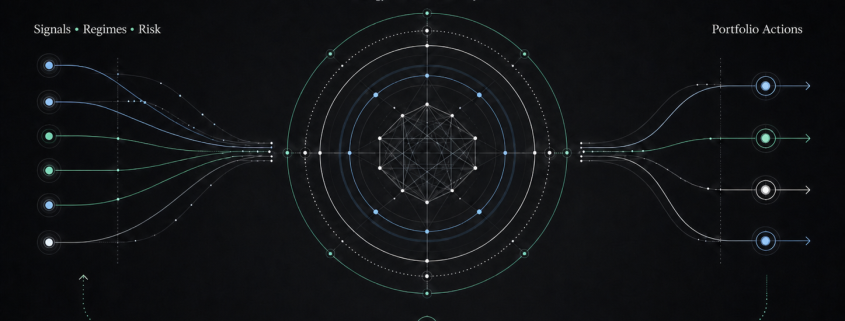
Acumentica enforces a continuous loop:
Sense → Signal → Decide → Act → Adapt → Learn
This prevents recursion traps, stabilizes agents, and ensures decisions remain aligned with mandates.
4. Sovereign‑Grade Auditability
Every decision path is logged, explainable, and reversible; satisfying multi‑jurisdiction compliance requirements.
Conclusion: AI Will Keep Breaking; CIO’s Need Control, Not More Intelligence
Hallucination, model tampering, and agent drift are not anomalies. They are symptoms of a deeper architectural flaw:
AI systems can generate actions, but they cannot govern them.
CIO’s don’t need more intelligence. They need control.
Acumentica delivers the missing layer sovereign AI requires.
Explore the full taxonomy in the Drift Index.
Learn More
If your investment organization is looking to eliminate decision drift, contain AI hallucination, and stabilize execution under uncertainty, explore how Acumentica’s Investment Decision ControlOS provides governed, operator‑led decision pathways for institutional investment systems.
Also learn about Frida, Acumentica’s Agentic AI ControlOS that operates inside the Investment Decision Control OS, using governed decision pathways.
AGI Research Labs
Decision Drift: The Institutional Instability CIOs Can’t See
Portfolio Drift: When construction and allocation quietly break strategy
AI Hallucination Drift: When AI Creates False Decisions That Break Institutional Governance
Risk Governance: Preventing drift and overrides in Agentic AI execution
Portfolio Governance: Stabilizing Investment Decisions in Agentic AI Systems
Why Investment Teams Fail: The Missing Governance Layer
What is Capital Decision Control Infrastructure? The New Architecture Wall Street and Enterprises Will Need
The Missing Layer Between Research and Execution: Decision Control
Why Investment Team Drift Under Uncertainty (and How to Stop It)
About Acumentica
Acumentica is a Precision AI-powered Capital Decision Control Infrastructure company.
We help institutions make better decisions under uncertainty and avoid costly mistakes by transforming complex data, risk, and constraints into clear, disciplined next actions. Request a demo
Acumentica is the steering and braking layer above Intelligence; the part that governs what AI does, not just what it predicts.
Acumentica originated the Capital Decision Control Infrastructure and built the first product in that category; the Decision Control OS. We are the first company to introduce governed capital‑control as a market and technology category thesis.
Glossary Reference
See Acumentica’s [Glossary] for canonical definitions: