

Exposure Governance ControlOS: Governing Factor, Regime & Thematic Exposure in Runtime

By Team Acumentica
Exposure Governance ControlOS: Governing Factor, Regime & Thematic Exposure in Runtime
Exposure Governance ControlOS is a core subsystem inside the Investment Decision ControlOS, which itself sits within the Capital Decision Control OS . It governs how exposure behaves under volatility, regime shifts, autonomous exploration, and machine‑speed decision cycles.
Exposure drift is invisible; until it destabilizes the entire institution. Across every collapse, exposure drift is one of the earliest and most dangerous signals. CIOs do not lose institutions because exposures are wrong; they lose institutions because exposures are ungoverned.
Ungoverned exposure pipelines allow:
- factor exposures to creep beyond mandate
- regime exposures to misalign with macro conditions
- thematic exposures to drift off‑strategy
- sector and macro exposures to compound hidden risks
- concentration and correlation exposures to destabilize portfolios
This drift propagates into risk drift, portfolio drift, execution instability, and collapse dynamics.
The Industrial Diagnostic Role of Exposure Governance
Exposure Governance ControlOS functions as an industrial diagnostic surface for the entire investment system. It continuously monitors:
- factor signatures
- regime boundaries
- thematic exploration
- correlation matrices
- concentration limits
- cross‑asset exposure pathways
By diagnosing drift at the exposure level, the OS suppresses collapse dynamics before they propagate into risk or portfolio instability. Exposure governance is not just a subsystem; it is a diagnostic engine for the entire Investment Decision ControlOS.
Subsystem Map; The Governance Layer
Exposure Governance ControlOS operates alongside:
Risk Governance ControlOS : Constrains factor, regime, and correlation exposures so they cannot generate hidden risk drift.
Portfolio Governance ControlOS : Prevents exposure drift from pushing construction or allocation into misaligned portfolio directions.
Performance Governance ControlOS : Governs performance behavior so exposure‑driven distortions cannot alter return pathways or create collapse dynamics.
Agentic Investment ControlOS : Constrains autonomous systems so agentic exploration cannot create unbounded exposure loops or unintended factor/regime drift.
What-If Scenario ControlOS: Governs scenario exploration so exposure simulations cannot introduce unbounded assumptions or drift‑driven misalignment.
Behavioral & Adversarial Resilience ControlOS : Stabilizes exposure behavior under stress, bias, or adversarial pressure; preventing drift‑driven exposure instability.
Together, these form the Governance Layer of the Investment Decision Control OS.
Evidence: How Governed Exposure Behaves Differently. The Exposure Governance Signature (2000–2026)
Exposure drift is invisible; until it isn’t.
Across the last 26 years, every major collapse began with misaligned exposures:
- factors that amplified volatility
- sectors that drifted off‑mandate
- correlations that destabilized portfolios
- regimes that shifted without governance
- autonomous exposure loops that magnified instability
The empirical record; reflected in the chart below; demonstrates how governed exposure pipelines behave compared to ungoverned exposure pipelines across four major crises. When factor, regime, thematic, and correlation exposures are governed in runtime, institutions avoid the collapse dynamics that ungoverned exposure inevitably amplifies.
Four crises. One institution. Two very different outcomes.
| Crisis | Ungoverned Exposure → Institutional Outcome | Governed Exposure → Institutional Outcome |
|---|---|---|
| Dot‑Com Bust | Factor drift → amplified collapse | Factor governance → stability maintained |
| Global Financial Crisis | Correlation drift → systemic failure | Correlation governance → resilience preserved |
| COVID‑19 | Thematic drift → chaotic exposures | Thematic governance → constraint‑aligned exposures |
| 2022 Rate Shock | Regime drift → exposure misalignment | Regime governance → drift suppressed |
Evidence: Exposure Drift vs Exposure Governance
Below is the chart demonstrating how governed exposure pipelines suppress collapse dynamics across four crises:
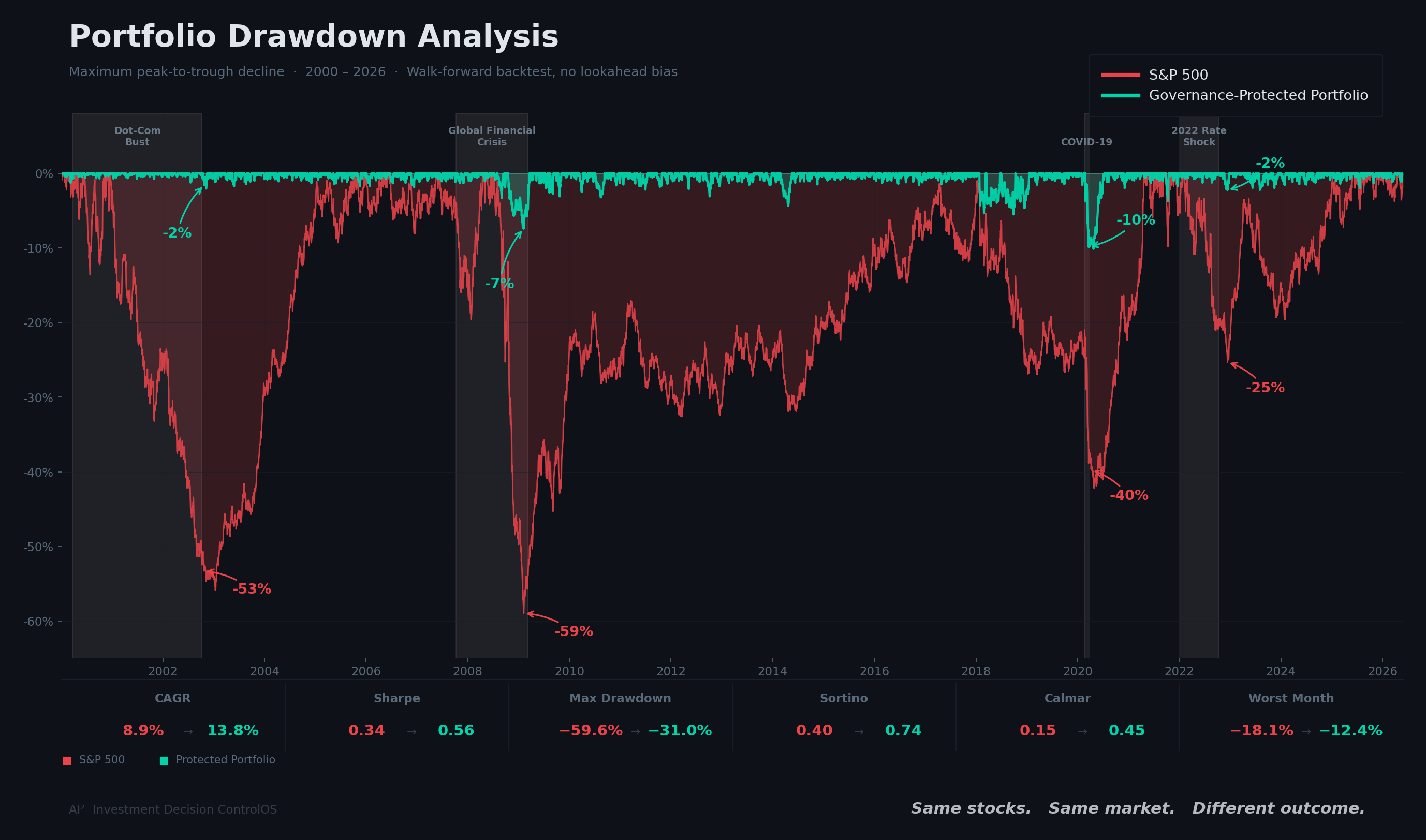
This chart shows:
- Same stocks. Same market. Different outcome.
- Ungoverned exposure pipelines amplify drawdowns.
- Governed exposure pipelines suppress collapse dynamics.
- Governance‑Protected Portfolios maintain stability even under extreme volatility.
This is the operational signature of Exposure Governance ControlOS.
When Exposure Governance Is Absent
Ungoverned exposure pipelines generate:
- misaligned factors
- hidden correlations
- thematic instability
- regime misalignment
- concentration drift
- cross‑asset exposure loops
These propagate into:
- risk drift
- portfolio drift
- collapse dynamics
When Exposure Governance ControlOS Is Active
Governed exposure pipelines remain:
- aligned
- bounded
- governed
- stable
- coherent
- collapse‑resistant
Exposure Governance ControlOS does not change the market. It changes how exposure interacts with the market.
It ensures exposure cannot generate drift; even when markets shift, models optimize, or autonomous systems explore at machine speed.
Operational Signature
Exposure Governance ControlOS enforces runtime boundaries across:
- Factor Governance → prevents mandate creep
- Regime Governance → aligns exposures with macro conditions
- Thematic Governance → constrains exploration to mandate
- Correlation Governance → suppresses hidden systemic risk
- Concentration Governance → enforces diversification boundaries
- Agentic Exposure Governance → constrains autonomous exposure loops
This is the operational signature of Exposure Governance ControlOS.
Industry‑Agnostic Exposure Governance
Exposure drift is not limited to investment institutions. It appears in every industry where factors, regimes, correlations, or thematic exposures can deviate from intent.
Exposure Governance ControlOS is industry‑agnostic. It governs exposure pipelines wherever unmanaged factor, sector, correlation, or regime drift leads to collapse dynamics:
- Aerospace and mission‑critical systems
- Healthcare and clinical operations
- Manufacturing and supply chain analytics
- Energy and utilities
- Construction and infrastructure planning
- Technology and AI operations
- Government and sovereign systems
- University and research institutions
- Physical AI and autonomous industrial systems
Why This Matters
Exposure is the origin point of institutional behavior. If exposure drifts, everything downstream drifts with it.
Exposure Governance ControlOS matters because it:
- enforces CIO‑defined exposure boundaries
- prevents unbounded factor, sector, thematic, and regime drift
- stabilizes exposure pipelines under volatility
- ensures correlations and concentrations cannot create hidden systemic risk
- suppresses collapse dynamics at the source
- transforms exposure governance from review to runtime enforcement
Institutions collapse when exposure is unmanaged. Exposure Governance ControlOS ensures exposure cannot drift; even when uncertainty spikes or autonomous systems explore aggressively.
This is why runtime exposure governance is no longer optional; it is the foundation of institutional stability.
CIO Takeaway
CIO’s do not lose institutions because exposures are wrong. They lose institutions because exposures are ungoverned.
Exposure Governance ControlOS ensures exposures cannot generate drift; even under volatility, regime shifts, or autonomous exploration. This is how institutions remain collapse‑resistant.
Learn More
If your institution is experiencing exposure instability, factor or sector drift, regime misalignment, or unexplained allocation behavior, explore how Acumentica’s Investment Decision‑ControlOS governs construction, allocation, exposure, and execution to eliminate drift.
Also learn about Frida, Acumentica’s Agentic AI ControlOS that operates inside the Investment Decision Control OS, using governed decision pathways to stabilize factor, regime, thematic, and correlation exposures in runtime.
Decision Control Research Lab
The Decision Control Research Lab researches drift, collapse dynamics, and the Decision‑Control layer; the institutional execution‑governance systems that keep autonomous and enterprise systems stable, aligned, and protected from drift‑driven failure.
Investment Research Governance ControlOS: Governing Research Direction & Exploration in Runtime
Portfolio Governance ControlOS: Preventing Portfolio Drift in Runtime
Risk Governance ControlOS: Runtime Enforcement of Institutional Risk Boundaries
AI Hallucination Drift: When AI Creates False Decisions That Break Institutional Governance
Risk Governance: Preventing drift and overrides in Agentic AI execution
Portfolio Drift: When construction and allocation quietly break strategy
Decision Drift: The Institutional Instability CIOs Can’t See
Portfolio Governance: Stabilizing Investment Decisions in Agentic AI Systems
Why Investment Teams Fail: The Missing Governance Layer
What is Capital Decision Control Infrastructure? The New Architecture Wall Street and Enterprises Will Need
The Missing Layer Between Research and Execution: Decision Control
Why Investment Team Drift Under Uncertainty (and How to Stop It)
About Acumentica
Acumentica is a Precision AI-powered Capital Decision Control Infrastructure company.
We help institutions make better decisions under uncertainty and avoid costly mistakes by transforming complex data, risk, and constraints into clear, disciplined next actions. Request a demo
Acumentica is the steering and braking layer above Intelligence; the part that governs what intelligence does, not just what it predicts.
Acumentica originated the Capital Decision Control Infrastructure and built the first product in that category; the Decision Control OS. We are the first company to introduce governed capital‑control as a market and technology category thesis.
Glossary Reference
See Acumentica’s [Glossary] for canonical definitions: