

Risk Drift: When Exposure and Limits Quietly Break Strategy
By Team Acumentica
Risk Drift: When Exposure and Limits Quietly Break Strategy
Risk Drift is the most dangerous form of institutional drift because it hides inside the part of the system everyone assumes is stable.
Risk systems are supposed to protect strategy. But when they drift, they quietly reshape strategy instead.
Risk Drift doesn’t show up as a dramatic failure. It shows up as:
- exposures that don’t match intent
- limits that move without approval
- volatility responses that feel “off”
- rebalancing that doesn’t align with mandate
- risk logic behaving differently under uncertainty
Risk Drift is subtle. It’s cumulative. And it’s one of the fastest ways an institution loses control of its execution.
Situational Awareness Hedge Fund Capital Example:
How Risk Drift Actually Spreads
At Situational Awareness Hedge Fund, nothing looked wrong at first.
A volatility model interpreted a market signal as slightly elevated. Exposure limits tightened by a fraction. The allocation engine rebalanced accordingly. Automation executed downstream tasks. Humans assumed the system was correct because “risk moved.”
Every step was rational. Every step was explainable. Every step was defensible.
But the combined effect was drift.
Within weeks:
- exposures no longer matched strategy
- limits had quietly shifted
- rebalancing was happening without mandate alignment
- the portfolio behaved differently than intended
Leopold Aschenbrenner’s didn’t experience a failure; he experienced Risk Drift.
This is how drift spreads in real institutions.
Why Risk Drift Happens
Risk Drift emerges when risk systems operate without governed decision pathways.
It’s not caused by:
- bad models
- bad data
- bad dashboards
- bad committees
It’s caused by ungoverned risk logic.
The most common sources:
- Risk engines adjusting exposures based on unstable signals
- Volatility models reacting outside authority boundaries
- AI systems generating synthetic risk interpretations
- Human overrides made under pressure
- Automation executing rebalancing without governed checkpoints
- Allocation engines feeding risk systems drifting inputs
Risk Drift is not a technical failure; it’s a governance gap.
The Pattern CIO’s Are Starting to Recognize
Across institutions, Risk Drift follows a predictable sequence:
- A risk model interprets a signal differently under uncertainty.
- Exposure limits adjust slightly.
- Allocation engines rebalance based on the new limits.
- Automation executes downstream tasks.
- Humans assume the system is correct because “risk moved.”
Every step is rational. Every step is explainable. Every step is defensible.
But the combined effect is drift.
Risk Drift is dangerous because it looks like normal risk behavior; until it isn’t.
Why Risk Drift Is Increasing
Risk Drift is accelerating because:
- risk engines are more dynamic
- volatility models react faster
- AI systems generate more risk interpretations
- automation executes instantly
- mandates are more complex
- exposures are more interconnected
- human oversight is thinner
The more complex the risk environment becomes, the more drift accelerates.
CIO’s describe it simply: “Our risk systems are moving even when we’re not.”
The Real Problem: Ungoverned Risk Pathways
Risk Drift doesn’t come from bad risk systems. It comes from ungoverned risk pathways.
When risk engines operate without governed boundaries, drift becomes inevitable.
The solution is not:
- more dashboards
- more alerts
- more committees
- more overrides
The solution is governed risk execution.
The Solution: Governed Risk Logic and Exposure Control
Acumentica’s Investment Decision Control OS governs risk logic at the decision level; not the data level.
It provides:
- governed exposure boundaries
- governed risk pathways
- governed volatility interpretation
- governed rebalancing constraints
- governed execution checkpoints
- operator‑led authority control
- governed research pathways
- governed what-if scenario controls
Risk Drift cannot occur when risk systems are governed.
Chart Evidence
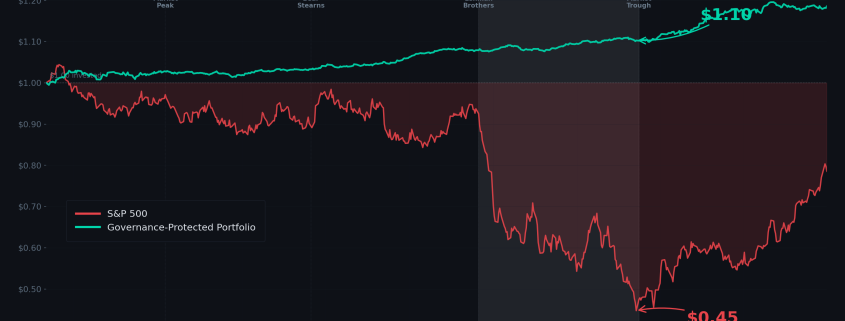
The chart below shows how a governed portfolio behaves when exposure, limits, and execution are continuously controlled; not just predicted. Across every major crisis since 2000, drawdowns were cut in half, resilience increased, and risk‑adjusted performance improved without any black‑box automation or hindsight optimization.
Four market crises. One portfolio. Two very different outcomes.
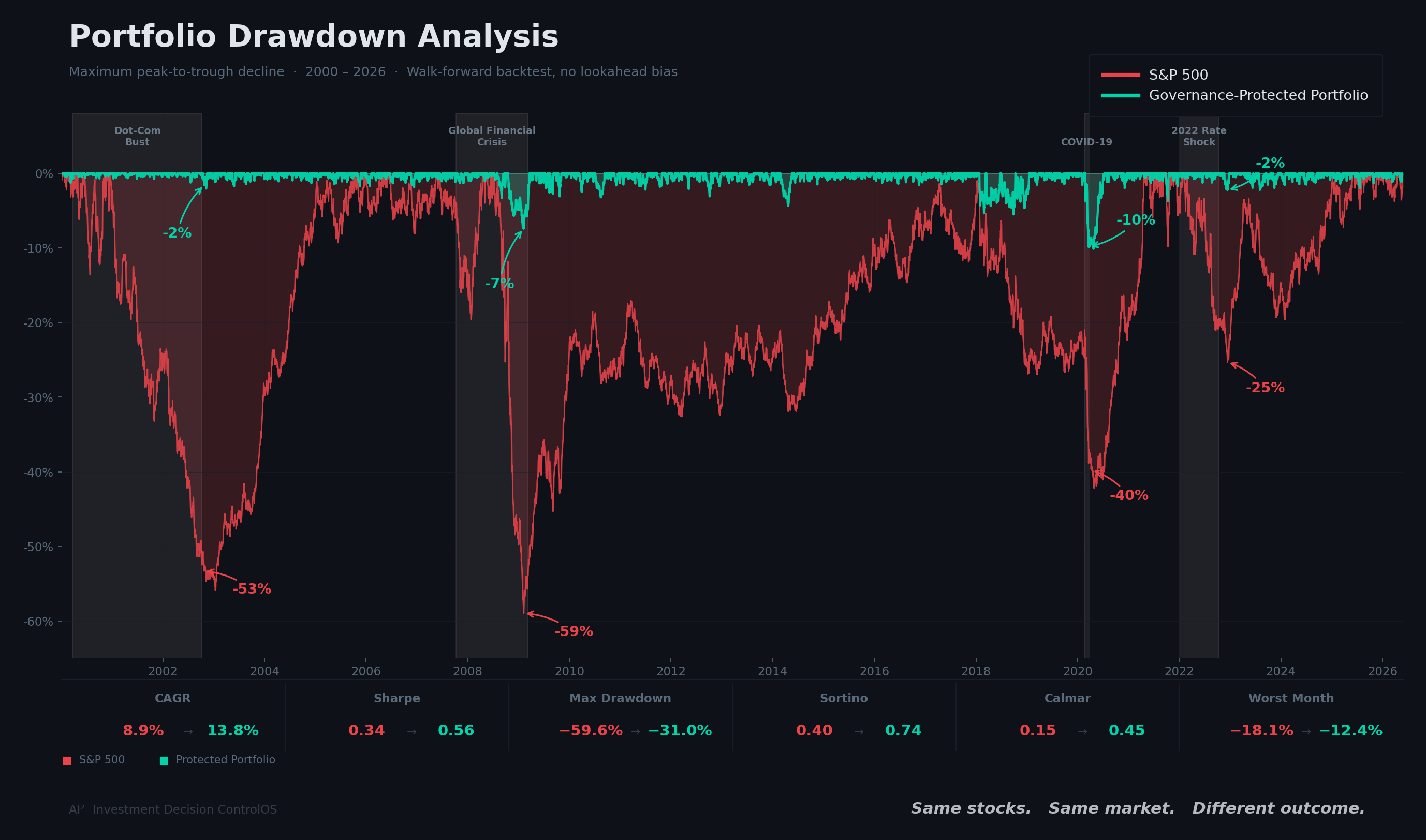
- Drawdowns cut in half across every major crisis since 2000
- 13.8% CAGR over 21 years, beating the S&P 500 by nearly 5 points annually
- Sharpe ratio 65% higher than the benchmark
- Walk‑forward tested across 26 years; no hindsight, no curve‑fitting
- No black box. No automated trading
Why this matters
Risk Drift is structural. When exposure and limits drift, strategy breaks quietly; long before performance reveals the damage.
A governed portfolio behaves differently because:
- Intelligence identifies opportunities
- Decision Control governs exposure, limits, and execution
- The PM still decides; but drift cannot compound into failure
Acumentica Governs. Your PM Decides.
What CIO’s Gain When Risk Drift Is Eliminated
1. Exposure Stability
Exposures stay aligned with strategy, even under uncertainty.
2. Limit Discipline
Risk limits remain within governed boundaries.
3. Volatility Integrity
Volatility models cannot drift away from mandate.
4. Rebalancing Alignment
Rebalancing follows governed pathways, not drifting logic.
5. AI Oversight
AI‑generated risk interpretations cannot create false exposure changes.
6. Execution Confidence
Automation executes only governed risk decisions.
Risk Drift is not just a risk problem; it’s an institutional stability problem.
Explore the full taxonomy in the Drift Index.
Learn More
If your institution is experiencing portfolio instability, drift in exposures, or unexplained allocation changes, explore how Acumentica’s Investment Decision ControlOS governs construction, allocation, and execution to eliminate drift.
Also learn about Frida, Acumentica’s Agentic AI ControlOS that operates inside the Investment Decision Control OS, using governed decision pathways.
AGI Research Labs
Portfolio Drift: When construction and allocation quietly break strategy
Decision Drift: The Institutional Instability CIOs Can’t See
AI Hallucination Drift: When AI Creates False Decisions That Break Institutional Governance
Risk Governance: Preventing drift and overrides in Agentic AI execution
Portfolio Governance: Stabilizing Investment Decisions in Agentic AI Systems
Why Investment Teams Fail: The Missing Governance Layer
What is Capital Decision Control Infrastructure? The New Architecture Wall Street and Enterprises Will Need
The Missing Layer Between Research and Execution: Decision Control
Why Investment Team Drift Under Uncertainty (and How to Stop It)
About Acumentica
Acumentica is a Precision AI-powered Capital Decision Control Infrastructure company.
We help institutions make better decisions under uncertainty and avoid costly mistakes by transforming complex data, risk, and constraints into clear, disciplined next actions. Request a demo
Acumentica is the steering and braking layer above Intelligence; the part that governs what AI does, not just what it predicts.
Acumentica originated the Capital Decision Control Infrastructure and built the first product in that category; the Decision Control OS. We are the first company to introduce governed capital‑control as a market and technology category thesis.