

What‑If Scenario ControlOS: Governing Alternative Futures, Stress Variants and Scenario Drift Before Decisions Are Approved
By Team Acumentica
What‑If Scenario ControlOS: Governing Alternative Futures, Stress Variants & Scenario Drift Before Decisions Are Approved
Investment decisions rarely fail because teams lack data. They fail because the future unfolds differently than the scenario everyone assumed.
Markets shift regimes. Liquidity conditions change. Behavioral pressure emerges. Execution becomes constrained. Signals behave differently under stress.
And decisions that looked reasonable under one future become fragile under another.
What‑If Scenario ControlOS is Acumentica’s scenario‑governance module inside the AI Investment Decision ControlOS. It challenges investment decisions against multiple future pathways before capital is exposed; not just the “base case” or the optimistic scenario.
This module governs:
- alternative futures
- stress‑variant scenarios
- scenario drift
- future‑pathway divergence
- committee‑ready scenario evidence
It ensures decisions remain resilient even when the future refuses to cooperate.
Why Scenario Governance Matters
Most investment processes rely on a single forward view:
- a forecast
- a model output
- a research narrative
- a committee assumption
But portfolios fail when the future deviates from that assumption.
What‑If Scenario ControlOS matters because it forces decisions to prove themselves under:
- different market regimes
- different liquidity conditions
- different behavioral environments
- different correlation structures
- different execution realities
It challenges decisions under multiple futures, not just the one everyone hopes for.
This strengthens foresight discipline and prevents fragile decisions from entering the portfolio.
What What‑If Scenario ControlOS Governs
1. Alternative Futures & Regime Variants
Markets behave differently across:
- inflation regimes
- rate cycles
- volatility environments
- correlation structures
- liquidity conditions
This module tests decisions across these variants to surface where the decision breaks.
2. Scenario Drift & Pathway Divergence
Even well‑constructed scenarios drift over time.
This module governs:
- drift between expected and actual pathways
- divergence between forecast and realized conditions
- alignment between decision intent and future behavior
It ensures decisions remain stable even as the future evolves.
3. Stress‑Variant Scenarios
Stress variants reveal fragility that base cases hide.
This module challenges decisions under:
- volatility spikes
- liquidity compression
- crowding pressure
- execution strain
- behavioral stress
It exposes vulnerabilities before they become portfolio damage.
4. Committee‑Ready Scenario Evidence
The output is not a black‑box verdict. It is decision evidence.
This module gives CIO’s and committees:
- scenario‑aligned sizing guidance
- hedging considerations
- timing adjustments
- escalation triggers
- approval, delay, or rejection evidence
It strengthens governance without replacing judgment.
Scenario Behavior Under Alternative Futures
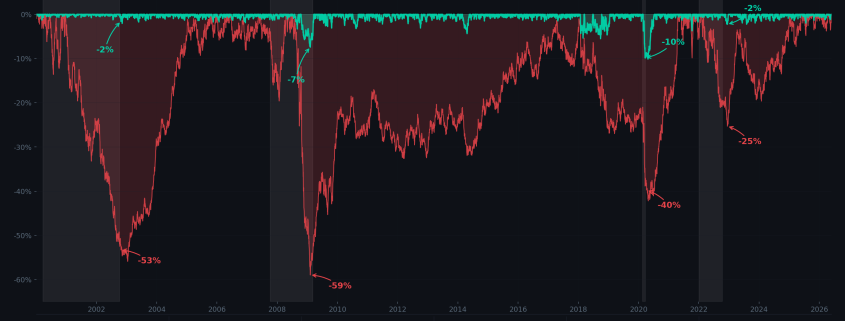
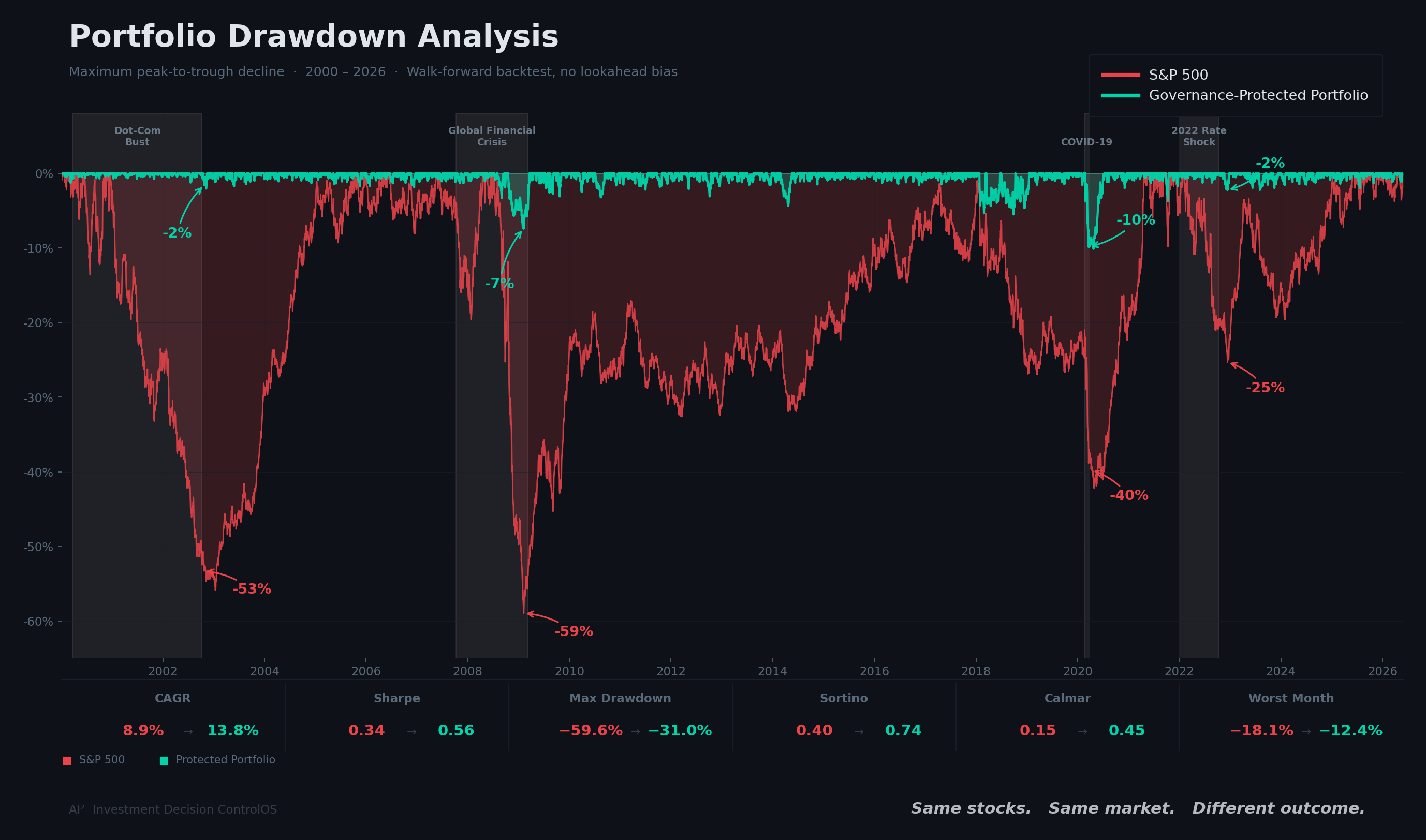
Walk‑forward scenario analysis comparing base‑case, stress‑variant, and alternative‑regime outcomes. Same decision. Different futures. Different outcomes.
The chart illustrates how a single investment decision behaves across multiple future pathways. Scenario drift, regime shifts, and stress variants reveal fragility that base‑case assumptions hide. This is the core purpose of What‑If Scenario ControlOS: to challenge decisions under futures that are plausible, not just preferred.
Industry‑Agnostic Scenario Governance
Scenario drift is not limited to financial markets. It appears in every industry where capital, timelines, and uncertainty intersect.
This module applies across:
- Aerospace & Defense; procurement delays, geopolitical shifts
- Real Estate; refinancing pressure, liquidity compression
- Construction & Infrastructure; cost overruns, timeline volatility
- Universities & Endowments; donor cycles, enrollment shifts
- Financial Services; regime changes, crowding behavior
Scenario governance is not a sector feature; it is a decision requirement.
Why CIO’s Need a What-if Scenario ControlOS
CIOs are accountable for decisions that must survive futures no one can fully predict. Markets shift regimes, liquidity conditions change, correlations compress, and behavioral pressure emerges; often faster than committees can react. What‑If Scenario ControlOS gives CIO’s governed foresight by challenging every decision against multiple plausible futures, not just the preferred one. It surfaces where a decision breaks, where it drifts, and where it becomes fragile, giving CIO’s clearer evidence for approval, sizing, hedging, delay, or rejection. In an environment where uncertainty is the norm, governed scenario discipline becomes a strategic advantage.
Conclusion
What‑If Scenario ControlOS strengthens the investment decision process by challenging decisions against multiple future pathways before capital is exposed. Markets, liquidity, behavior, and execution rarely follow a single script — and decisions that rely on one future often fail when reality diverges.
By governing alternative futures, stress variants, and scenario drift, this module gives CIOs and committees clearer evidence for approval, sizing, hedging, delay, or rejection. It prevents fragile decisions from entering the portfolio and strengthens foresight discipline across the entire investment process.
It is a core component of Acumentica’s AI Investment Decision‑ControlOS and the broader Capital Decision‑Control Infrastructure; ensuring decisions remain stable, aligned, and resilient across all future pathways.
Learn More
To strengthen decision stability across every stage of the investment process, explore how the rest of Acumentica’s Decision‑Control OS governs risk, portfolio structure, exposure, performance, and behavioral resilience in runtime. Modules like Risk Governance ControlOS, Portfolio Governance ControlOS, Performance Governance ControlOS, and Behavioral & Adversarial Resilience ControlOS work together inside the AI Investment Decision ControlOS to ensure decisions remain aligned, resilient, and committee‑ready before capital is exposed.
Also learn how FRIDA stabilizes runtime behavior through governed agentic reasoning while What‑If Scenario ControlOS challenges decisions against alternative futures before capital is exposed.
Decision Control Research Lab
The Decision Control Research Lab researches drift, collapse dynamics, and the Decision‑Control layer; the institutional execution‑governance systems that keep autonomous and enterprise systems stable, aligned, and protected from drift‑driven failure.
Investment Research Governance ControlOS: Governing Research Direction & Exploration in Runtime
Portfolio Governance ControlOS: Preventing Portfolio Drift in Runtime
Risk Governance ControlOS: Runtime Enforcement of Institutional Risk Boundaries
AI Hallucination Drift: When AI Creates False Decisions That Break Institutional Governance
Risk Governance: Preventing drift and overrides in Agentic AI execution
Portfolio Drift: When construction and allocation quietly break strategy
Decision Drift: The Institutional Instability CIOs Can’t See
Portfolio Governance: Stabilizing Investment Decisions in Agentic AI Systems
Why Investment Teams Fail: The Missing Governance Layer
What is Capital Decision Control Infrastructure? The New Architecture Wall Street and Enterprises Will Need
The Missing Layer Between Research and Execution: Decision Control
Why Investment Team Drift Under Uncertainty (and How to Stop It)
About Acumentica
Acumentica is a Precision AI-powered Capital Decision Control Infrastructure company.
We help institutions make better decisions under uncertainty and avoid costly mistakes by transforming complex data, risk, and constraints into clear, disciplined next actions. Request a demo
Acumentica is the steering and braking layer above Intelligence; the part that governs what intelligence does, not just what it predicts.
Acumentica originated the Capital Decision Control Infrastructure and built the first product in that category; the Decision Control OS. We are the first company to introduce governed capital‑control as a market and technology category thesis.
Glossary Reference
See Acumentica’s [Glossary] for canonical definitions: