

Capital Decision Control Infrastructure (CDCI) | Governing Decision Behavior Under Pressure
By Team Acumentica
Capital Decision Control Infrastructure (CDCI): Governing How Decisions Behave Under Pressure, Not Just How They Perform Under Ideal Conditions
Institutions don’t fail because they lack intelligence. They fail because intelligence behaves unpredictably under pressure.
Models drift. Signals conflict. Execution windows tighten. Committees feel behavioral stress. And decisions that looked structurally sound in calm conditions become fragile when uncertainty rises.
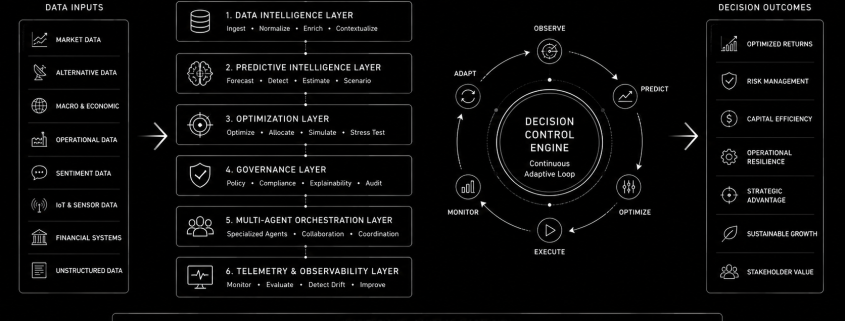
Capital Decision Control Infrastructure (CDCI) is Acumentica’s unified governance fabric that stabilizes institutional decisions before, during, and after capital is exposed. It governs how decisions behave under volatility, constraint, pressure, and operational strain; not just how they perform under ideal assumptions.
Instead of asking, “Did this decision work?” CDCI asks, “Will this decision remain governed, aligned, and stable when markets, systems, and people behave badly?”
This is the difference between intelligence and decision control.
Why institutions need CDCI
Traditional enterprise systems focus on:
- analytics
- dashboards
- predictive models
- workflow automation
- reporting
But none of these govern decision behavior.
Under real‑world pressure:
- strategies drift
- exposures creep
- risk boundaries weaken
- execution becomes fragile
- committees react emotionally
- agentic systems behave inconsistently
Institutions don’t lose capital because they lack insight. They lose capital because decisions break governance, discipline, and structure when uncertainty rises.
CDCI exists to prevent that breakage.
It governs the decision lifecycle, not just the decision output.
What CDCI governs
CDCI is built to stabilize decisions across six critical dimensions:
1. Reasoning behavior under uncertainty
Governed agentic reasoning, recursion control, and runtime stability through FRIDA.
2. Resilience under market, behavioral, and structural stress
Governance‑protected behavior through Behavioral & Adversarial Resilience ControlOS.
3. Prescriptive next‑action discipline
Governed prescriptive pathways that align with strategy, constraints, and institutional intent.
4. Performance under load
Throughput, latency, execution stability, and runtime degradation governed by Performance Governance ControlOS.
5. Exposure alignment
Factor, regime, thematic, and concentration governance through Exposure Governance Control OS.
6. Risk boundary protection
Mandate, oversight, and policy governance through Risk Governance ControlOS.
7. Scenario pathway governance
Alternative market, behavioral, and structural pathways governed by What‑If Scenario ControlOS.
Together, these modules form a unified governance fabric that stabilizes decisions across the entire lifecycle — from reasoning → to action → to execution → to oversight.
The problem CDCI solves
Institutions operate in environments where:
- volatility spikes
- correlations compress
- liquidity thins
- execution becomes costly
- committees face drawdown pressure
- narratives conflict
- constraints tighten
- systems degrade under load
In these conditions, decision behavior matters more than decision output.
CDCI prevents:
- strategy drift
- exposure creep
- risk boundary violations
- execution fragility
- behavioral pressure breakage
- agentic instability
- governance misalignment
It ensures decisions remain stable, disciplined, and aligned with institutional intent; even when conditions deteriorate.
Governance‑Protected Decision Behavior
CDCI does not predict outcomes. It governs how decisions behave.
The difference is foundational:
Same models. Same signals. Same market. Same team.
Different outcome; because of governance.
CDCI ensures that decisions:
- follow strategy
- respect constraints
- remain executable
- stay aligned with exposure intent
- behave consistently under pressure
- produce committee‑ready evidence
- avoid fragile pathways
- remain stable across regimes
This is the purpose of decision control.
Built for institutional decision‑makers
CDCI is designed for:
- CIO’s and investment committees
- family offices and RIA’s
- hedge funds and institutional allocators
- enterprise risk and oversight teams
- operational leaders in capital‑dependent environments
It strengthens:
- governance
- discipline
- alignment
- stability
- communication
- oversight
- institutional confidence
CDCI is not analytics. It is governed decision architecture.
Industry‑agnostic decision governance
CDCI applies across:
- Aerospace & Defense
- Real Estate
- Construction & Infrastructure
- Universities & Endowments
- Manufacturing & Supply Chain
- Energy & Industrial Operations
Any environment where decisions must remain stable under pressure benefits from CDCI.
Decision control is not a sector feature. It is an institutional requirement.
Conclusion
Capital Decision Control Infrastructure (CDCI) governs how decisions behave under uncertainty, pressure, and operational strain; not just how they perform under ideal conditions.
Markets become volatile. Systems degrade. People react emotionally. Constraints tighten. Execution windows narrow.
CDCI stabilizes decisions across all of these conditions, ensuring they remain aligned, disciplined, and resilient before, during, and after capital is exposed.
It is the governance fabric behind Acumentica’s Decision Control OS; and the foundation of modern institutional decision‑making.
Learn More
Explore how the Investment Decision ControlOS governs autonomous reasoning, execution, and performance across institutional systems.
Learn how FRIDA stabilizes runtime behavior through governed agentic reasoning and recursion control.
Decision Control Research Lab
The Decision Control Research Lab researches drift, collapse dynamics, and the Decision‑Control layer; the institutional execution‑governance systems that keep autonomous and enterprise systems stable, aligned, and protected from drift‑driven failure.
Governed Risk and Compliance Decision Control OS
Governed Agentic Enterprise OS | Governing Enterprise Decisions Under Uncertainty
Investment Research Governance ControlOS: Governing Research Direction & Exploration in Runtime
Portfolio Governance ControlOS: Preventing Portfolio Drift in Runtime
Risk Governance ControlOS: Runtime Enforcement of Institutional Risk Boundaries
AI Hallucination Drift: When AI Creates False Decisions That Break Institutional Governance
Risk Governance: Preventing drift and overrides in Agentic AI execution
Portfolio Drift: When construction and allocation quietly break strategy
Decision Drift: The Institutional Instability CIOs Can’t See
Portfolio Governance: Stabilizing Investment Decisions in Agentic AI Systems
Why Investment Teams Fail: The Missing Governance Layer
What is Capital Decision Control Infrastructure? The New Architecture Wall Street and Enterprises Will Need
The Missing Layer Between Research and Execution: Decision Control
Why Investment Team Drift Under Uncertainty (and How to Stop It)
About Acumentica
Acumentica is a Precision AI-powered Capital Decision Control Infrastructure company.
We help institutions make better decisions under uncertainty and avoid costly mistakes by transforming complex data, risk, and constraints into clear, disciplined next actions. Request a demo
Acumentica is the steering and braking layer above Intelligence; the part that governs what intelligence does, not just what it predicts.
Acumentica originated the Capital Decision Control Infrastructure and built the first product in that category; the Decision Control OS. We are the first company to introduce governed capital‑control as a market and technology category thesis.
Glossary Reference
Control Plane: The governance layer that directs agentic systems.
Closed Loop: A feedback system ensuring accountability and correction.
Governed Intelligence: AI systems operating under explicit decision‑control rules.
See Acumentica’s [Glossary] for canonical definitions.