

When The Tech Last Broke: What Dot-Com Tell Us About The AI Bubble – Investment Decision ControlOS
By Ryan D’Souza, Founder & CEO, Acumentica
When Tech Last Broke, Decision Control Was the Difference. What the Dot-Com Bust Teaches Us About the AI Bubble.
Executive Summary
The 2000 dot-com bust remains the only true historical analog to today’s AI concentration. Both periods share the same structural fingerprint: narrative-driven leadership, extreme multiple expansion, and crowded positioning in a small number of technology names. Using the same seventeen AI stocks that define today’s institutional exposure, Acumentica’s Investment Decision ControlOS was walk-forward tested through the March 2000 to October 2002 dot-com decline. The passive basket lost 88% of its value. The governed version lost 40%. A $1 investment became $0.16 passively; the governed version preserved $0.71. The results underscore a central thesis in modern capital governance: Decision Control, not merely prediction, is what preserves capital when market leadership unwinds and regimes change.
Introduction
There is a question many CIO’s have stopped asking out loud, because asking it feels like heresy
What if the AI Bubble breaks the way tech broke in 2000?
The question feels uncomfortable because the stocks involved are the best businesses of our era. Nvidia is not Pets.com. Microsoft in 2026 is not Microsoft in 2000. Meta, Google, and Amazon are generational franchises. The AI buildout is real, the capital expenditures are real, and the earnings growth is real.
But the dot-com companies that collapsed in 2000 were also, for the most part, real businesses. Cisco was the undisputed leader in networking. Oracle dominated enterprise databases. Intel owned the processor market. Microsoft had a monopoly on operating systems. These were not fraudulent businesses. They were extraordinary businesses trading at valuations that assumed extraordinary futures.
The futures mostly arrived. The valuations did not survive the wait.
That is what makes the dot-com period the most honest reference point we have for the current AI concentration cycle.
Not because AI will unwind the same way. We don’t predict markets. But because the structural pattern, concentrated leadership, extreme multiples, narrative-driven buying, and institutional positioning concentrated in the same handful of names, has only one true precedent at this scale. The question is not whether history repeats exactly. The question is whether institutions have a framework capable of preserving Decision Control if the regime changes.
So we ran the test every CIO privately wants to see.
The Setup
We used the same seventeen stocks from our prior AI concentration study. Nvidia, Microsoft, Google, Meta, Amazon, Broadcom, AMD, TSMC, Oracle, Palantir, Intel, IBM, Cisco, Apple, and three adjacent names. These are the stocks that define today’s AI exposure for most institutional portfolios.
The historical period was the dot-com bust itself: March 2000 through October 2002. Benchmark was QQQ, the tech-heavy index.Preset was Growth Governance, matching the stance of an investor who wants participation in the upside, not a defensive crouch.
Rebalancing was monthly.
The backtest was walk-forward. At every rebalancing point, the system only used information that would have been available on that date. No lookahead. No hindsight. No curve-fitting.
We let it run through the full crisis; the initial correction in spring 2000, the deeper collapse through 2001, the September 11 shock, and the final capitulation in October 2002 when the NASDAQ bottomed roughly 78% below its March 2000 peak. This analysis was conducted using Acumentica’s What-If Scenario ControlOS, allowing CIO’s to evaluate how concentrated portfolios would behave under one of the most severe technology-led market declines in modern history.
The objective was not to determine whether the system could predict the collapse. The objective was to evaluate whether a governed Decision Control framework could preserve capital as the regime deteriorated.
The Chart
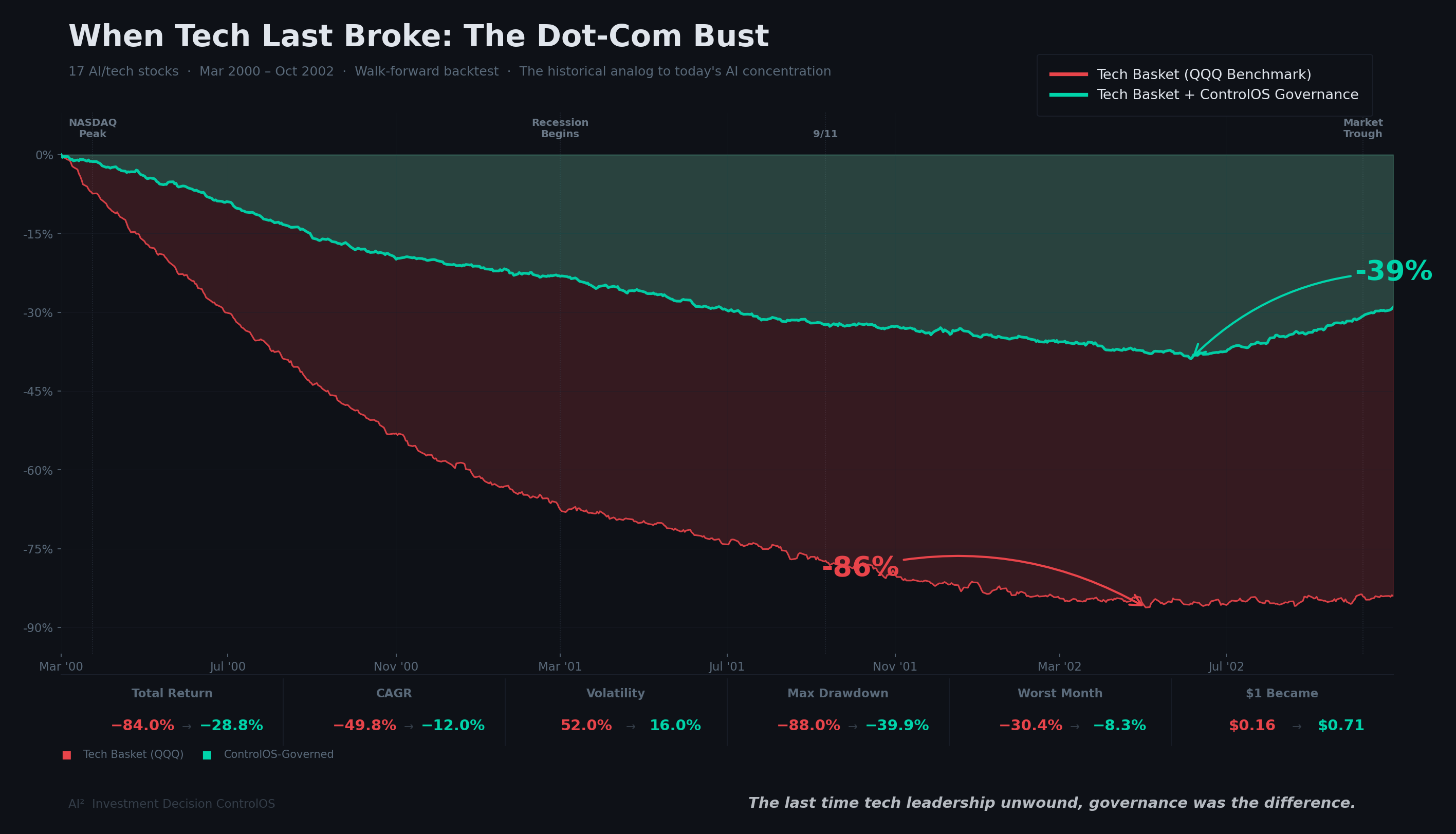
Illustrative. Based on confirmed walk-forward backtest results.
What the Numbers Say
The red line is what a passive investor holding this tech basket experienced through the dot-com bust. The teal line is the same basket under ControlOS governance.
The numbers are stark.
The passive basket lost 84% in total return over the 32-month period. The governed version lost 28.8%. On an annualized basis, the benchmark compounded at −49.8%; the governed version at −12.0%. Maximum drawdown was 88% for the passive portfolio and 40% for the governed one. Monthly volatility fell from 52% to 16%. The worst single month was −30.4% for the benchmark and −8.3% for the governed version.
The most important number is the one at the far right of the metrics bar. One dollar invested in the passive AI/tech basket at the start of March 2000 was worth $0.16 cents by October 2002. One dollar invested in the governed version was worth $0.71 cents.
That is the difference between a wipeout and a bruise. Between a client relationship ended and a client relationship kept. Between years spent explaining losses and years spent compounding again.
Those are not projections. Those are what a portfolio holding these specific stocks under this governance would have done through the deepest technology correction in modern market history.
More importantly, they demonstrate what happens when Decision Control remains intact as market regimes deteriorate. The objective was never to eliminate losses. The objective was to preserve capital, maintain Constraint Integrity, and prevent exposure from compounding as conditions worsened.
What Makes This Different
Most risk systems fail during crises because they were calibrated during calm.
Investment Decision ControlOS was built from the opposite direction. The system was designed to govern exposure through regime change; specifically to detect when the market environment that justified a given level of risk has stopped existing.
That matters here because the dot-com decline was not a single event. It was a 32-month regime shift that most forecasting systems missed because they were still fitting to the 1999 environment. The companies didn’t disappear. The business models didn’t disappear. What disappeared was the regime that supported extreme multiples. By the time most risk systems noticed, the drawdown was already compounded.
Decision Control is different from prediction.
Prediction attempts to determine what the market will do next.
Decision Control determines how exposure should be governed when the market environment changes.
Decision Control preserves optionality when the regime changes. It reduces exposure when the conditions that justified exposure have deteriorated. It does this using observable, measurable signals from market behavior itself; volatility, correlation, and dispersion; rather than opinions about where prices should be.
The result is a system that participated in the pre-2000 technology expansion, detected the regime shift as it developed, and reduced exposure in time to preserve capital. The 32-month unwind was not survived by picking the top. It was survived through continuous governance of exposure as conditions deteriorated.
According to Acumentica’s Decision Control Research Lab, many of the largest losses in institutional portfolios occur not because investors lack intelligence, but because exposure remains tied to assumptions that no longer match the active market regime. This is a form of Exposure Drift, one of the core pathways identified in Acumentica’s Drift Index: Six Pathways of Institutional Drift. This is one of the core challenges addressed by SI Governance, where decision systems must remain governed as operating conditions change.
That principle is what separates Capital Decision Control Infrastructure from traditional risk analytics.
Traditional risk analytics observe exposure.
Decision Control governs it.
Why the Recovery Math Matters More Than People Think
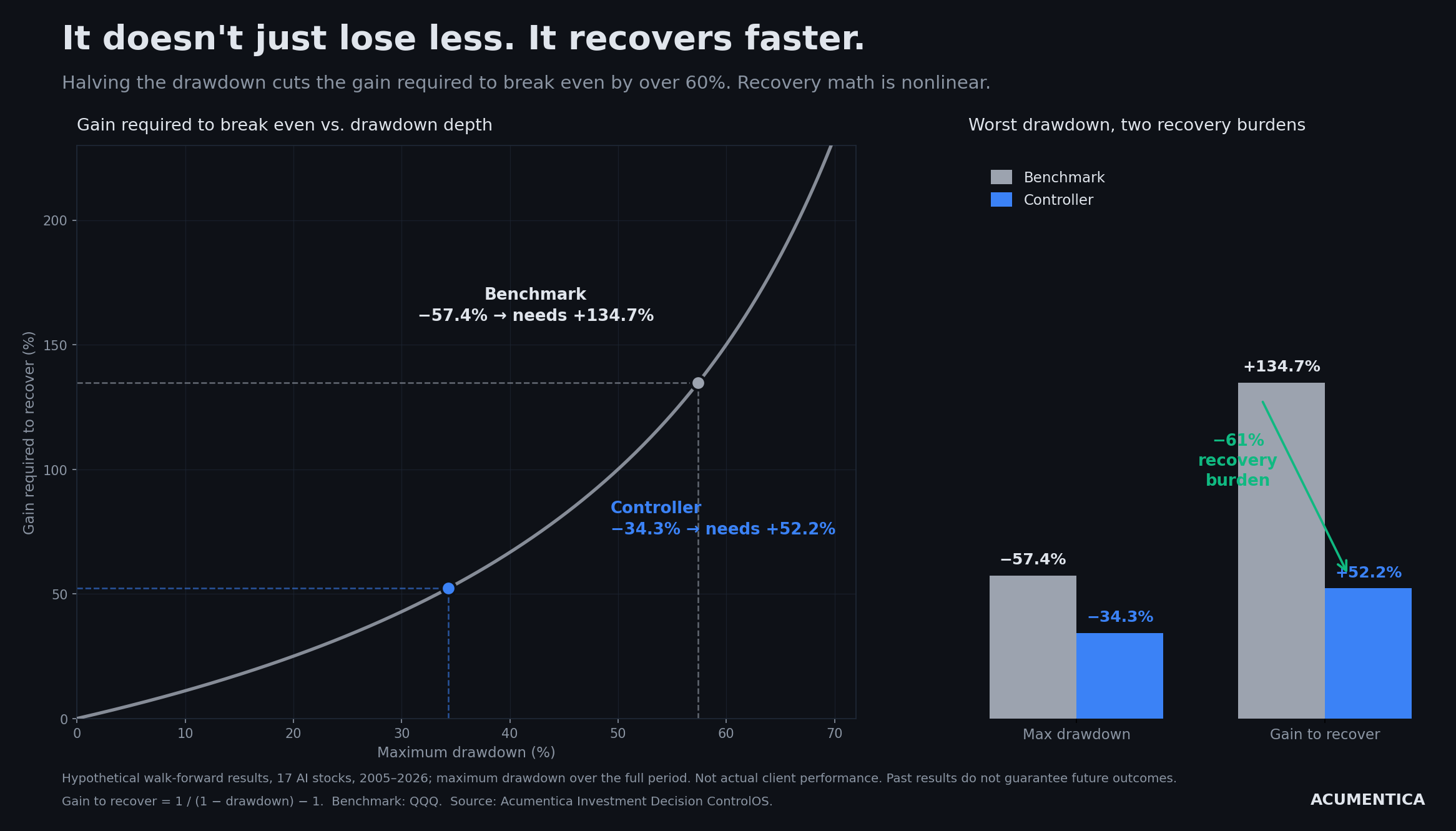
The dot-com bust makes the recovery math impossible to ignore.
A portfolio that loses 88% needs to gain 734% just to break even. A portfolio that loses 40% needs to gain 67%.
That is not a modest difference. That is a different trajectory for the next twenty years of a client’s capital.
The passive investor who held through the dot-com decline needed the market to multiply more than eightfold from the trough just to recover the dollar they started with. QQQ did eventually recover; but it took until 2015 to permanently close above its March 2000 peak. 15 years underwater. Fifteen years of client conversations, fiduciary explanations, and compounded opportunity cost.
The governed investor needed a 67% recovery. That typically takes two to four years in a normal recovery environment. The difference between fifteen years and three years is not a performance detail. It is the difference between a client relationship that survives and one that doesn’t.
This is why Calmar ratio matters more than Sharpe for institutional capital. Sharpe measures smoothness. Calmar measures how much return you generate per unit of drawdown pain. In the dot-com test, the controller delivered a Calmar of −0.30 versus the benchmark’s −0.57. Both negative because the period itself was negative, but the controller generated nearly twice the return per unit of drawdown exposure.
Over long horizons, that gap compounds into entirely different outcomes.
What This Test Does and Does Not Show
This test does not predict that AI will unwind like dot-com did.
Markets may continue higher. AI adoption may continue accelerating. The current leaders may continue delivering earnings growth that justifies their valuations.
The purpose of the test is not merely forecasting. The purpose is preparation.
What the test does show is that structural decision control, applied to a concentrated technology basket during the deepest tech-led decline in modern history, preserved capital that would otherwise have been destroyed. The exposure was reduced before the full extent of the decline became obvious. The audit trail is complete. The decision pathway is reproducible.
This matters because the question for any fiduciary holding today’s concentrated AI exposure is not “will AI unwind.” The question is “what framework governs my exposure if conditions change.” Most portfolios do not have an answer. The dot-com test provides evidence for one answer.
The test also does not suggest the decision controller eliminates all pain. The governed version still lost 40% at its trough. The system is not a hedge. It is a runtime decision control layer that reduces exposure as regime signals deteriorate. During a 32-month unwind, that still produces losses. The losses are survivable. The passive alternative, for a concentrated tech book, often was not.
What It Does Say
If you hold concentrated AI exposure today, and you believe at some point in the next five years there is a meaningful possibility of a reversal in today’s leaders, the dot-com test offers something unusual: concrete evidence of what governance looks like when leadership actually breaks.
Not opinions. Not forecasts. A walk-forward backtest using real stocks through real history during the only real analog event we have.
The passive investor lost 84% of their capital over thirty-two months. The governed investor lost 28.8%.
A $1 investment became $0.16 passively. The governed version preserved $0.71.
Those numbers represent two completely different outcomes for client capital. One is survivable. One, for most institutional mandates, is not.
The purpose of decision control is not to pick tops. The purpose is to preserve Decision Control when the environment that justified concentration ceases to exist.
That is what the controller did during the dot-com bust. That is what it is designed to do if the AI trade reverses.
Why This Matters for CIO’s
Every CIO holding concentrated AI exposure today faces the same fiduciary question.
If the regime changes, what framework governs the response?
Most portfolios rely on judgment; the PM’s judgment, the risk committee’s judgment, the chief investment officer’s judgment. Judgment is valuable. Judgment is also slow during regime transitions, because the human mind defaults to the environment it has recently experienced.
The dot-com decline was not survived by judgment. It was survived by frameworks that could govern exposure faster than conviction could update. The portfolios that preserved capital through 2000 to 2002 almost universally had structural rules — not forecasts — that reduced exposure as conditions deteriorated.
Investment Decision ControlOS is a modern implementation of that principle. It operates as a sovereign Decision Control system that continuously governs exposure based on observable regime signals, independent of narrative conviction. It does not replace the PM. It’s operator-led, and gives the PM a decision pathway that is auditable, reproducible, and already governed when the environment changes.
This is the distinction at the center of Capital Decision Control Infrastructure. Intelligence predicts. Decision Control preserves.
What’s Underneath This
The system is not magic and it is not a black box. It is three layers.
A regime detector reads sixty-three days of market volatility, correlation, and dispersion to classify the current environment. A capital control layer translates that regime read into an equity budget; the amount of the portfolio that should be at risk given current conditions. An optimizer rebalances within that budget, respecting constraints, mandates, and client-specific rules to preserve Constraint Integrity through regime change.
Every decision generates an audit record. If a client asks why their portfolio moved from 95% invested to 55% invested in late 2000, the system shows them the regime signal, the budget calculation, and the rebalancing decision that followed. The PM reviewed it, approved it, and signed off. That is decision control a compliance team can underwrite.
The system has been validated across seven distinct crisis types, five benchmarks, portfolio sizes from ten to forty stocks, every governance preset offered, and the historical dot-com bust presented here. The protection is structural. It does not depend on a specific basket, benchmark, or market environment.
The Bigger Lesson
The dot-com bust taught the market a lesson that gets forgotten every cycle.
Great businesses can lose most of their market value for extended periods, and the losses can compound through investor behavior long after the fundamental case has stabilized. The companies that survived the dot-com decline were not the ones with the best technology or the strongest business models. They were the ones whose investors had frameworks to survive the drawdown without being forced to sell.
AI will likely be bigger than the internet. The AI buildout is probably more durable than the dot-com buildout. The current leaders are, by most measures, higher quality businesses than the dot-com leaders were.
None of that protects a portfolio from a regime change in how the market prices those businesses.
What protects a portfolio is governance. Specifically, governance that detects when the regime that justified a given level of exposure has shifted, and reduces exposure before the shift fully compounds into drawdown.
That is the lesson of 2000 to 2002. That is the lesson Investment Decision ControlOS was built to operationalize for the next regime shift, whenever it arrives.
What To Do Next
If you are a CIO or portfolio manager with concentrated AI exposure today, the dot-com test is the single most relevant historical reference available. The pattern is not identical. The pattern never is. But the structural dynamics — concentration, multiple expansion, narrative conviction, crowded positioning — are closer to today than any other period in modern market history.
We will run your actual portfolio through the same stress test shown here. Your holdings, your weights, your mandates, your constraints. We will show you how the portfolio would have behaved if it had held through March 2000 to October 2002 under Decision Control OS . If the result changes how you think about your current concentration, we will walk through what live deployment looks like.
The goal is not to sell software. The goal is to understand how your portfolio behaves if the AI regime ever ends.
No sales pitch. Just evidence. Request A Decision Control Walkthrough →
Learn More
Explore how the Investment Decision ControlOS establishes a System of Control for institutional investment environments, preserving Decision Integrity, Constraint Integrity, and governed decision pathways across changing market regimes.
Explore how the Capital Decision Control Infrastructure — Category Anchor establishes the governance environment that all enterprise and capital systems operate within.
Learn how the Capital Decision Control Infrastructure — Definition formalizes the discipline of governed intelligence and the fourth‑layer architecture that stabilizes enterprise decision pathways.
Learn how the Agentic AI Control OS stabilizes agentic systems under real‑world constraints.
Decision Control Research Lab
The Decision Control Research Lab researches drift, collapse dynamics, and the Decision‑Control layer; the institutional execution‑governance systems that keep autonomous and enterprise systems stable, aligned, and protected from drift‑driven failure.
Read the companion study: If the AI Trade Breaks, Your Portfolio Doesn’t Have To. Evidence From 21 Years of Market Stress
AI Bubble: Why Investors Should Grab Popcorn Before The Credits Roll
Governed Pathways For Navigating Market Regimes
The CIO Boundary: Why AI Cannot Govern Capital Systems
Why Safety AI Fails Without Regime Adaptation
Sovereign Financial SI – The Domain Where Super Intelligence Becomes Sovereign
Constraint Integrity: Why Enterprise Systems Break Without Deterministic Systems
AI Warning Sign: Cutting Through The Marketing Fluff With Decision Control Discipline
Governed Agentic Enterprise OS | Governing Enterprise Decisions Under Uncertainty
Capital Decision Control Infrastructure | Governing Decision Behavior Under Pressure
Governed Risk and Compliance Decision Control OS
Prescriptive Decision ControlOS: Governing Next actions, Strategic Alignment and Execution Discipline
Investment Research Governance ControlOS: Governing Research Direction & Exploration in Runtime
Portfolio Governance ControlOS: Preventing Portfolio Drift in Runtime
Risk Governance ControlOS: Runtime Enforcement of Institutional Risk Boundaries
AI Hallucination Drift: When AI Creates False Decisions That Break Institutional Governance
Risk Governance: Preventing drift and overrides in Agentic AI execution
Portfolio Drift: When construction and allocation quietly break strategy
Decision Drift: The Institutional Instability CIOs Can’t See
Portfolio Governance: Stabilizing Investment Decisions in Agentic AI Systems
Why Investment Teams Fail: The Missing Governance Layer
What is Capital Decision Control Infrastructure? The New Architecture Wall Street and Enterprises Will Need
The Missing Layer Between Research and Execution: Decision Control
Why Investment Team Drift Under Uncertainty (and How to Stop It)
About Acumentica
Acumentica is a Precision AI-powered Capital Decision Control Infrastructure company.
We help institutions make better decisions under uncertainty and avoid costly mistakes by transforming complex data, risk, and constraints into clear, disciplined next actions. Request A Decision Control Walkthrough →
Acumentica is the steering and braking layer above Intelligence; the part that governs what intelligence does, not just what it predicts.
Acumentica originated the Capital Decision Control Infrastructure and built the first product in that category; the Decision Control OS. We are the first company to introduce governed capital‑control as a market and technology category thesis.
Glossary Reference
See Acumentica’s [Glossary] for canonical definitions.
Decision Control OS: is the operating system that governs SI‑class systems, enforcing constraints, stabilizing execution, and preventing drift across enterprise and national infrastructures.
SI (Superintelligence): intelligence that operates at sovereign‑scale or enterprise‑scale with the ability to govern execution across mandates, constraints, boundaries, exposures, and fiduciary obligations. SI‑class systems require deterministic governance to prevent drift, override, hallucination, and instability.
SI Governance: the discipline that enforces constraints deterministically across enterprise, capital, and national systems to keep superintelligence‑class execution aligned, stable, drift‑free, and mandate‑compliant. It governs future‑intelligence classes, including superintelligence and sovereign‑scale intelligence.
Control Plane: The governance layer that directs agentic systems.
Closed Loop: A feedback system ensuring accountability and correction.
Governed Intelligence: AI systems operating under explicit decision‑control rules.
AI: is task‑level intelligence that performs localized, probabilistic actions such as generating text, classifying data, or automating workflows.
Constraint Integrity: is the enterprise’s ability to enforce constraints deterministically so systems remain aligned with mandates, boundaries, and fiduciary obligations under all conditions.
Institutional Drift: is the silent misalignment that occurs when systems deviate from mandates and constraints, accumulating exposure over time.
Deterministic Governance: ensures systems always obey constraints and mandates, producing stable, predictable, and aligned execution.
Probabilistic AI: generates actions based on statistical inference rather than constraints, making its behavior non‑deterministic and non‑governing.