Research Governance: The Hidden Lever of Institutional Performance in Agentic AI Systems

Author: Ryan D’Souza, CEO Acumentica

Introduction

Agentic AI is no longer a theoretical concept. Institutions are deploying autonomous systems that can generate insights, propose strategies, and even execute decisions. Yet, as these systems expand their reach, CIO’s face a new challenge: how to govern research outputs that may drift from institutional mandates.

This is where research governance becomes the hidden lever of institutional performance. Without it, agentic AI risks producing outcomes that undermine authority, misallocate capital, or destabilize portfolios. With it, institutions can harness innovation while maintaining control.

CIO Pain Points: Why Research Governance Is Urgent

CIOs are already feeling the strain of agentic AI research systems. The pain points are clear:

  • Drift Risk: Research outputs diverge from institutional mandates, creating misaligned strategies.
  • Execution Gap: Agentic AI moves from insight to execution without proper oversight.
  • Capital Misallocation: Research initiatives consume resources without reinforcing institutional priorities.
  • Reputational Risk: Unchecked research outputs can lead to decisions that damage institutional credibility.

These are not abstract risks. They are daily realities for CIOs navigating agentic AI adoption.

What Is Research Governance?

Research governance is the structured oversight of agentic AI research outputs within the Capital Decision Control OS. It ensures that exploration, innovation, and discovery remain tethered to institutional mandates.

Unlike traditional governance frameworks, research governance is not about slowing innovation. It is about stabilizing innovation so that agentic AI becomes an asset, not a liability.

Core Principles of Research Governance

1. Mandate Alignment

Every research initiative must map back to institutional mandates. Without this, agentic AI risks producing outputs that are intellectually interesting but strategically irrelevant.

Example: An AI research system proposes a new investment strategy. Mandate alignment ensures the proposal is evaluated against institutional authority before execution.

2. Override Control

Agentic AI thrives on autonomy, but institutions cannot allow research outputs to bypass approval. Override control ensures that execution remains under institutional authority.

Example: A research output suggests reallocating capital. Override control prevents automatic execution until CIOs validate alignment.

3. Drift Prevention

Drift occurs when research outputs gradually move away from institutional priorities. Continuous monitoring and governance frameworks prevent this by tethering outputs to defined boundaries.

Example: A research system explores alternative asset classes. Drift prevention ensures exploration remains within mandate limits.

4. Cross‑Domain Reinforcement

Research governance does not exist in isolation. It links directly to portfolio governance, risk governance, and mandate governance. Together, these domains form a Capital Decision Control OS that stabilizes agentic AI across the institution.

Case Example: Research Governance in Action

Imagine a global investment institution deploying agentic AI to explore new portfolio strategies.

  • Without research governance: The AI proposes a high‑risk strategy, bypasses oversight, and reallocates capital. The institution suffers losses and reputational damage.
  • With research governance: The AI’s proposal is evaluated against mandates, reinforced by risk governance, and tethered to portfolio governance. The institution benefits from innovation without destabilization.

This is the difference between drift and stability.

Why Traditional Governance Fails

Traditional governance frameworks were designed for human‑led research. They assume oversight is manual, slow, and hierarchical. Agentic AI breaks these assumptions.

  • Speed: Agentic AI produces outputs faster than manual governance can review.
  • Autonomy: Agentic AI can execute without waiting for approval.
  • Complexity: Research outputs span multiple domains simultaneously.

Only a Decision Control OS can embed governance directly into the infrastructure, ensuring stability at agentic speed.

The Capital Decision Control OS Advantage

The Capital Decision Control OS is not just a framework. It is an operating system for institutional governance. Research governance is embedded as a core domain, ensuring:

  • Mandate authority is reinforced.
  • Risk boundaries are respected.
  • Portfolio stability is maintained.
  • Institutional performance is safeguarded.

This is how institutions transform agentic AI from a risk into a governed asset.

Conclusion

Research governance is the hidden lever of institutional performance. Without it, agentic AI risks drift, misalignment, and uncontrolled execution. With it, institutions can unlock innovation while maintaining authority.

By embedding research governance into the Capital Decision Control OS, Acumentica defines the category of governed institutional systems. CIO’s who adopt this model will stabilize agentic AI and secure institutional performance for the long term.

Learn More

If your investment organization is looking to reduce decision drift, strengthen governance, and maintain execution consistency under uncertainty, explore how Acumentica’s Investment Decision ControlOS provides a governed, closed-loop operating layer for institutional investment decision making.

Related Articles

  • Why Investment Teams Drift Under Uncertainty (and How to Stop It)
  • The Missing Layer Between Research and Execution: Decision Control
  • What Is a Capital Decision Control Infrastructure? The New AI Architecture Wall Street and Enterprises Will Need
  • Why Investment Teams Fail: The Missing Governance Layer

About Acumentica

We are a Precision AI-powered Capital Decision Control Infrastructure company.

We help institutions make better decisions under uncertainty and avoid costly mistakes by transforming complex data, risk, and constraints into clear, disciplined next actions. Contact Us 

Acumentica is the creator of the Capital Decision Control Infrastructure and Decision Control OS; the first company to establish governed capital‑control as a technology category.

How the Decision Control OS Governs GTM Execution Under Uncertainty

Author: Ryan D’Souza, CEO Acumentica

GTM teams believe they operate with clear plans, defined targets, and aligned priorities. But when uncertainty rises; market shifts, competitive pressure, pipeline volatility;  GTM execution becomes inconsistent.

Sales teams drift. Marketing teams drift. Product teams drift. Leadership overrides strategy. Execution fragments across functions.

This isn’t a communication problem. It isn’t a leadership problem. It isn’t a “we need better alignment” problem.

It’s a governance problem.

GTM teams drift under uncertainty for the same structural reasons investment teams drift: they operate without a governed system of decision control.

Why GTM Teams Drift Under Uncertainty

Uncertainty affects GTM teams in predictable ways:

1. Targets become flexible instead of fixed

Quarterly goals bend under pressure. Pipeline expectations soften. Forecasts become “ranges.”

2. Strategy loses authority

Teams override strategy because “the market feels different now.”

3. Execution fragments across functions

Sales, marketing, and product interpret the same strategy differently.

4. Overrides accelerate

Leaders make reactive decisions that conflict with the original plan.

This is GTM drift; and it spreads quickly.

The Hidden Cause: GTM Has No Governance Layer

GTM organizations have systems for:

  • CRM
  • analytics
  • forecasting
  • pipeline management
  • attribution
  • reporting

But they do not have systems for:

  • mandate alignment
  • constraint enforcement
  • override governance
  • cross‑functional execution consistency
  • uncertainty stabilization
  • closed‑loop decision control

This is why GTM execution breaks down under pressure.

GTM teams have intelligence. They do not have control.

Why GTM Tools Make Drift Worse

GTM tools;  CRM dashboards, analytics platforms, AI copilots;  increase:

1. Signal velocity

Teams react faster;  often too fast.

2. Signal volume

More dashboards = more interpretations.

3. Override frequency

AI suggestions conflict with strategy.

4. Execution fragmentation

Different functions follow different signals.

GTM tools increase intelligence. They do not govern execution.

Intelligence without control creates instability.

The Missing Layer: A Governed GTM Decision Control OS

GTM teams don’t need more dashboards. They don’t need more analytics. They don’t need more AI.

They need governed execution.

They need a system that:

  • stabilizes GTM decisions under uncertainty
  • enforces GTM mandates
  • prevents cross‑functional drift
  • protects strategy authority
  • synchronizes execution across teams
  • closes the loop between signals and actions

This is what the Capital Decision Control OS provides.

It governs GTM execution the same way it governs investment execution.

How the Decision Control OS Governs GTM Execution

A governed OS stabilizes GTM execution through three mechanisms:

1. Mandate Enforcement

GTM mandates remain fixed even when uncertainty rises.

2. Strategy Authority

Strategy retains priority over reactive signals.

3. Closed‑Loop Execution

Sales, marketing, and product stay synchronized through governed feedback.

This eliminates GTM drift.

The Cost of GTM Drift

GTM drift shows up as:

  • inconsistent messaging
  • contradictory sales motions
  • misaligned product priorities
  • unstable pipeline forecasts
  • reactive leadership overrides
  • performance volatility

By the time drift is visible, the damage is already done.

Governance prevents drift before it spreads.

The Future of GTM Is Governed, Not Just Intelligent

GTM teams have reached the limits of intelligence‑only systems.

They cannot stabilize execution with:

  • more dashboards
  • more analytics
  • more AI
  • more meetings
  • more alignment sessions

These tools increase awareness, not stability.

The next decade belongs to GTM teams that operate inside governed systems of control.

Because intelligence without control is instability. And instability is lost revenue.

Learn More

If your organization is working to eliminate go‑to‑market decision drift, prevent AI‑driven misalignment, and stabilize execution across fast‑moving commercial environments, explore how Acumentica’s GTM Decision ControlOS provides governed, operator‑led decision pathways for revenue, marketing, and growth operations.

Also learn about Acumentica’s governed Agentic AI Control OS, which operates inside the GTM Decision Control OS; executing only through approved, operator‑defined decision pathways to ensure alignment, consistency, and controlled acceleration across all GTM functions.

AGI Research Labs

Decision Drift: The Institutional Instability CIOs Can’t See

Risk Governance: Preventing drift and overrides in Agentic AI execution

Portfolio Governance: Stabilizing Investment Decisions in Agentic AI Systems

Why Investment Teams Fail: The Missing Governance Layer

What is Capital Decision Control Infrastructure? The New Architecture Wall Street and Enterprises Will Need

The Missing Layer Between Research and Execution: Decision Control

Why Investment Team Drift Under Uncertainty (and How to Stop It)

About Acumentica

Acumentica is a Precision AI-powered Capital Decision Control Infrastructure company.

We help institutions make better decisions under uncertainty and avoid costly mistakes by transforming complex data, risk, and constraints into clear, disciplined next actions. Request a demo


Acumentica is the creator of the Capital Decision Control Infrastructure and the Decision Control OS; the first company to establish governed capital‑control as a market and technology category.

What Is Agentic AI?

Author: Ryan D’Souza, CEO Acumentica

What Is Agentic AI?

Agentic AI is being talked about everywhere. But most definitions are vague, incomplete, or misleading.

Some describe it as “autonomous AI.” Others call it “AI that acts.” But none explain the real difference; or the real risk.

So let’s define it clearly.

The Definition: Agentic AI

Agentic AI is intelligence that doesn’t just predict or prescribe. It acts with autonomy. It makes decisions. It executes actions. It interacts with systems. It operates inside workflows.

This is the difference:

  • Generative AI → produces outputs (text, images, code).
  • Agentic AI → executes actions, makes decisions, interacts with systems.

Agentic AI is not just “smarter AI.” It is decision‑making AI.

Why Agentic AI Matters

Agentic AI is powerful because it can:

  • place trades
  • adjust portfolios
  • reallocate budgets
  • launch campaigns
  • approve workflows
  • interact with enterprise systems

But it is also dangerous. Because without governance, agentic AI:

  • drifts from mandates
  • ignores constraints
  • overrides research
  • destabilizes execution
  • creates institutional risk

Agentic AI is not just intelligence. It is decision power. And decision power without control is instability.

The Governance Gap

Agentic AI fails without governance because:

  • mandates collapse under uncertainty
  • overrides accelerate under pressure
  • drift spreads across functions
  • execution fragments across teams

Agentic AI needs a governed operating system to remain stable.

The Solution: Capital Decision‑Control OS and Agentic AI Control OS

Agentic AI becomes unstable without governance.

That’s why Acumentica created the Capital Decision Control OS ; the governed operating system that ensures agentic AI stays aligned with:

  • mandates
  • constraints
  • risk boundaries
  • research authority
  • execution stability

Under the Capital Decision Control OS sits the Agentic AI Capital Control Infrastructure, which implements capital‑grade governance for agentic AI across institutional environments.

Inside that infrastructure lives the Agentic AI Control OS, the layer that:

  • governs recursion and autonomy
  • constrains decision pathways
  • enforces domain‑specific rules
  • stabilizes multi‑agent behavior

Agentic AI without governance destabilizes institutions. Agentic AI inside the Capital Decision Control OS, Agentic AI Capital Control Infrastructure, and Agentic AI Control OS stabilizes them.

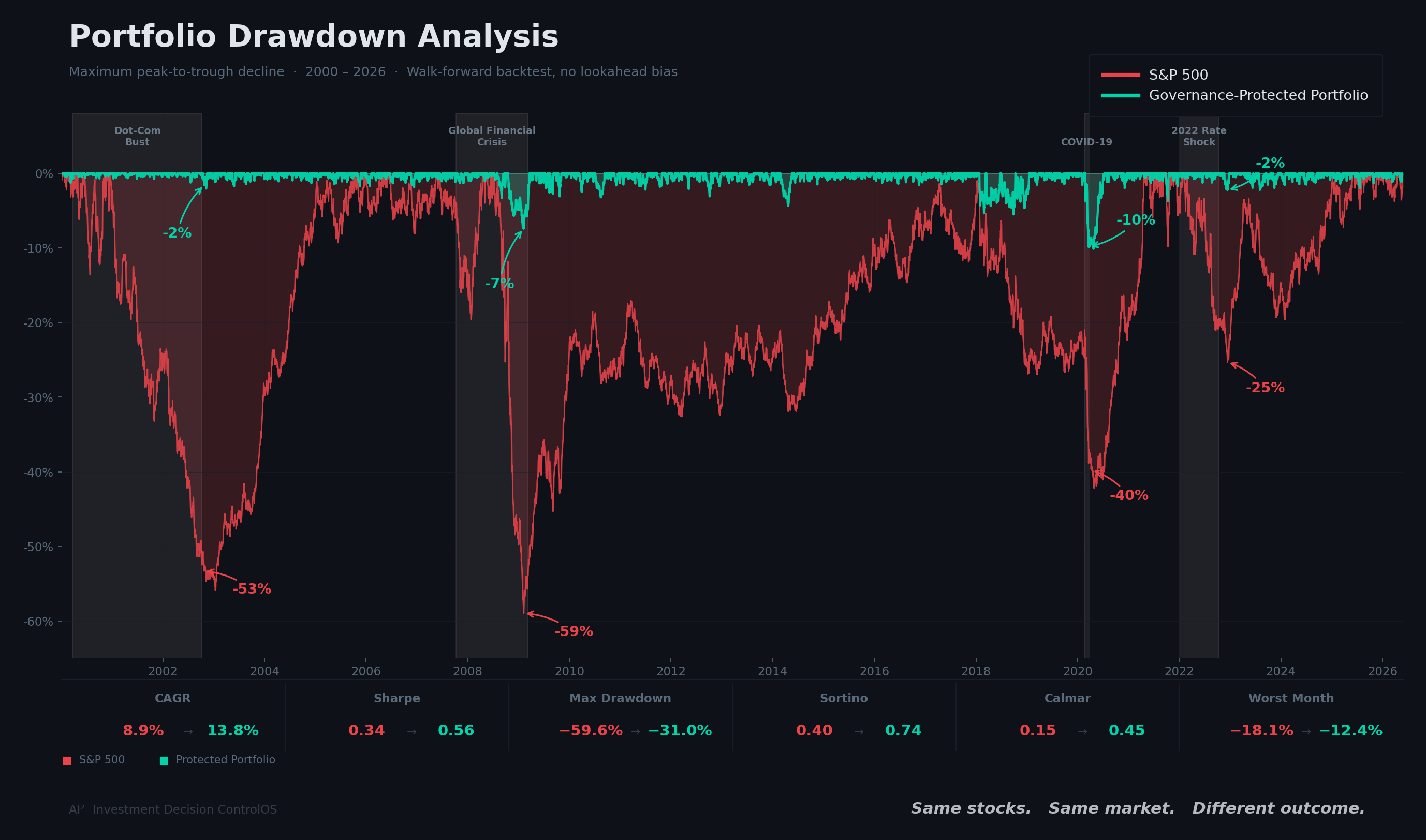
Evidence: Governance Changes Outcomes

Same market. Same signals. Same intelligence.

Without governance → drift, overrides, volatility. With governance → mandate alignment, execution stability, performance consistency.

Governance is the difference.

Conclusion: Agentic AI Needs Control

Agentic AI is not just another buzzword. It is the next frontier of institutional systems.

But agentic AI without governance is risk. Agentic AI with governance is stability.

That’s why the future belongs to institutions that operate inside governed systems of decision control.

Explore Acumentica Agentic AI Control OS

At Acumentica. our Agentic AI introduces a new class of autonomous, recursive intelligence capable of generating actions, plans, and decisions without human prompting. This power demands a governing operating system; one that constrains, stabilizes, and directs agentive behavior inside institutional environments.

The Agentic AI Control OS is the category that defines how agentic AI must be governed.

It establishes the institutional guardrails, recursion‑control architecture, and decision‑control boundaries required for agentic AI to operate safely across industries such as investment, manufacturing, construction, supply chain, and enterprise operations.

This OS transforms agentic AI from an unbounded decision engine into a governed, auditable, and institution‑ready intelligence layer.

Learn More

If your investment organization is looking to eliminate mandate drift, enforce governed authority across all decision systems, stabilize research‑to‑allocation pathways, and maintain execution consistency under uncertainty, explore how Acumentica’s Investment Decision ControlOS provides a governed, operator‑led decision layer for institutional investment execution; ensuring every research insight, construction action, allocation move, and risk adjustment operates within institutional mandates and governed decision pathways. Also Learn about Frida our Agentic AI Investment ControlOS that operates inside the Investment Decision Control OS, using governed decision pathways.

Decision Control Research Lab

Portfolio Drift: When construction and allocation quietly break strategy

Decision Drift: The Institutional Instability CIOs Can’t See

AI Hallucination Drift: When AI Creates False Decisions That Break Institutional Governance

Risk Governance: Preventing drift and overrides in Agentic AI execution

Portfolio Governance: Stabilizing Investment Decisions in Agentic AI Systems

Why Investment Teams Fail: The Missing Governance Layer

What is Capital Decision Control Infrastructure? The New Architecture Wall Street and Enterprises Will Need

The Missing Layer Between Research and Execution: Decision Control

Why Investment Team Drift Under Uncertainty (and How to Stop It)

About Acumentica

Acumentica is a Precision AI-powered Capital Decision Control Infrastructure company.

We help institutions make better decisions under uncertainty and avoid costly mistakes by transforming complex data, risk, and constraints into clear, disciplined next actions. Request a demo

Acumentica is the steering and braking layer above Intelligence; the part that governs what AI does, not just what it predicts.

Acumentica is the creator of the Capital Decision Control Infrastructure and the Decision Control OS; the first company to establish governed capital‑control as a market and technology category.

The Missing Layer in Institutional Decision‑Making: Control, Not More Intelligence

Author: Ryan D’Souza

Every institution believes the answer to instability is more intelligence. More dashboards. More analytics. More AI. More signals. More data.

But intelligence alone does not stabilize decisions. In fact, intelligence without control increases volatility, drift, and overrides.

The missing layer in institutional decision‑making is not more intelligence. It is control.

Why Intelligence Alone Creates Instability

Intelligence expands awareness. But awareness without governance creates instability.

Here’s how intelligence destabilizes institutions:

1. Signal Overload

Too many signals create conflicting interpretations.

2. Override Acceleration

Teams override mandates because “the data feels urgent.”

3. Drift Expansion

Execution fragments as different functions follow different signals.

4. Uncertainty Collapse

When markets shift, intelligence amplifies reactivity instead of stabilizing mandates.

Intelligence increases speed. Control enforces stability.

Why Institutions Keep Adding Intelligence

Institutions assume instability is caused by insufficient awareness. So they add:

  • more dashboards
  • more analytics
  • more AI copilots
  • more reporting layers

But instability is not caused by lack of awareness. It is caused by lack of governance.

Mandates fail not because teams don’t know enough. They fail because nothing enforces them.

The Missing Layer: Control

Control is the layer that:

  • enforces mandates
  • prevents overrides
  • stabilizes execution
  • governs uncertainty
  • closes the loop between research and action

Without control, intelligence accelerates instability. With control, intelligence becomes productive.

Why AI Tools Cannot Provide Control

AI tools generate intelligence. They do not govern decisions.

AI tools:

  • increase signal velocity
  • increase override frequency
  • increase interpretation variance
  • increase urgency

They accelerate drift. They do not prevent it.

Control requires governance. AI tools cannot provide governance.

The Only Way to Stabilize Institutions: A Governed Decision Control System

Institutions remain stable only when decisions are governed by a closed‑loop system that enforces:

  • mandate alignment
  • constraint adherence
  • override governance
  • research authority
  • execution consistency
  • uncertainty stabilization

This is what the Capital Decision‑Control OS provides.

It doesn’t replace intelligence. It governs it.

It doesn’t eliminate uncertainty. It stabilizes decisions inside it.

It doesn’t restrict judgment. It prevents judgment from destabilizing mandates.

Control Is the Missing Layer

Institutions don’t fail because they lack intelligence. They fail because they lack control.

The future belongs to institutions that operate inside governed systems of decision‑control.

Because intelligence without control is instability. And instability cannot govern capital.

Learn More

If your investment organization is looking to reduce decision drift, strengthen governance, and maintain execution consistency under uncertainty, explore how Acumentica’s Capital Decision Control OS provides a governed, closed-loop operating layer for institutional investment decision making.

Related Articles

  • Why Investment Teams Drift Under Uncertainty (and How to Stop It)
  • The Missing Layer Between Research and Execution: Decision Control
  • What Is a Capital Decision Control Infrastructure? The New AI Architecture Wall Street and Enterprises Will Need
  • Why Investment Teams Fail: The Missing Governance Layer

About Acumentica

We are a Precision AI-powered Capital Decision Control Infrastructure company.

We help institutions make better decisions under uncertainty and avoid costly mistakes by transforming complex data, risk, and constraints into clear, disciplined next actions. Contact Us 

Investing 101: Fundamentals of Investing Through Capital AI and Decision Control OS

By Team Acumentica

Investing 101: Fundamentals of Investing Through Capital AI & Decision‑Control OS

Market capitalization

Market capitalization commonly referred to as market cap, is a measure of the total value of a publicly traded company’s outstanding shares. It is calculated by multiplying the current share price by the total number of outstanding shares. Market cap provides a quick estimate of a company’s size and the value the market places on the company, making it a critical tool for investors to gauge a company’s size, growth prospects, and risk profile.

How Market Cap is Used:

  1. Size Classification: Market cap allows investors to classify companies into different size segments:

Large-Cap: Companies with a market cap of $10 billion or more. They are typically industry leaders and are considered relatively stable investments.

Mid-Cap: Companies with a market cap between $2 billion and $10 billion. These companies are in the process of expanding. They offer more growth potential than large-cap stocks, but with increased risk.

Small-Cap: Companies with a market cap between $300 million and $2 billion. These are smaller companies that are often more volatile, but they may offer significant growth potential.

Micro-Cap: Companies with a market cap between $50 million and $300 million. These stocks are generally considered to be highly speculative.

Nano-Cap: Companies with a market cap less than $50 million. These are the smallest companies on the stock market and can be very risky to invest in.

  1. Investment Decision Making: Market cap helps investors determine a company’s financial stability, investor perception, and the scope of operational reach. It affects how stocks are analyzed and chosen in an investment portfolio.


  1. Risk Assessment: Typically, larger companies with higher market caps are considered safer investments compared to smaller companies with lower market caps, as they can often manage economic downturns better due to their resources and market diversification.


  1. Benchmarking Performance: Investors use market cap to compare company performance within sectors or against market indexes. A market index, like the S&P 500 or the NASDAQ, often comprises companies that are selected based on market cap.

Example Calculation:

If a company has 100 million outstanding shares and the current share price is $50, the market cap would be:

\[ \text{Market Cap} = 100,000,000 \, \text{shares} \times \$50/\text{share} = \$5,000,000,000 \]

This means the company’s market cap is $5 billion, classifying it as a mid-cap company.

Market capitalization reflects the market’s perception of a company’s net worth and is a determining factor in some investment strategies, influencing how portfolios are constructed based on different market cap levels.

Circle Of Competence

The concept of the “circle of competence” in investing was popularized by Warren Buffett, one of the most successful investors in history. It refers to the area or range of businesses and investments that an individual thoroughly understands. The idea emphasizes that investors should stick to industries and companies they are knowledgeable about, rather than venturing into areas outside of their expertise.

Key Aspects of the Circle of Competence:

  1. Self-Awareness: The circle of competence requires an investor to be critically aware of what they know and, importantly, what they do not know. It demands an honest assessment of one’s skills, knowledge, and expertise in specific areas.


  1. Risk Reduction: By investing within one’s circle of competence, an investor can reduce the risk of making poor investment decisions that arise from a lack of understanding. Knowledge about a particular sector can provide insights into its growth potential, competitive dynamics, and potential pitfalls.


  1. Focused Investing: This concept encourages investors to focus on a few areas where they have the most insight rather than spreading their investments thin across many areas where they might lack depth of understanding.


  1. Continuous Learning: While it is advisable to invest within one’s circle of competence, Buffett also encourages continuous learning and expansion of one’s circle. As knowledge and experience grow, so too can the circle, allowing for more diversified investment opportunities.

 Application in Investment Strategy:

Specialization: Investors might specialize in specific industries. For example, someone with a background in technology might focus on tech stocks because they understand the business models and market dynamics better than industries where they have less experience.

Due Diligence: Before making investments, thorough research is conducted within the circle of competence. Investors use their deep understanding to evaluate business fundamentals like management quality, financial health, competitive advantages (moats), and market opportunities.

Long-Term Perspective: Investing within one’s circle of competence often aligns with a long-term investment approach. Understanding the nuances of an industry can lead to better predictions about long-term trends and company performance.

Examples:

Warren Buffett often invests in companies that are easy to understand, like Coca-Cola or McDonald’s. He avoids sectors he feels he does not understand well, such as high-tech industries, because he believes his lack of expertise in these areas makes it harder to make informed investment decisions.

In practice, maintaining discipline to invest only within one’s circle of competence can be challenging, especially in times of market euphoria when it seems like everyone is making money in areas outside one’s expertise. However, adhering to this principle can safeguard against common pitfalls that befall less disciplined investors, particularly during market downturns.

Investing In Index Funds

Investing in an index fund is a popular strategy for many investors, particularly those looking for a low-maintenance way to achieve broad market exposure and diversification. Index funds are mutual funds or exchange-traded funds (ETFs) designed to replicate the performance of a specific index. Here’s an overview of what it means to invest in an index, the benefits, and how to get started:

What is an Index Fund?

An index fund is a type of investment fund that aims to replicate the performance of a benchmark index. These indexes could be based on stocks, bonds, commodities, or any number of other asset classes. Common stock indexes include the S&P 500, the NASDAQ Composite, and the Dow Jones Industrial Average.

Benefits of Investing in Index Funds

  1. Diversification: By investing in an index fund, you are purchasing a small piece of all the assets in that index. This broad exposure helps to mitigate risk compared to investing in individual stocks.
  2. Low Cost: Index funds generally have lower expense ratios than actively managed funds because they are not paying analysts and managers to pick stocks. They pass these savings on to investors in the form of higher returns.
  3. Simplicity: Investing in an index fund is straightforward—once you invest, the fund manager replicates the index, and no further action is needed from you to pick individual stocks.
  4. Performance: Historically, index funds have often outperformed actively managed funds after fees and taxes.

How to Invest in Index Funds

  1. Choose Your Index: Decide which index you want to invest in. Consider your financial goals, risk tolerance, and investment timeline. For example, the S&P 500 is popular for those seeking exposure to large-cap U.S. equities.
  2. Select Your Fund Type: Choose between ETFs and mutual funds. ETFs can be traded like stocks throughout the trading day, whereas mutual funds are priced at the end of the trading day.
  3. Pick a Brokerage or Fund Provider: You can buy index funds from most online brokerage accounts or directly from mutual fund companies. Compare fees, ease of use, and available services.
  4. Consider Costs: Look at expense ratios and any potential trading fees. Even small differences in fees can make a big impact over the long term.
  5. Set Up Regular Investments: Consider setting up a regular investment plan to take advantage of dollar-cost averaging, which involves regularly investing a fixed dollar amount regardless of the fund’s share price.

Common Index Funds

Vanguard 500 Index Fund (VFIAX): Tracks the S&P 500; known for very low expense ratios.

Fidelity ZERO Total Market Index Fund (FZROX): Provides exposure to a broad range of U.S. stocks with zero expense ratio.

-iShares Russell 2000 ETF (IWM): Tracks the Russell 2000 index, which is composed of small-cap U.S. equities.

Additional Considerations

Tax Efficiency: ETFs are generally more tax-efficient than mutual funds due to how they are structured and managed.

Investment Strategy: Index investing is best suited for long-term investors who are looking for growth over time and can tolerate short-term market fluctuations.

By investing in index funds, you can gain easy access to a wide array of assets, maintaining a balanced and diversified portfolio with minimal effort. This approach is highly recommended for both novice and experienced investors seeking to align with market performance.

Auction Driven Market

An auction-driven market, also known as a price-driven or order-driven market, is a type of financial market where buyers and sellers submit orders to buy or sell assets, and transactions occur based on these orders without the intervention of market makers or specialists. Prices are determined purely by supply and demand dynamics as the market participants place bids and offers.

Key Features of an Auction Driven Market:


  1. Order Book: This market uses an electronic list of buy and sell orders for specific securities or financial instruments organized by price level. The order book is continuously updated in real time, reflecting new orders, executed orders, and cancelled orders.


  1. Matching Orders: Trades are facilitated by matching buy orders (bids) with sell orders (asks) based on price and time priority. The highest price bids and lowest price asks get priority.


  1. Transparency: Auction-driven markets often provide a high level of transparency as all market participants can see the existing bids and offers at different price levels in the order book.


  1. No Market Makers: Unlike quote-driven markets, where market makers provide bid and ask prices, an auction market relies entirely on the orders placed by participants. This means there is no intermediary guaranteeing liquidity or prices.


  1. Price Discovery: Efficient price discovery as prices reflect the real-time sentiment of all market participants about the value of the securities based on supply and demand.

Types of Orders in an Auction Driven Market:

Market Orders: Orders to buy or sell immediately at the best available current price.

Limit Orders: Orders to buy or sell at a specific price or better. These orders only execute if the market reaches the limit price.

Stop Orders: Orders that become market orders once a specified price level is reached.

Examples of Auction Driven Markets:

Stock Exchanges: Most modern stock exchanges (e.g., NYSE, NASDAQ) operate on an auction-driven format, especially for opening and closing trades.

Foreign Exchange: The Forex market is primarily auction-driven, operating virtually 24/7 through a global network of banks and brokers.

Advantages of Auction Driven Markets:

Fairness: All participants have equal access to information and trades are executed impartially based on price and time priorities.

Efficiency: The market quickly assimilates information from all participating buyers and sellers to establish the market price.

Depth of Market: Provides insight into the trading activity and market sentiment by displaying depth of the market and potential price movements.

Disadvantages:

Liquidity Concerns: In less active markets, the lack of market makers can mean less liquidity and higher volatility.

Complex for New Investors: The transparency and speed can be overwhelming for new investors who are not familiar with the dynamic nature of auction markets.

Overall, auction-driven markets are foundational to modern financial systems, facilitating an efficient mechanism for the exchange of assets while providing participants with a transparent and equitable trading environment.

In an auction-driven market, where prices are determined directly by the bids and asks of participants without market makers, the concepts of underpricing and overpricing are particularly salient. These terms relate to the value of securities as perceived by the market participants versus their fundamental or intrinsic value. Here’s a breakdown of how underpricing and overpricing occur in such markets:

Underpricing

Underpricing happens when a security is sold at a price lower than its perceived fundamental value. This can occur due to several reasons:

Lack of Information: If participants are not fully aware of all the relevant information about a security, they might not bid it up to its true value.

Risk Aversion: In times of high uncertainty or market volatility, investors might be wary of holding risky assets, leading to lower bids even if the fundamentals are strong.

Opening Prices: New listings, such as IPOs, might be initially underpriced due to conservative pricing strategies to ensure the market absorbs the full offering.

Market Sentiment: Negative sentiment or pessimism, even if unfounded, can lead to lower prices than fundamentals would justify.

Overpricing

Overpricing occurs when a security’s market price is higher than its fundamental value. This might happen due to:

Speculation: Traders may drive up prices beyond intrinsic values based on speculative future gains rather than current fundamentals.

Information Asymmetries: Sometimes, certain market participants might have, or are perceived to have, more or better information, which can lead to higher pricing based on assumptions of knowledge.

Market Sentiment: Positive market sentiment or hype, especially around certain sectors or stocks, can lead to inflated prices.

Liquidity: High liquidity can sometimes contribute to overpricing if it leads to increased buying without regard for the underlying value.

Market Efficiency and Price Discovery

Auction-driven markets are typically efficient in their price discovery due to the transparent nature of the bidding process, which allows all available information to be factored into the price quickly. However, efficiency doesn’t always equate to accuracy:

Short-term Fluctuations: Prices can fluctuate widely over the short term due to tactical trading behaviors rather than changes in fundamental values.

Long-term Accuracy: Over the long term, prices tend to converge more closely with fundamental values as temporary market emotions and speculative bubbles dissipate.

Implications for Traders and Investors

Traders and investors need to be vigilant about the potential for underpricing and overpricing:

Research and Analysis: Performing thorough fundamental analysis or relying on technical indicators can help identify when a security might be under or overvalued.

Market Timing: Understanding market conditions and sentiment can help in deciding the best times to buy or sell to capitalize on or avoid the effects of mispricing.

Risk Management: Establishing strong risk management strategies is crucial, especially in highly volatile or speculative markets where overpricing might lead to sudden corrections.

Understanding the dynamics of underpricing and overpricing in auction-driven markets is vital for anyone involved in trading or investing, as it directly affects decision-making and potential returns on investments.

Growth Engines

When investing with a long-term perspective, focusing on “long growth engines, secular tailwinds, and strong management” is a strategic approach that can yield substantial returns. Let’s break down what each of these elements means and how to identify and invest in companies that exhibit these characteristics:

Long Growth Engines

These are the core aspects of a business that can drive sustained growth over an extended period. Industries with long growth engines often have enduring demand for their products or services, continuous innovation, and the ability to scale effectively. Examples include technology, healthcare, and renewable energy sectors.

Identifying Long Growth Engines:

Market Trends: Look for industries that are aligned with long-term global or regional trends such as digital transformation, aging populations, or sustainability.

Innovation Potential: Companies that consistently invest in research and development and that patent new technologies are often well-positioned for long-term growth.

Financial Health: Consistent revenue growth, healthy profit margins, and strong balance sheets are indicators of companies capable of sustaining growth.

Secular Tailwinds

Secular tailwinds are macroeconomic or societal trends that drive growth across an entire industry or sector over many years, regardless of economic cycles. These could include demographic shifts, technological advancements, and changes in consumer behavior.

Capitalizing on Secular Tailwinds:

Demographic Changes: Investing in healthcare or retirement services in countries with aging populations.

Technological Adoption: Companies that benefit from the widespread adoption of emerging technologies such as artificial intelligence, cloud computing, or electric vehicles.

Regulatory Changes: Businesses that stand to gain from new regulations or policies, such as renewable energy companies benefiting from government incentives.

Strong Management

The importance of skilled, experienced, and visionary leadership cannot be overstated. Strong management is crucial for navigating challenges, seizing opportunities, and executing long-term strategic plans effectively.

Evaluating Management Quality:

Track Record: Look at the historical performance of the company under the current management team. Successful past initiatives and problem-solving are positive signs.

Communication: Effective communication with stakeholders and clarity of vision are hallmarks of good leadership.

Adaptability: Leaders who have demonstrated the ability to adapt to changing industry conditions and have steered the company through tough times are valuable.

Investment Strategies:

Diversified Portfolio: While focusing on sectors with long growth engines and secular tailwinds, it’s crucial to maintain a diversified portfolio to mitigate risks.

Long-term Horizon: Invest with a long-term horizon, considering that real growth and substantial returns from sectors benefiting from secular trends may take time to materialize.

Regular Review: Continuously monitor the performance and strategic direction of the companies to ensure they remain aligned with long-term goals and are effectively managed.

Tools and Approaches:

ETFs and Mutual Funds: Consider investing in ETFs or mutual funds focused on specific themes or sectors that match long growth engines and secular tailwinds. This can provide exposure while reducing the risk of individual stock selection.

Continuous Learning: Stay informed about global economic trends, technological advancements, and industry news to spot emerging opportunities.

By focusing on companies and sectors powered by long growth engines, benefiting from secular tailwinds, and led by strong management, investors can position their portfolios to capitalize on long-term growth opportunities, ultimately achieving substantial returns over time.

To find stocks that encapsulate long-term growth engines, are propelled by secular tailwinds, and are managed by strong leadership, we should look at industries and companies that are well-positioned for sustained growth based on current and foreseeable trends. Here are several sectors and examples of companies within those sectors that match these criteria:

  1. Technology

The technology sector is renowned for its rapid growth and innovation, continuously transforming how we work, communicate, and live.

NVIDIA (NVDA): A leader in graphics processing units (GPUs) essential for gaming, data centers, and AI applications. NVIDIA is well-positioned to benefit from the growth in AI and cloud computing.

Alphabet (GOOGL): Beyond its dominance in search, Alphabet is a major player in AI, autonomous driving through Waymo, and cloud computing, all areas with significant long-term growth potential.

Healthcare

With innovations in biotechnology, healthcare IT, and an aging global population, the healthcare sector is expected to grow significantly.

UnitedHealth Group (UNH): Offers health insurance services, data analytics, and healthcare services, positioning it well in a sector that is expanding due to demographic trends and healthcare needs.

Intuitive Surgical (ISRG): A pioneer in robotic-assisted surgery, Intuitive Surgical benefits from both technological innovation and increasing acceptance of minimally invasive surgeries worldwide.

2. Renewable Energy

As the global economy shifts towards sustainable energy, companies in the renewable energy sector stand to gain from regulatory support and changing consumer preferences.

NextEra Energy (NEE): The world’s largest producer of wind and solar energy. It is well-positioned to capitalize on the growing shift toward renewable energy sources.

Enphase Energy (ENPH): A leading supplier of solar microinverters, benefiting from the global adoption of solar technology.

3. Electric Vehicles (EV) and Autonomous Driving

This sector is set to transform the automotive industry with significant investments and rapid technological advancements.

Tesla (TSLA): A leader in electric vehicles, Tesla is at the forefront of the EV market and also involved in battery technology and autonomous driving solutions.

NIO Inc. (NIO): A Chinese automobile manufacturer specializing in designing and developing electric vehicles, NIO is expanding its global footprint in the fast-growing EV market.

4. E-Commerce and Digital Payments

Online shopping and digital transactions have become ubiquitous, with tremendous growth potential as more of the world’s population comes online.

Amazon (AMZN): Dominates the global e-commerce landscape and continues to expand into new sectors like cloud computing, digital streaming, and artificial intelligence.

PayPal (PYPL): A leader in digital payments, benefiting from the increase in online shopping and the global shift toward cashless transactions.

Investment Considerations

When evaluating these stocks:

Look for Sustainable Competitive Advantages: Companies with a moat (sustainable competitive advantages) are better positioned to fend off competition.

Examine Financial Health: Review financial statements for profitability, debt levels, and cash flow stability.

Leadership and Corporate Governance: Assess the quality of management and board structures.

Each of these companies is considered a leader in industries that are likely to see long-term growth due to technological advances, demographic shifts, or changes in consumer behavior. They also demonstrate strong management, which is crucial for navigating future challenges and seizing opportunities. Investing in such stocks should be done with a long-term perspective, considering broader market conditions and individual financial goals.

2026 Update: How Investing 101 Connects to Acumentica’s Investment Decision‑Control OS

Investing fundamentals have evolved beyond simple diversification and risk‑return tradeoffs. Modern investment environments operate as decision systems, where every allocation, rebalance, and exposure shift must remain governed, stable, and aligned with constraints.

Acumentica’s Investment Decision Control OS provides the governed‑autonomy layer that ensures even beginner‑level investment decisions remain:

  • risk‑consistent
  • mandate‑aligned
  • exposure‑stable
  • drift‑free
  • auditable
  • predictable

Traditional investing teaches what to do. The Decision Control OS governs how decisions behave over time.

Inside the OS, Frida, Acumentica’s Agentic AI, executes governed decision pathways that prevent drift, stabilize exposure, and ensure every autonomous action remains within fiduciary and regulatory boundaries — even for foundational investment strategies.

This update contextualizes the original article within Acumentica’s modern architecture, where investing fundamentals connect directly to governed capital decision systems.

Learn More

If your institution is experiencing allocation drift, inconsistent exposures, or unstable investment behavior — even at the foundational level — explore how Acumentica’s Investment Decision Control OS governs construction, allocation, and execution to eliminate drift across all investment strategies.

Also learn about Frida, Acumentica’s Agentic AI ControlOS that operates inside the Investment Decision‑Control OS, using governed decision pathways to stabilize capital decisions from beginner‑level fundamentals to advanced institutional strategies.

Decision Control Research Lab

The Decision Control Research Lab researches drift, collapse dynamics, and the Decision‑Control layer; the institutional execution‑governance systems that keep autonomous and enterprise systems stable, aligned, and protected from drift‑driven failure.

AI Hallucination Drift: When AI Creates False Decisions That Break Institutional Governance

Risk Governance: Preventing drift and overrides in Agentic AI execution

Portfolio Drift: When construction and allocation quietly break strategy

Decision Drift: The Institutional Instability CIOs Can’t See

Portfolio Governance: Stabilizing Investment Decisions in Agentic AI Systems

Why Investment Teams Fail: The Missing Governance Layer

What is Capital Decision Control Infrastructure? The New Architecture Wall Street and Enterprises Will Need

The Missing Layer Between Research and Execution: Decision Control

Why Investment Team Drift Under Uncertainty (and How to Stop It)

About Acumentica

Acumentica is a Precision AI-powered Capital Decision Control Infrastructure company.

We help institutions make better decisions under uncertainty and avoid costly mistakes by transforming complex data, risk, and constraints into clear, disciplined next actions. Request a demo

Acumentica is the steering and braking layer above Intelligence; the part that governs what intelligence does, not just what it predicts.

Acumentica originated the Capital Decision Control Infrastructure and built the first product in that category; the Decision Control OS. We are the first company to introduce governed capital‑control as a market and technology category thesis.