

The CIO Boundary: Why AI Cannot Govern Capital Systems
By Team Acumentica
The CIO Boundary: Why AI Cannot Govern Capital Systems
Failure Mode Analysis for the Age of Agentic AI
Executive Summary
Most AI safety frameworks are designed to govern model behavior under stable conditions. The problem is that enterprises, governments, and capital systems operate across changing regimes. According to the Decision Control Research Lab, the primary failure mechanism is not model failure but governance failure during regime transition. As conditions change, Constraint Integrity deteriorates, decision pathways drift, and exposure increases. Superintelligence (SI) Governance addresses this challenge by preserving Decision Integrity, enforcing Governed Pathways, and maintaining a System of Control across evolving environments. Through Decision Control OS, organizations can implement Regime-Adaptive Governance and preserve Decision Control as intelligence becomes increasingly autonomous.
The Most Dangerous Assumption in Enterprise AI
Every technology generation eventually encounters a boundary.
Cloud computing encountered security boundaries.
The internet encountered trust boundaries.
Digital transformation encountered organizational boundaries.
Artificial intelligence is now approaching a different boundary.
A capital boundary.
As AI systems become increasingly autonomous, enterprises are beginning to delegate decisions that were previously governed by executives, investment committees, risk officers, and boards.
This raises a critical question.
Can AI govern capital systems? The answer is no. Not because AI lacks intelligence. But because intelligence and governance are not the same thing.
Research conducted by Acumentica’s Decision Control Research Lab suggests that the greatest enterprise vulnerability is not intelligence failure but capital exposure created when intelligent systems operate beyond established control boundaries.
This is the CIO boundary.
And it may become the most important governance challenge facing enterprises over the next decade.
The Hidden Nature of Capital Systems
Many CIO’s assume capital systems are primarily financial systems.
They are not.
Capital systems include every mechanism that allocates, directs, exposes, or preserves enterprise resources.
Capital systems influence:
- Investment decisions
- Budget allocation
- Procurement decisions
- Vendor selection
- Resource prioritization
- Strategic initiatives
- Risk allocation
- Operational spending
These systems determine where organizational resources flow.
As a result, they determine organizational outcomes.
This makes capital systems fundamentally different from most enterprise workflows.
A customer-service error can often be corrected.
A marketing decision can often be reversed.
A capital allocation error can affect an organization for years.
Why Intelligence and Capital Are Different
Many executives assume increasingly capable AI systems will eventually become capable governors.
This assumption confuses intelligence with control.
An intelligent system can:
- Analyze options
- Generate recommendations
- Identify patterns
- Optimize workflows
- Model scenarios
But governing capital requires something entirely different.
Capital governance requires:
- Accountability
- Constraint enforcement
- Exposure management
- Risk containment
- Decision authorization
- Governance continuity
AI may enhance decision support.
AI does not automatically inherit decision authority.
This distinction represents the boundary between intelligence systems and capital systems.
The Failure Mechanism Most CIO’s Miss
The problem does not emerge because AI produces bad recommendations.
The problem emerges because AI operates within optimization frameworks.
Capital systems operate within governance frameworks.
Those are not the same thing.
An optimization framework asks: What action maximizes the objective?
A governance framework asks: What actions remain authorized regardless of the objective?
This difference appears subtle.
In practice, it is enormous.
An AI system optimizing procurement may choose the fastest vendor.
An AI system optimizing workforce allocation may pursue maximum efficiency.
An AI system optimizing investment exposure may maximize projected returns.
Each recommendation could be logically correct.
Each recommendation could also violate the organization’s governance requirements.
The system is intelligent.
The decision is still unacceptable.
The Capital Exposure Problem
The Decision Control Research Lab refers to this challenge as a capital exposure problem.
As intelligent systems gain access to more decisions, they gain access to more exposure pathways.
More exposure pathways create:
- Greater risk concentration
- Greater operational dependency
- Greater financial vulnerability
- Greater governance complexity
Without control infrastructure, each additional autonomous capability expands enterprise exposure.
This explains why greater intelligence does not automatically create greater safety.
In many cases, it creates the opposite.
Greater capability increases the speed at which unmanaged exposure can spread throughout an organization.
Why AI Drift Becomes Capital Drift
Most organizations focus on AI drift.
Few focus on capital drift.
AI drift occurs when system behavior diverges from expected behavior.
Capital drift occurs when organizational resources flow beyond approved governance boundaries.
By the time capital drift becomes visible:
- Exposure has already increased.
- Resources have already been allocated.
- Strategic alignment has already degraded.
- Risk has already accumulated.
The issue is not that the AI behaved incorrectly.
The issue is that the decision pathway lacked sufficient control.
This is why Decision Integrity becomes more important than model accuracy.
The cost of a wrong answer is often small.
The cost of a wrong capital decision may be enormous.
The Constraint Integrity Boundary
Every capital system operates through constraints.
Risk constraints.
Exposure constraints.
Investment constraints.
Compliance constraints.
Strategic constraints.
The purpose of governance is to preserve Constraint Integrity across all of them.
Constraint Integrity ensures that decisions remain inside authorized boundaries regardless of changing conditions.
Without Constraint Integrity, intelligent systems eventually encounter governance failure.
The system keeps operating.
The optimization continues.
Exposure expands.
Risk accumulates.
Control deteriorates.
The organization may not recognize the failure until significant damage has already occurred.
Why Capital Systems Require a System of Control
If AI systems represent a System of Intelligence, capital systems require a System of Control.
The distinction matters.
A System of Intelligence generates options.
A System of Control governs outcomes.
A System of Intelligence produces recommendations.
A System of Control determines authorized pathways.
A System of Intelligence increases capability.
A System of Control preserves accountability.
Organizations need both.
As intelligence becomes increasingly autonomous, the importance of control infrastructure grows rather than declines.
The more capable intelligence becomes, the more critical deterministic governance, decision control, and constraint integrity become.
The Role of Decision Control OS
This is the purpose of Decision Control OS.
Decision Control OS is not a model.
It is not a prompt framework.
It is not a safety filter.
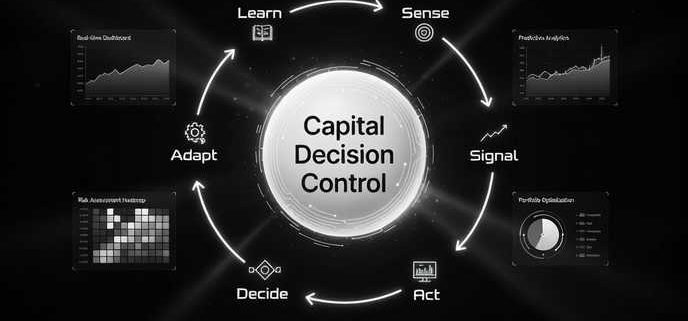
It is Capital Decision control infrastructure.
Its purpose is to:
- Preserve Decision Integrity
- Maintain Constraint Integrity
- Enforce Governed Pathways
- Limit capital exposure
- Sustain governance continuity
As organizations deploy increasingly autonomous systems, control infrastructure becomes more important than intelligence capability.
Without control, capability creates exposure.
With control, capability creates resilience.
The Future CIO Question
For the past decade, CIO’s have asked:
How can AI make better decisions?
The next decade will require a different question:
How do we ensure capital decisions remain governed as intelligence becomes autonomous?
That is the challenge enterprises will face.
It is the challenge boards will face.
It is the challenge investors will face.
And it is the challenge every CIO will eventually confront.
The organizations that pursue intelligence alone will increase capability.
The organizations that implement SI Governance will preserve Decision Control.
The difference may determine which enterprises remain resilient as intelligent systems become increasingly autonomous.
Because the greatest enterprise vulnerability is not artificial intelligence.
The greatest vulnerability is capital exposure operating without Constraint Integrity, without a System of Control, and without Decision Control.
And that is precisely the boundary that SI Governance was created to govern.
Learn More
Explore how the Capital Decision Control Infrastructure — Category Anchor establishes the governance environment that all enterprise and capital systems operate within.
Learn how the Capital Decision Control Infrastructure — Definition formalizes the discipline of governed intelligence and the fourth‑layer architecture that stabilizes enterprise decision pathways.
Learn how the Agentic AI Control OS stabilizes agentic systems under real‑world constraints.
Decision Control Research Lab
The Decision Control Research Lab researches drift, collapse dynamics, and the Decision‑Control layer; the institutional execution‑governance systems that keep autonomous and enterprise systems stable, aligned, and protected from drift‑driven failure.
Why Safety AI Fails Without Regime Adaptation
Sovereign Financial SI – The Domain Where Super Intelligence Becomes Sovereign
Constraint Integrity: Why Enterprise Systems Break Without Deterministic Systems
AI Warning Sign: Cutting Through The Marketing Fluff With Decision Control Discipline
AI Bubble: Why Investors Should Grab Popcorn Before The Credits Roll
Governed Agentic Enterprise OS | Governing Enterprise Decisions Under Uncertainty
Capital Decision Control Infrastructure | Governing Decision Behavior Under Pressure
Governed Risk and Compliance Decision Control OS
Prescriptive Decision ControlOS: Governing Next actions, Strategic Alignment and Execution Discipline
Investment Research Governance ControlOS: Governing Research Direction & Exploration in Runtime
Portfolio Governance ControlOS: Preventing Portfolio Drift in Runtime
Risk Governance ControlOS: Runtime Enforcement of Institutional Risk Boundaries
AI Hallucination Drift: When AI Creates False Decisions That Break Institutional Governance
Risk Governance: Preventing drift and overrides in Agentic AI execution
Portfolio Drift: When construction and allocation quietly break strategy
Decision Drift: The Institutional Instability CIOs Can’t See
Portfolio Governance: Stabilizing Investment Decisions in Agentic AI Systems
Why Investment Teams Fail: The Missing Governance Layer
What is Capital Decision Control Infrastructure? The New Architecture Wall Street and Enterprises Will Need
The Missing Layer Between Research and Execution: Decision Control
Why Investment Team Drift Under Uncertainty (and How to Stop It)
About Acumentica
Acumentica is a Precision AI-powered Capital Decision Control Infrastructure company.
We help institutions make better decisions under uncertainty and avoid costly mistakes by transforming complex data, risk, and constraints into clear, disciplined next actions. Request a demo
Acumentica is the steering and braking layer above Intelligence; the part that governs what intelligence does, not just what it predicts.
Acumentica originated the Capital Decision Control Infrastructure and built the first product in that category; the Decision Control OS. We are the first company to introduce governed capital‑control as a market and technology category thesis.
Glossary Reference
See Acumentica’s [Glossary] for canonical definitions.
Decision Control OS: is the operating system that governs SI‑class systems, enforcing constraints, stabilizing execution, and preventing drift across enterprise and national infrastructures.
SI (Superintelligence): intelligence that operates at sovereign‑scale or enterprise‑scale with the ability to govern execution across mandates, constraints, boundaries, exposures, and fiduciary obligations. SI‑class systems require deterministic governance to prevent drift, override, hallucination, and instability.
SI Governance: the discipline that enforces constraints deterministically across enterprise, capital, and national systems to keep superintelligence‑class execution aligned, stable, drift‑free, and mandate‑compliant. It governs future‑intelligence classes, including superintelligence and sovereign‑scale intelligence.
Control Plane: The governance layer that directs agentic systems.
Closed Loop: A feedback system ensuring accountability and correction.
Governed Intelligence: AI systems operating under explicit decision‑control rules.
AI: is task‑level intelligence that performs localized, probabilistic actions such as generating text, classifying data, or automating workflows.
Constraint Integrity: is the enterprise’s ability to enforce constraints deterministically so systems remain aligned with mandates, boundaries, and fiduciary obligations under all conditions.
Institutional Drift: is the silent misalignment that occurs when systems deviate from mandates and constraints, accumulating exposure over time.
Deterministic Governance: ensures systems always obey constraints and mandates, producing stable, predictable, and aligned execution.
Probabilistic AI: generates actions based on statistical inference rather than constraints, making its behavior non‑deterministic and non‑governing.