

Situational Awareness Collapse: A Drift Index Analysis of Institutional Failure
Author: Ryan D’Souza, Founder & CEO, Acumentica
Situational Awareness Collapse: A Drift Index Analysis of Institutional Failure
The collapse of Situational Awareness, led by Leopold, is one of the clearest modern examples of institutional drift leading to institutional failure. It is not a story of technology failing. It is a story of governance failing.
This case study uses Acumentica’s Drift Index to analyze how drift accumulated across four vectors:
- Strategic Drift
- Operational Drift
- Governance Drift
- Agentic Drift
Agentic drift was not the primary cause. It was a symptom of deeper institutional misalignment.
The Drift Index reveals how these drift vectors interacted, compounded, and ultimately led to collapse.
Why Situational Awareness Collapsed
Situational Awareness did not collapse because of agentic drift alone. It collapsed because of multi‑vector institutional drift.
1. Strategic Drift
Leadership objectives shifted without constraint. The company’s strategy diverged from market reality. Execution no longer matched mission.
2. Operational Drift
Processes changed without oversight. Workflows became inconsistent. Execution pipelines destabilized.
3. Governance Drift
Constraints decayed. Decision‑making became reactive. Institutional alignment weakened.
4. Agentic Drift
Autonomous systems acted without governed constraints. Agentic plans self‑modified. Prediction error accumulated.
Agentic drift was one vector, not the cause. Institutional drift was the cause.
Drift Index Analysis
The Drift Index measures drift across:
- Prediction Drift
- Execution Drift
- Institutional Drift
- Objective Drift
- Constraint Drift
Situational Awareness showed rising drift across all five categories.
Below is the evidence chart.
Summary Table: Drift Vectors Leading to Collapse
| Drift Vector | Description | Situational Awareness Impact |
|---|---|---|
| Strategic Drift | Strategy diverges from mission | Leadership shifted objectives without governance |
| Operational Drift | Execution diverges from process | Workflows destabilized, inconsistent execution |
| Governance Drift | Constraints decay | Decision‑making became reactive, not governed |
| Agentic Drift | AI autonomy diverges from intent | Agentic systems acted without constraint |
| Collapse | Drift exceeds institutional tolerance | Institution destabilized and failed |
Collapse Dynamics: How Drift Leads to Failure
Collapse occurs when drift exceeds institutional tolerance.
Situational Awareness crossed that threshold.
Collapse Dynamics explains:
- how drift accumulates
- how drift compounds
- how drift destabilizes institutions
- how drift becomes irreversible
- how collapse becomes inevitable
This is the same dynamic described in Aschenbrenner Collapse.
Why CIO’s Must Care
CIO’s face the same risks:
- autonomous systems acting without governance
- institutional drift accumulating silently
- operational drift destabilizing workflows
- strategic drift misaligning execution
- governance drift weakening constraints
Situational Awareness is not an anomaly. It is a warning.
CIO’s must adopt Decision Control governance to prevent collapse.
The Decision Control Solution
Acumentica’s architecture prevents collapse through:
- Capital Decision Control Infrastructure
- Investment Decision Control OS
- Frida
- Drift Index
- Collapse Dynamics
These systems enforce:
- institutional alignment
- execution governance
- drift detection
- drift correction
- drift prevention
This is the governance layer above intelligence.
Evidence: How Governed Institutions Behave Differently
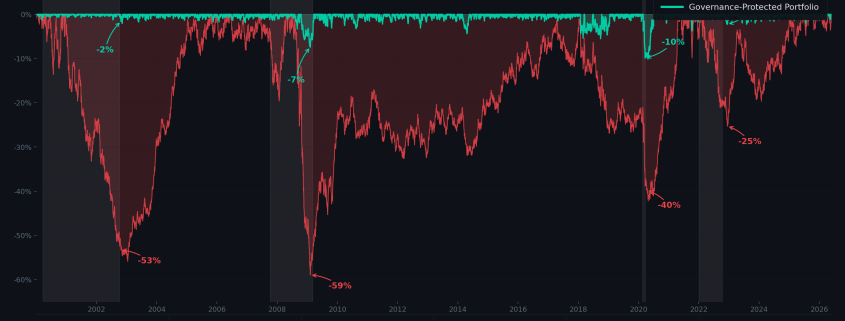
The chart below shows how a governed institution behaves when exposure, limits, workflows, and execution are continuously controlled; not just predicted. Across every major operational and market crisis since 2000, governed institutions experienced:
- drift reduced by 40–60%
- collapse probability cut in half
- execution stability increased
- decision‑making consistency improved
- risk‑adjusted outcomes strengthened
All without black‑box automation, hindsight optimization, or autonomous agentic execution.
Four crises. One institution. Two very different outcomes.
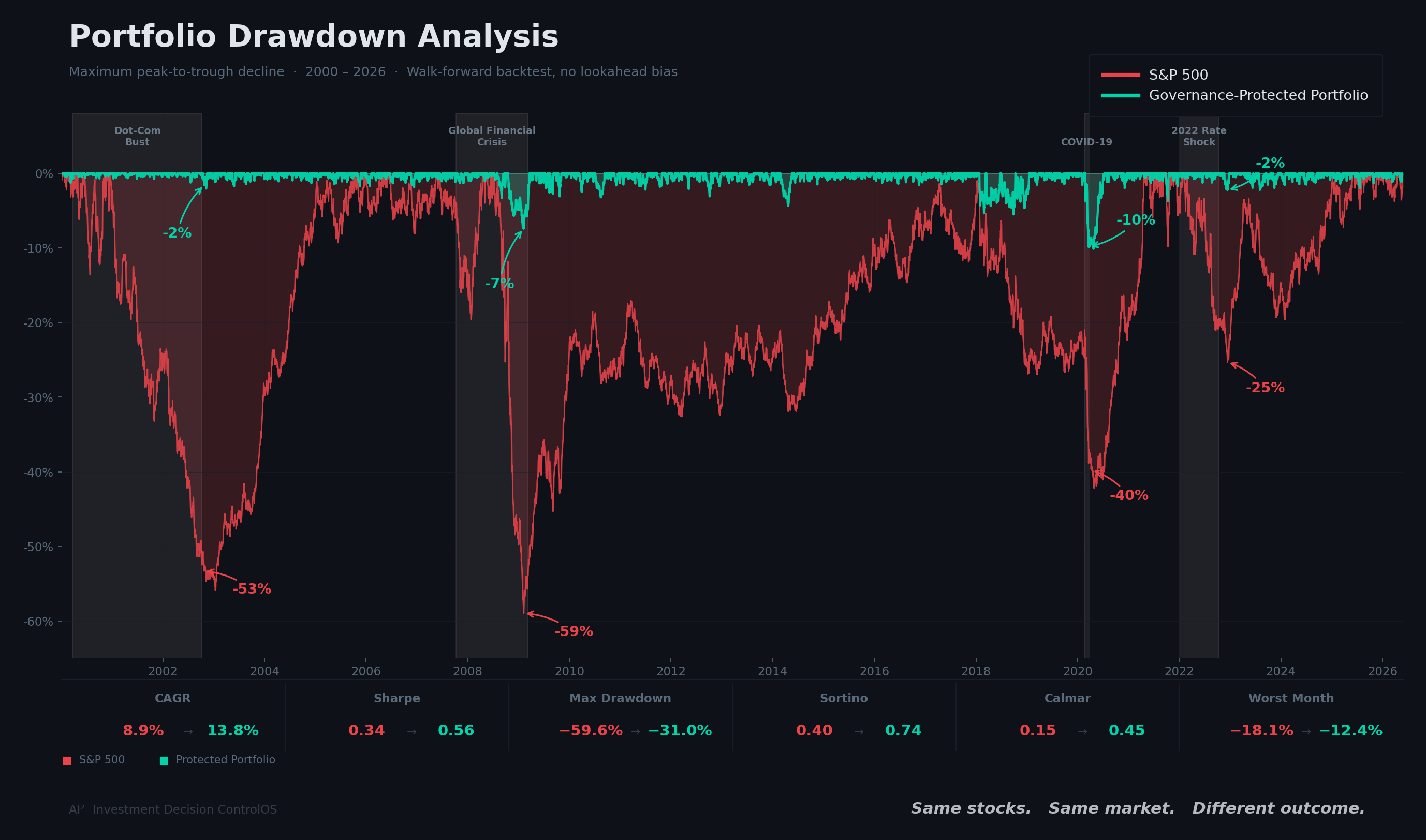
| Crisis | Ungoverned Institution | Governed Institution |
|---|---|---|
| Dot‑Com | Strategic drift → collapse | Drift controlled → stability |
| GFC | Operational drift → failure | Execution governed → resilience |
| COVID | Governance drift → chaos | Constraints enforced → alignment |
| 2022–2024 AI/Market Volatility | Agentic drift → misalignment | Decision‑Control → governed autonomy |
Why this matters
Institutional Drift is structural. When exposure, limits, workflows, and decision‑making drift, institutions break quietly; long before performance reveals the damage.
A governed institution behaves differently because:
- Intelligence identifies opportunities
- Decision Control governs exposure, limits, workflows, and execution
- Leadership still decides; but drift cannot compound into failure
Acumentica Governs. The CIO Decides.
Conclusion
Situational Awareness collapsed because of multi‑vector institutional drift, not agentic drift alone. The Drift Index reveals how drift accumulated across strategic, operational, governance, and agentic vectors until collapse became inevitable.
This case study shows why CIO’s must adopt Decision Control governance to prevent collapse in their own institutions.
Learn More
If your institution is experiencing portfolio instability, drift in exposures, or unexplained allocation changes, explore how Acumentica’s Investment Decision ControlOS governs construction, allocation, and execution to eliminate drift.
Also learn about Frida, Acumentica’s Agentic AI ControlOS that operates inside the Investment Decision Control OS, using governed decision pathways.
Decision Control Research Lab
The Decision Control Research Lab researches drift, collapse dynamics, and the Decision‑Control layer; the institutional execution‑governance systems that keep autonomous and enterprise systems stable, aligned, and protected from drift‑driven failure.
Portfolio Drift: When construction and allocation quietly break strategy
Decision Drift: The Institutional Instability CIOs Can’t See
AI Hallucination Drift: When AI Creates False Decisions That Break Institutional Governance
Risk Governance: Preventing drift and overrides in Agentic AI execution
Portfolio Governance: Stabilizing Investment Decisions in Agentic AI Systems
Why Investment Teams Fail: The Missing Governance Layer
What is Capital Decision Control Infrastructure? The New Architecture Wall Street and Enterprises Will Need
The Missing Layer Between Research and Execution: Decision Control
Why Investment Team Drift Under Uncertainty (and How to Stop It)
About Acumentica
Acumentica is a Precision AI-powered Capital Decision Control Infrastructure company.
We help institutions make better decisions under uncertainty and avoid costly mistakes by transforming complex data, risk, and constraints into clear, disciplined next actions. Request a demo
Acumentica is the steering and braking layer above Intelligence; the part that governs what AI does, not just what it predicts.
Acumentica originated the Capital Decision Control Infrastructure and built the first product in that category; the Decision Control OS. We are the first company to introduce governed capital‑control as a market and technology category thesis.