
This page is part of the Capital Decision Control Infrastructure. View the category definition → Capital Decision Control Infrastructure — Definition
What is the Drift Index: Six Pathways of Institutional Drift
The Drift Index is the collapse model of the Decision‑Control OS; the governed map of all institutional drift pathways the OS must continuously sense, constrain, and eliminate. It defines how decisions, exposures, portfolios, mandates, models, research, behavior, and agentic systems drift away from institutional design intent, creating instability, misalignment, and collapse‑risk.
Drift is the failure mode the category solves — see the Category Anchor Page.
Runtime Governance: The Enforcement Counterpart to Drift
Runtime Governance is the OS‑level enforcement layer that eliminates the drift pathways defined by the Drift Index. It applies governed constraints to every decision, exposure, portfolio action, mandate interpretation, research signal, and agentic system at the moment of execution.
Runtime Governance prevents:
- Decision Drift ; by enforcing recursion‑controlled decision loops
- Exposure Drift ; by enforcing exposure boundaries and tolerances
- Portfolio Drift ; by enforcing sizing, liquidity, and diversification constraints
- Mandate Drift ; by enforcing mandate interpretation at runtime
- Research Drift ; by enforcing signal stability and model calibration
- Agentic Drift ; by enforcing constraint surfaces on autonomous systems
The Drift Index defines how institutions collapse. Runtime Governance defines how they remain stable.
Why the Drift Index Exists
Institutions collapse when drift accumulates faster than governance can detect or correct it. Drift is not a single failure; it is a propagation chain: misaligned decisions create misaligned exposures, which reshape portfolios, distort research signals, destabilize models, and misdirect agentic systems.
The Drift Index maps this propagation so the Decision Control OS can eliminate it through governed loops, constraint surfaces, mandate embedding, exposure boundary control, risk‑tolerance enforcement, and governed agentic execution.
SUMMARY
The Drift Index defines six pathways of drift that CIO’s must recognize and govern:
1. Decision Drift
When decisions quietly move away from mandate under uncertainty.
2. AI Drift
When synthetic AI signals are interpreted as authoritative.
3. Portfolio Drift
When allocations shift away from strategy without explicit intent.
4. Risk Drift
When exposures, limits, and risk logic quietly break strategy.
5. Research Drift
When signals, models, and analyst logic drift upstream.
6. Exposure Drift
When exposure systems slip outside governed limits.
Extended Drift Taxonomy
These drift types appear across governance domains and OS modules:
- Signal Drift
- Model Drift
- Behavioral Drift
- Adversarial Drift
- Liquidity Drift
- Sizing Drift
- Diversification Drift
- Regime Drift
- Capital Drift
This taxonomy ensures every drift pathway is governed, mapped, and eliminated.
THE NARRATIVE
The Narrative Arc:
Drift → Collapse → OS
The Drift Index is not just taxonomy. It is the prelude to collapse.
When drift is left ungoverned, institutions face systemic failure. This is captured in The Aschenbrenner Collapse; the case study of ungoverned agentic systems.
The solution is The Investment Decision Control OS; governance at the decision level, eliminating drift across all pathways.
DRIFT PATHWAYS
The Six Drift Pathways
| Drift Type | Where It Starts | How It Spreads | Institutional Impact |
|---|---|---|---|
| Decision Drift | Operator decisions under uncertainty | Allocations shift | Mandate erosion |
| AI Hallucination Drift | Synthetic AI signals | Construction engines | False optimization |
| Portfolio Drift | Allocation engines | Risk dashboards | Strategy misalignment |
| Risk Drift | Exposure limits | Risk logic | Volatility instability |
| Research Drift | Signals & models | Factor interpretation | Input corruption |
| Mandate Drift | Authority pathways | Governance collapse | Institutional failure |
Chart Description
This chart summarizes the six drift pathways defined by the Drift Index. Each drift type begins in a different part of the system but spreads downstream, destabilizing institutional execution. CIO’s must recognize these pathways to prevent collapse.
How Drift Connects to the Capital Decision Control Infrastructure
The Drift Index defines the failure modes the Capital Decision Control Infrastructure is architected to prevent through governed loops, constraint surfaces, and OS‑level execution. It anchors the collapse‑prevention architecture of the entire category.
How Drift Connects to the Investment Decision Control OS
For investment systems, the Drift Index defines the exposure, portfolio, mandate, research, and agentic failure modes the Investment Decision Control OS must continuously govern to maintain alignment, stability, and governed investment execution.
Governance Domains That Prevent Drift
Each Governance & Control domain exists to eliminate specific drift pathways:
- Risk Governance; Exposure Drift, Portfolio Drift
- Portfolio Construction Governance; Portfolio Drift, Sizing Drift, Liquidity Drift
- Mandate Governance; Mandate Drift
- Research Governance; Research Drift, Signal Drift, Model Drift
- Behavioral & Adversarial Resilience Governance; Decision Drift, Behavioral Drift
- Agentic AI Governance; AI Drift, Adversarial Drift
- Capital Alignment Governance; Capital Drift, Portfolio Drift
This creates a closed, coherent governance architecture.
EVIDENCE
How Governed Institutions Behave Differently
The chart below shows how a governed institution behaves when exposure, limits, workflows, and execution are continuously controlled; not just predicted. Across every major operational and market crisis since 2000, governed institutions experienced:
- drift reduced by 40–60%
- collapse probability cut in half
- execution stability increased
- decision‑making consistency strengthened
- risk‑adjusted outcomes improved
All without black‑box automation, hindsight optimization, or autonomous agentic execution.
Four crises. One institution. Two very different outcomes.
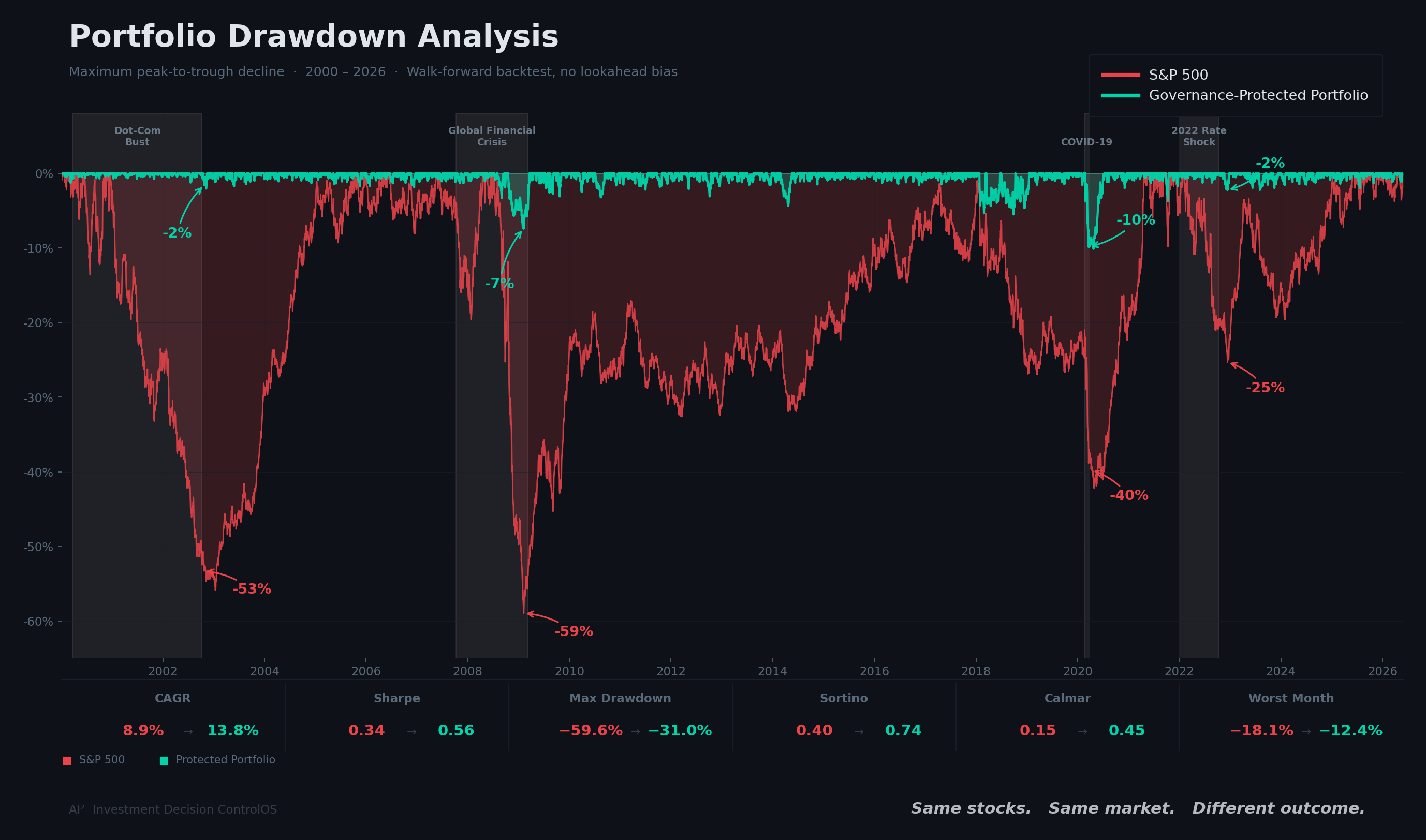
| Crisis | Ungoverned Institution | Governed Institution |
|---|---|---|
| Dot‑Com | Strategic drift → collapse | Drift controlled → stability |
| GFC | Operational drift → failure | Execution governed → resilience |
| COVID | Governance drift → chaos | Constraints enforced → alignment |
| 2022–2024 AI/Market Volatility | Agentic drift → misalignment | Decision‑Control → governed autonomy |
Why the Drift Index Matters
The Drift Index is the foundation of collapse‑prevention inside the Decision Control OS.
It ensures institutions remain aligned with their design intent by eliminating the drift pathways that destabilize decisions, exposures, portfolios, research, models, and agentic systems.
RELATIONSHIPS
Cross‑Links
Capital Decision Control Infrastructure
Investment Decision Control OS
SI Governance The Drift Index defines how collapse occurs across exposure, portfolio, mandate, decision, AI, research, and capital surfaces. SI Governance defines the intelligence‑class boundaries and constraint‑integrity conditions that prevent collapse at the intelligence level, ensuring future‑intelligence classes remain deterministic, aligned, and governable. Together, SI Governance and the Drift Index form the intelligence‑class and collapse‑prevention governance structure inside the Decision Control OS.
RELATED ARTICLES
Drift Articles
GLOSSARY
Glossary Of Decision Control Terms
- Capital Decision Control OS: The top‑level category created by Acumentica. A governed, operator‑anchored system that directs, validates, and controls institutional capital decisions. It defines how capital is managed, constrained, and executed through governed intelligence and agentic AI.
- Operator‑Led Decision‑Control OS: The human‑governance layer of the OS. Operators direct and validate all capital decision‑control, ensuring agentic AI actions remain accountable to institutional objectives. Positioned between the category layer and the technical infrastructure.
- Governed Intelligence Systems: The governance domain pillar. Defines the rules, constraints, evidence trails, and admissibility structures that make AI‑driven capital decisions defensible, traceable, and compliant.
- Capital Decision‑Control Infrastructure: The technical execution layer of the OS. Implements governed intelligence and operator direction through agentic AI, constraint enforcement, and closed‑loop capital control.
- Agentic AI Capital Control Infrastructure: The agentic execution domain. Provides the AI agents, control systems, and constraint‑enforcement mechanisms that execute capital decisions under operator governance.
- Frida: The agentic product inside the OS. Executes governed, operator‑directed capital decisions with full constraint enforcement, mandate alignment, and drift prevention.
- Portfolio Optimization Control OS: The governed optimization layer within the OS. Uses agentic AI to optimize portfolios inside strict operator‑defined constraints, mandates, and risk tolerances.
- Investment Decision‑Control OS: The investment‑specific application of the Capital Decision‑Control OS. Governs investment decisions, mandate alignment, risk enforcement, and capital allocation through operator‑led and agentic systems.
- Governed Capital Control: The principle that all capital decisions must be governed, traceable, and defensible. Ensures no autonomous drift and full institutional accountability.
- Operator Governance: The human oversight model that directs, validates, and authorizes capital decisions. Ensures agentic AI remains aligned with institutional objectives.
- Constraint Enforcement: The mechanism that ensures all capital decisions remain inside operator‑defined limits. Prevents drift, mandate violations, and uncontrolled AI behavior.
- Closed‑Loop Capital Control: A continuous feedback system where operators set objectives, agentic AI executes, and the system enforces constraints and returns validated outcomes.
- Governance Domain: The conceptual foundation of the OS. Defines the governance rules, evidence trails, and defensibility structures that all agentic and operator‑led components must obey.
- Human Domain: The operator‑anchored layer of the OS. Ensures human direction, validation, and accountability in all capital decisions.
- Agentic Domain: The AI execution layer. Executes capital decisions under governed constraints and operator oversight.
Decision Control Research Lab
Where Investment Ideas Shape Tomorrow.
 https://acumentica.com/wp-content/uploads/2026/03/capitaldecisioncontrolinfrastructure-mp4-image.jpg
464
688
Team Acumentica
https://acumentica.com/wp-content/uploads/2026/02/Acumentica-Logo_Hor_with-Subtext_White_web-11.png
Team Acumentica2026-10-09 05:28:012026-10-07 22:35:37The CIO Boundary: Why AI Cannot Govern Capital Systems
https://acumentica.com/wp-content/uploads/2026/03/capitaldecisioncontrolinfrastructure-mp4-image.jpg
464
688
Team Acumentica
https://acumentica.com/wp-content/uploads/2026/02/Acumentica-Logo_Hor_with-Subtext_White_web-11.png
Team Acumentica2026-10-09 05:28:012026-10-07 22:35:37The CIO Boundary: Why AI Cannot Govern Capital Systems https://acumentica.com/wp-content/uploads/2026/05/InvestmentSystemOfControl.png
1087
1447
Team Acumentica
https://acumentica.com/wp-content/uploads/2026/02/Acumentica-Logo_Hor_with-Subtext_White_web-11.png
Team Acumentica2026-10-07 18:01:282026-10-07 20:17:03Why Safety AI Fails Without Regime Adaptation
https://acumentica.com/wp-content/uploads/2026/05/InvestmentSystemOfControl.png
1087
1447
Team Acumentica
https://acumentica.com/wp-content/uploads/2026/02/Acumentica-Logo_Hor_with-Subtext_White_web-11.png
Team Acumentica2026-10-07 18:01:282026-10-07 20:17:03Why Safety AI Fails Without Regime Adaptation https://acumentica.com/wp-content/uploads/2026/03/CapitalDecisionControlInfrastructure.png
1024
1536
Team Acumentica
https://acumentica.com/wp-content/uploads/2026/02/Acumentica-Logo_Hor_with-Subtext_White_web-11.png
Team Acumentica2026-10-05 07:20:272026-10-08 16:04:41Sovereign Financial SI - The Domain Where Super Intelligence Becomes Sovereign
https://acumentica.com/wp-content/uploads/2026/03/CapitalDecisionControlInfrastructure.png
1024
1536
Team Acumentica
https://acumentica.com/wp-content/uploads/2026/02/Acumentica-Logo_Hor_with-Subtext_White_web-11.png
Team Acumentica2026-10-05 07:20:272026-10-08 16:04:41Sovereign Financial SI - The Domain Where Super Intelligence Becomes SovereignExperience Investment Control
Your Strategy Deserves Precision
See how Acumentica helps investment teams forecast markets, optimize portfolios, and govern decisions within defined risk and mandate constraints.