
The Missing Layer in Institutional Decision‑Making: Control, Not More Intelligence
Author: Ryan D’Souza

Every institution believes the answer to instability is more intelligence. More dashboards. More analytics. More AI. More signals. More data.

But intelligence alone does not stabilize decisions. In fact, intelligence without control increases volatility, drift, and overrides.

The missing layer in institutional decision‑making is not more intelligence. It is control.

Why Intelligence Alone Creates Instability

Intelligence expands awareness. But awareness without governance creates instability.

Here’s how intelligence destabilizes institutions:

1. Signal Overload

Too many signals create conflicting interpretations.

2. Override Acceleration

Teams override mandates because “the data feels urgent.”

3. Drift Expansion

Execution fragments as different functions follow different signals.

4. Uncertainty Collapse

When markets shift, intelligence amplifies reactivity instead of stabilizing mandates.

Intelligence increases speed. Control enforces stability.

Why Institutions Keep Adding Intelligence

Institutions assume instability is caused by insufficient awareness. So they add:

  • more dashboards
  • more analytics
  • more AI copilots
  • more reporting layers

But instability is not caused by lack of awareness. It is caused by lack of governance.

Mandates fail not because teams don’t know enough. They fail because nothing enforces them.

The Missing Layer: Control

Control is the layer that:

  • enforces mandates
  • prevents overrides
  • stabilizes execution
  • governs uncertainty
  • closes the loop between research and action

Without control, intelligence accelerates instability. With control, intelligence becomes productive.

Why AI Tools Cannot Provide Control

AI tools generate intelligence. They do not govern decisions.

AI tools:

  • increase signal velocity
  • increase override frequency
  • increase interpretation variance
  • increase urgency

They accelerate drift. They do not prevent it.

Control requires governance. AI tools cannot provide governance.

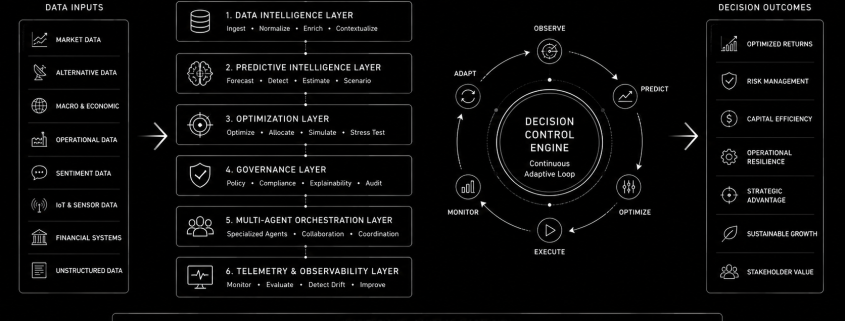
The Only Way to Stabilize Institutions: A Governed Decision Control System

Institutions remain stable only when decisions are governed by a closed‑loop system that enforces:

  • mandate alignment
  • constraint adherence
  • override governance
  • research authority
  • execution consistency
  • uncertainty stabilization

This is what the Capital Decision‑Control OS provides.

It doesn’t replace intelligence. It governs it.

It doesn’t eliminate uncertainty. It stabilizes decisions inside it.

It doesn’t restrict judgment. It prevents judgment from destabilizing mandates.

Control Is the Missing Layer

Institutions don’t fail because they lack intelligence. They fail because they lack control.

The future belongs to institutions that operate inside governed systems of decision‑control.

Because intelligence without control is instability. And instability cannot govern capital.

Learn More

If your investment organization is looking to reduce decision drift, strengthen governance, and maintain execution consistency under uncertainty, explore how Acumentica’s Capital Decision Control OS provides a governed, closed-loop operating layer for institutional investment decision making.

Related Articles

  • Why Investment Teams Drift Under Uncertainty (and How to Stop It)
  • The Missing Layer Between Research and Execution: Decision Control
  • What Is a Capital Decision Control Infrastructure? The New AI Architecture Wall Street and Enterprises Will Need
  • Why Investment Teams Fail: The Missing Governance Layer

About Acumentica

We are a Precision AI-powered Capital Decision Control Infrastructure company.

We help institutions make better decisions under uncertainty and avoid costly mistakes by transforming complex data, risk, and constraints into clear, disciplined next actions. Contact Us