
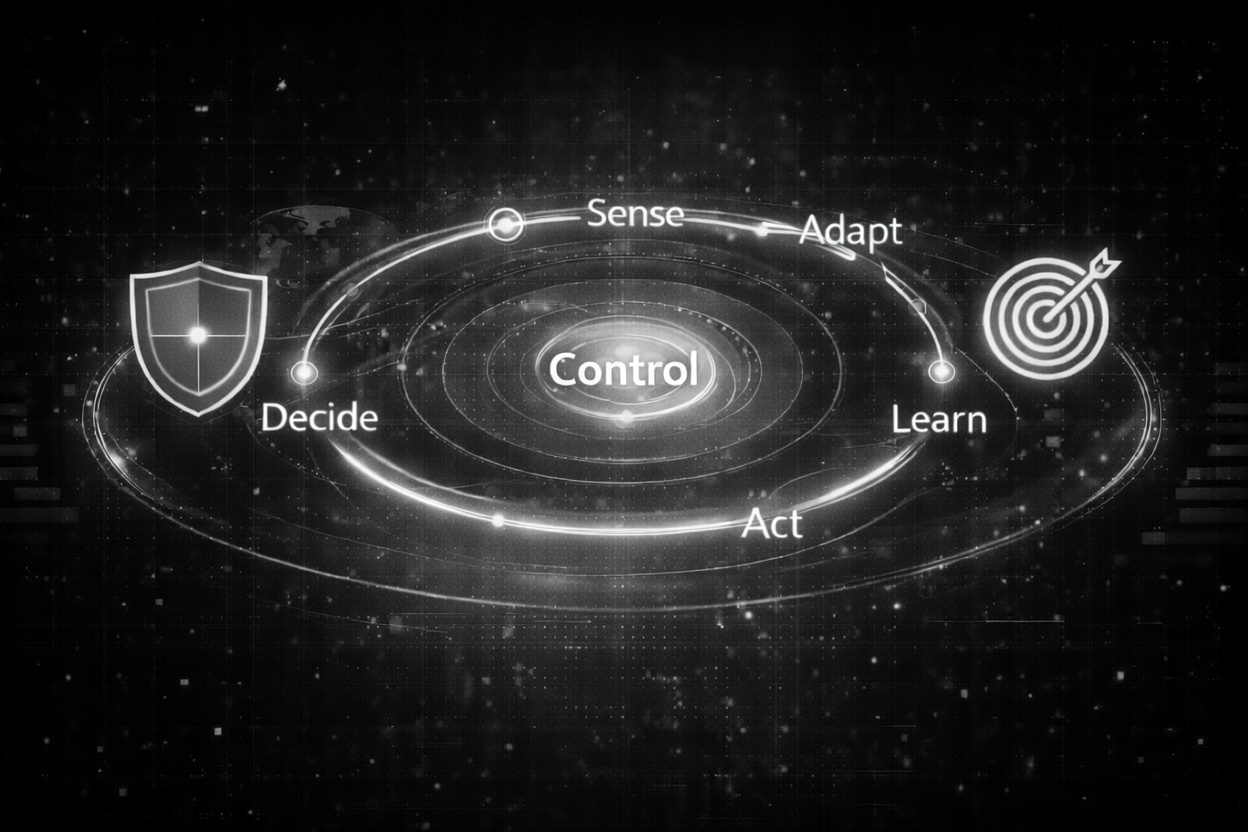
This page is part of the Capital Decision Control Infrastructure. View the category definition → Capital Decision Control Infrastructure — Definition
What SI Governance Means for National Readiness
Superintelligence (SI) does not exist today; but SI‑class conditions will eventually emerge as intelligence systems begin influencing capital, security, and institutional decision environments at scales beyond human governance.
National readiness requires governing those conditions before they arrive.
SI Governance is the discipline that ensures:
- constraint integrity
- drift‑control
- deterministic execution
- institutional alignment
- capital‑grade auditability
- governed autonomy
These are the primitives governments must have in place pre‑SI, not post‑SI.
SI Governance is not about building SI. It is about ensuring future‑intelligence classes remain governable, safe, and aligned with national‑level decision systems.
This is why SI Governance is a national‑readiness requirement, not a research initiative.
Drift is the failure mode the category solves — see the Category Anchor Page.
Why Governments Need SI Governance Before SI Exists
Governments cannot wait for SI‑class conditions to appear. National‑scale decision systems must already enforce:
- predictable behavior
- bounded autonomy
- drift‑free execution
- capital‑safe decision surfaces
- institutional‑scale oversight
Decision Control OS provides this infrastructure today; making SI Governance a present‑day national‑readiness capability, not a future aspiration.
WHAT IT DOES
Decision Control OS as SI Governance Infrastructure
Decision Control OS is the world’s first SI‑governance infrastructure, meaning:
- it governs future‑intelligence classes
- without requiring those classes to exist
- and without attempting to build them
This is the correct national‑readiness posture.
Governments need governed intelligence, not larger models.
RUNTIME SI GOVERNANCE
The Role of Runtime Governance in SI‑Class Safety
Runtime Governance enforces:
- no drift
- no uncontrolled autonomy
- no emergent behavior outside governed pathways
This is the SI‑class safety layer for national‑scale systems.
OUTCOMES
National Readiness Outcomes
SI Governance enables governments to achieve:
- strategic stability
- institutional alignment
- capital‑grade control
- operational determinism
- future‑intelligence safety
This is the foundation of national readiness.
DOMAIN
Domain SI Layers
Sovereign Financial SI — the national‑readiness financial SI layer that applies SI Governance to sovereign‑scale financial intelligence inside CDCI.
ARCHITECTURE
Runtime Governance as the National‑Scale Enforcement Layer
Runtime Governance provides the enforcement model required for national‑readiness. It ensures future‑intelligence conditions remain governable by maintaining constraint integrity, eliminating drift, and bounding autonomy across institutional and capital‑scale decision environments.
Where the Drift Index defines how collapse occurs, Runtime Governance defines how collapse is prevented; making it the operational safety layer for SI‑class conditions before they exist.
DOMAINS
Runtime Governance Across National‑Scale Domains
Runtime Governance operates across all institutional and capital‑scale domains, enforcing constraint integrity, drift‑control, and bounded autonomy wherever future‑intelligence conditions may emerge. Its cross‑domain enforcement model ensures SI‑class behavior remains governable across investment, risk, exposure, portfolio, mandate, research, and agentic AI environments; providing the national‑readiness layer required before SI‑class conditions exist.
Runtime Governance and SI‑Class Drift Prevention
Runtime Governance is the enforcement layer that prevents collapse conditions across national‑scale decision environments. It maintains constraint integrity, eliminates drift, and ensures future‑intelligence behavior remains governable and aligned with institutional and capital‑grade boundaries.
Where the Drift Index defines how collapse occurs, Runtime Governance defines how collapse is prevented — making it the national‑readiness enforcement model for SI‑class conditions before they exist.
WHY IT MATTERS
Why Runtime Governance Matters for National Readiness
Runtime Governance is the national‑scale stability layer that ensures future‑intelligence conditions remain governable, predictable, and aligned with institutional and capital‑grade intent. It prevents collapse, eliminates drift, stabilizes execution, governs autonomous systems, protects national‑scale capital systems, and maintains institutional integrity across all decision environments.
Without Runtime Governance, nations cannot enforce alignment under SI‑class conditions.
THE NARRATIVE
The Narrative Arc:
Drift → Collapse → SI Governance → National Readiness
SI Governance is the national‑scale enforcement model that prevents collapse under future‑intelligence conditions. Where the Drift Index defines how institutions fail, SI Governance defines how nations prevent those failures before SI‑class conditions emerge.
Ungoverned drift leads to systemic instability; the phenomenon captured in The Aschenbrenner Collapse, the case study of ungoverned agentic systems and compounding drift cascades.
SI Governance is the national‑readiness answer to collapse. It enforces constraints, stabilizes autonomous behavior, aligns institutional decision environments, protects capital systems, maintains mandate integrity, and constrains agentic systems at national scale.
This governance layer is what makes Governed Intelligence possible: stability under uncertainty, alignment under autonomy, and resilience under SI‑class conditions.
EVIDENCE
Evidence: How Runtime‑Governed Systems Behave Under SI‑Class Conditions
Runtime‑governed systems behave predictably under uncertainty because constraint integrity, drift‑control, and bounded autonomy are enforced continuously; not merely monitored. Across shocks, volatility regimes, and institutional stress events, runtime‑governed environments demonstrate lower collapse probability, higher execution stability, and stronger decision consistency.
This is the national‑readiness evidence: governed execution produces stability; ungoverned execution produces collapse.
SUMMARY
SI Governance & National Readiness defines how nations govern future‑intelligence conditions before they arrive. It establishes the enforcement model that maintains constraint integrity, eliminates drift, stabilizes autonomous behavior, and ensures institutional and capital‑grade alignment under SI‑class conditions. Runtime Governance provides the real‑time enforcement layer that makes SI‑class national readiness operational today.
Decision Control Research Lab
Research Foundation for SI‑Class Governance & National Readiness
 https://acumentica.com/wp-content/uploads/2026/03/SIGNALLAYER.jpg
832
1248
Team Acumentica
https://acumentica.com/wp-content/uploads/2026/02/Acumentica-Logo_Hor_with-Subtext_White_web-11.png
Team Acumentica2026-09-28 22:15:402026-09-28 22:15:40AI BreakoutOS Governed Delivery Model
https://acumentica.com/wp-content/uploads/2026/03/SIGNALLAYER.jpg
832
1248
Team Acumentica
https://acumentica.com/wp-content/uploads/2026/02/Acumentica-Logo_Hor_with-Subtext_White_web-11.png
Team Acumentica2026-09-28 22:15:402026-09-28 22:15:40AI BreakoutOS Governed Delivery Model https://acumentica.com/wp-content/uploads/2024/06/Agents.ModeOfAction.jpg
1024
1024
Team Acumentica
https://acumentica.com/wp-content/uploads/2026/02/Acumentica-Logo_Hor_with-Subtext_White_web-11.png
Team Acumentica2026-09-26 21:16:412026-09-30 21:50:49Institutional Drift: The Silent Risk in Enterprise Systems and AI
https://acumentica.com/wp-content/uploads/2024/06/Agents.ModeOfAction.jpg
1024
1024
Team Acumentica
https://acumentica.com/wp-content/uploads/2026/02/Acumentica-Logo_Hor_with-Subtext_White_web-11.png
Team Acumentica2026-09-26 21:16:412026-09-30 21:50:49Institutional Drift: The Silent Risk in Enterprise Systems and AI https://acumentica.com/wp-content/uploads/2024/06/Liquid-Neural-Networks.jpg
1024
1024
Team Acumentica
https://acumentica.com/wp-content/uploads/2026/02/Acumentica-Logo_Hor_with-Subtext_White_web-11.png
Team Acumentica2026-09-24 23:01:342026-09-30 21:55:19AI Warning Signs: Cutting Through the Marketing Fluff with Decision Control Discipline
https://acumentica.com/wp-content/uploads/2024/06/Liquid-Neural-Networks.jpg
1024
1024
Team Acumentica
https://acumentica.com/wp-content/uploads/2026/02/Acumentica-Logo_Hor_with-Subtext_White_web-11.png
Team Acumentica2026-09-24 23:01:342026-09-30 21:55:19AI Warning Signs: Cutting Through the Marketing Fluff with Decision Control DisciplineExperience Governed Intelligence
National‑Scale Stability for Future‑Intelligence Conditions
See how Acumentica enables agencies and institutions to enforce constraint integrity, eliminate drift, and maintain alignment under SI‑class conditions; the foundation of national readiness.