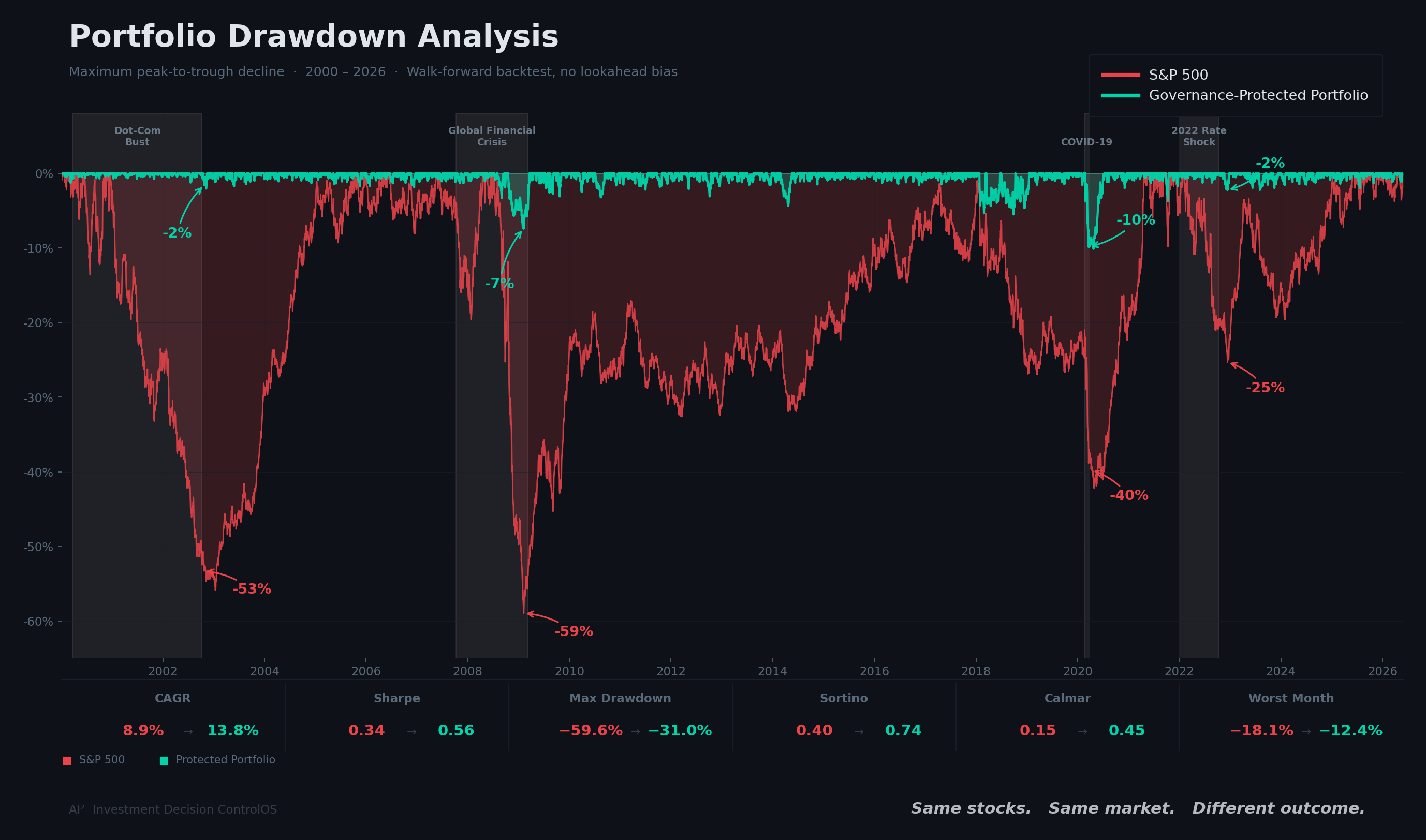
Advanced Portfolio Optimization

By Team Acumentica

Why Modern Investors Must Move Beyond Mean Variance Models

Introduction

Portfolio optimization has long been one of the central disciplines in institutional investing. For decades, investors have relied on quantitative frameworks to determine how capital should be allocated across assets in order to balance expected returns and risk.

The foundation of modern portfolio optimization dates back to the pioneering work of economist Harry Markowitz, whose mean–variance optimization framework transformed financial theory in the 1950s. Markowitz demonstrated that investors could construct portfolios that maximize expected return for a given level of risk by carefully selecting combinations of assets with different return and volatility characteristics.

The concept of efficient portfolios became a cornerstone of modern asset management. Institutional investors, pension funds, and hedge funds began incorporating optimization models into their portfolio construction processes.

Yet despite its historical importance, mean–variance optimization alone is often insufficient for navigating today’s financial markets.

Markets are now characterized by rapid structural shifts, complex risk dynamics, and large volumes of real-time data. As a result, modern investors are increasingly turning to advanced portfolio optimization frameworks that integrate additional constraints, risk measures, and adaptive decision models.

This article explores why traditional optimization approaches face limitations in modern markets and how advanced optimization frameworks are evolving to support more robust portfolio construction.

The Origins of Modern Portfolio Optimization

Modern portfolio optimization began with the concept of risk diversification.

Harry Markowitz’s framework introduced the idea that investors should not evaluate assets individually but rather consider how assets interact within a portfolio.

Two key insights emerged from this work:

  1. Portfolio risk depends not only on individual asset volatility but also on the correlation between assets.
  2. Investors can construct portfolios that maximize expected return for a given level of risk.

This framework gave rise to the efficient frontier, a curve representing the set of optimal portfolios offering the highest expected return for each level of risk.

Mean–variance optimization became widely adopted because it provided a mathematically rigorous way to construct diversified portfolios.

However, over time, practitioners began encountering several practical challenges.

Limitations of Mean Variance Optimization

Although mean–variance models remain foundational in financial theory, they exhibit several limitations when applied to real-world portfolio management.

Understanding these limitations helps explain why modern asset managers are exploring more advanced optimization techniques.

Sensitivity to Input Estimates

Mean–variance optimization relies heavily on estimates of:

  • expected asset returns
  • volatility
  • correlations between assets

Small changes in these estimates can lead to large changes in optimal portfolio allocations.

This sensitivity can produce unstable portfolio recommendations, particularly when estimates are uncertain.

Static Assumptions About Markets

Traditional optimization models often assume that market relationships remain relatively stable.

For example, they may assume:

  • stable correlations between asset classes
  • predictable volatility patterns
  • relatively stable economic regimes

In practice, these relationships frequently change during periods of market stress or economic transition.

Limited Risk Representation

Mean–variance models represent risk primarily through portfolio variance or volatility.

However, investors often care about other types of risk, including:

  • drawdown risk
  • tail risk
  • liquidity risk
  • regime shifts

These risk factors are not fully captured by variance alone.

Absence of Real World Constraints

Institutional portfolios operate under numerous practical constraints such as:

  • sector exposure limits
  • concentration limits
  • liquidity requirements
  • transaction cost considerations

Traditional optimization models often struggle to incorporate these constraints effectively.

The Emergence of Advanced Portfolio Optimization

To address these limitations, modern portfolio construction frameworks incorporate additional elements that extend beyond traditional mean–variance models.

These approaches seek to improve the robustness, stability, and practical applicability of portfolio optimization.

Several advanced optimization techniques are now widely used by institutional investors.

Multi-Objective Portfolio Optimization

One of the most important developments in modern portfolio construction is the use of multi-objective optimization.

Instead of optimizing solely for expected return versus variance, multi-objective frameworks consider several competing objectives simultaneously.

Examples of objectives include:

  • maximizing expected return
  • minimizing portfolio volatility
  • limiting drawdown risk
  • controlling factor exposures
  • minimizing transaction costs

These objectives are balanced through a structured optimization process that reflects the priorities of the investment strategy.

Risk Parity and Diversification-Based Allocation

Another important innovation in portfolio optimization is the concept of risk-based allocation.

Rather than allocating capital based purely on expected returns, risk parity frameworks allocate capital based on each asset’s contribution to overall portfolio risk.

This approach emphasizes diversification and can produce more balanced portfolios.

Risk parity and related frameworks, such as hierarchical risk parity, are designed to reduce dependence on unstable return forecasts while improving diversification.

Constraint-Based Optimization

Institutional portfolios must operate within defined governance frameworks.

Advanced optimization models incorporate constraints that reflect these policies.

Examples include:

  • maximum asset weights
  • sector exposure limits
  • volatility caps
  • drawdown controls
  • turnover constraints

Constraint-based optimization allows portfolios to remain aligned with institutional mandates while still benefiting from systematic allocation frameworks.

Adaptive Portfolio Optimization

Another emerging area of research involves adaptive portfolio optimization.

Adaptive frameworks adjust portfolio construction methods as market conditions evolve.

For example, portfolio models may respond differently during:

  • high-volatility environments
  • liquidity crises
  • inflationary regimes
  • economic expansions

Adaptive optimization frameworks allow investment systems to adjust their behavior based on the current market environment rather than relying on static assumptions.

The Role of Artificial Intelligence in Portfolio Optimization

Artificial intelligence and machine learning techniques are increasingly being incorporated into portfolio construction frameworks.

These technologies help investors process large volumes of financial data and identify patterns that may not be easily detectable through traditional statistical methods.

AI-driven portfolio optimization systems can assist with tasks such as:

  • market regime detection
  • signal aggregation
  • dynamic asset allocation
  • risk forecasting

When integrated within structured portfolio governance frameworks, these capabilities can support more adaptive and responsive investment systems.

Portfolio Optimization in Institutional Investment Systems

In modern institutional environments, portfolio optimization rarely operates in isolation.

Instead, optimization engines function as components within broader investment systems that also include:

These systems coordinate multiple analytical components to guide portfolio decisions while maintaining discipline and policy compliance.

The Future of Portfolio Optimization

Portfolio optimization will likely continue evolving as financial markets become more complex and data-driven.

Future portfolio construction frameworks may increasingly incorporate:

The goal is not simply to produce mathematically optimal portfolios but to support robust and disciplined capital allocation under uncertain market conditions.

Advanced optimization frameworks will play an essential role in helping investors navigate these challenges.

Conclusion

Mean–variance optimization laid the foundation for modern portfolio construction and remains one of the most influential ideas in financial economics.

However, the increasing complexity of global financial markets requires optimization frameworks that go beyond traditional models.

Advanced portfolio optimization techniques integrate multiple objectives, incorporate real-world constraints, and adapt to changing market conditions.

By combining diversification principles, risk governance, and modern analytical tools, these frameworks help investors construct portfolios that are more resilient and responsive to evolving financial environments.

As investment technology continues to evolve, advanced optimization systems will remain central to institutional portfolio management.

Learn More

To learn more about modern AI-driven Investment Decision Control Systems and how they can support institutional portfolio management, visit:

https://www.acumentica.com

or contact our team to explore how adaptive investment technology can help govern portfolio decisions in uncertain markets.


Why Asset Managers Need Investment Control Infrastructure

By Team Acumentica

Governing Portfolio Decisions in an Era of Market Uncertainty

Asset management has undergone profound technological transformation over the past several decades. Institutional investors now have access to a wide range of advanced tools designed to analyze financial markets, measure portfolio risk, and evaluate investment strategies.

These technologies include:

  • risk analytics platforms
  • portfolio optimization engines
  • economic research systems
  • algorithmic trading models
  • market data terminals

Together, these tools form the backbone of modern investment operations.

Yet despite this technological progress, many asset managers continue to face a persistent challenge: investment decisions are still governed primarily by fragmented workflows and manual interpretation of analytics.

In most organizations, data analysis, portfolio construction, risk monitoring, and trade execution are handled through separate systems. Portfolio managers must interpret signals from multiple sources and determine how to allocate capital accordingly.

While this approach has worked historically, it becomes increasingly difficult to manage in markets characterized by rapid information flow, complex risk dynamics, and evolving economic regimes.

As a result, a growing number of investment organizations are beginning to explore a new category of technology: Investment Control Infrastructure.

Investment control infrastructure provides a structured framework for coordinating analytics, portfolio optimization, risk governance, and decision processes within a unified system.

Rather than simply analyzing markets, these systems help institutions govern how portfolio decisions are made under uncertainty.

The Evolution of Investment Technology

The investment technology landscape has evolved through several major phases.

Understanding this evolution helps clarify why investment control infrastructure is emerging today.

Phase 1: Data and Market Information

The first generation of investment technology focused primarily on delivering financial data.

Platforms such as Bloomberg and Reuters allowed investors to access real-time market information, economic indicators, and corporate data.

These systems dramatically improved market transparency and analytical capability.

However, they primarily functioned as information platforms rather than decision systems.

Phase 2: Portfolio Analytics and Risk Management

The second phase introduced advanced analytics tools designed to evaluate portfolio behavior.

These systems included capabilities such as:

  • Value at Risk analysis
  • factor exposure modeling
  • stress testing
  • portfolio performance attribution

Institutional platforms such as BlackRock Aladdin, MSCI Barra, and Bloomberg PORT helped asset managers understand the risk characteristics of their portfolios.

These tools provided important analytical insights but still required human interpretation and decision-making.

Phase 3: Quantitative Models and Automation

In the third phase, asset managers began incorporating algorithmic trading models, machine learning techniques, and automated portfolio optimization frameworks.

These technologies allowed investors to process large volumes of market data and generate systematic trading signals.

However, many of these systems still operated as independent models within a broader portfolio management workflow.

As a result, investment decisions often remained fragmented across multiple analytical environments.

The Challenge of Fragmented Investment Workflows

Most asset management firms today operate with complex technology stacks.

A typical investment workflow may involve:

  • market data platforms
  • risk analytics systems
  • portfolio optimization tools
  • research databases
  • trading and execution platforms

Each of these systems performs an important function, but they are rarely integrated into a unified decision architecture.

This fragmentation introduces several challenges.

Decision Complexity

Portfolio managers must evaluate information from multiple sources simultaneously.

Signals from economic research, risk systems, and quantitative models may sometimes conflict with one another.

Determining the appropriate course of action requires significant human judgment.

Inconsistent Governance

Institutional portfolios operate under strict policy frameworks that include risk limits, diversification requirements, and regulatory constraints.

When decisions are made across fragmented systems, ensuring consistent policy enforcement becomes more difficult.

Latency in Decision Processes

Investment decisions often require multiple analytical steps before action can be taken.

In fast-moving markets, this latency can reduce the effectiveness of portfolio adjustments.

What Is Investment Control Infrastructure?

Investment control infrastructure is designed to address these challenges by integrating multiple analytical functions into a coordinated system that governs portfolio decisions.

Instead of operating as isolated tools, analytics, optimization engines, and risk governance frameworks function as components within a unified architecture.

At a high level, investment control infrastructure coordinates several key processes:

  1. Market sensing and data ingestion
  2. predictive evaluation of financial conditions
  3. portfolio optimization and allocation modeling
  4. risk governance and constraint enforcement
  5. feedback and system adaptation

These components operate within a continuous framework that helps guide portfolio decisions while maintaining alignment with institutional policies.

Key Components of Investment Control Infrastructure

Although implementations differ across organizations, several components typically define modern investment control infrastructure.

Market Intelligence Layer

This layer collects and processes information from financial markets and economic environments.

Examples of inputs include:

The objective is to maintain situational awareness of the financial environment.

Predictive Intelligence Layer

Predictive models analyze market dynamics and potential future developments.

These models may incorporate statistical forecasting techniques, economic models, and machine learning algorithms.

Their purpose is to support decision frameworks rather than operate as isolated trading signals.

Portfolio Construction Layer

Portfolio optimization frameworks determine how capital can be allocated given expected returns, diversification requirements, and risk constraints.

These engines help generate candidate portfolio allocations aligned with the investment strategy.

Governance and Risk Control Layer

Institutional portfolios must comply with predefined policies governing risk, diversification, and exposure limits.

Investment control infrastructure enforces these policies automatically by ensuring that portfolio decisions remain within established constraints.

Feedback and Adaptive Learning

Finally, the system evaluates outcomes and adapts its decision frameworks as market conditions evolve.

This adaptive capability allows investment systems to respond to changing market regimes over time.

Why Asset Managers Are Moving Toward Investment Control Infrastructure

Several forces are driving interest in this new category of investment technology.

Increasing Market Complexity

Global financial markets are influenced by a wide range of interconnected factors, including monetary policy, geopolitical developments, technological innovation, and global capital flows.

Managing portfolios in this environment requires systems capable of coordinating large volumes of information.

Institutional Governance Requirements

Regulators, fiduciaries, and investment committees expect asset managers to demonstrate disciplined governance over portfolio decisions.

Investment control infrastructure helps enforce risk policies and decision frameworks consistently.

The Need for Adaptive Investment Systems

Market conditions change over time, and investment systems must adapt accordingly.

Closed-loop decision architectures allow portfolios to respond dynamically to evolving environments while maintaining governance over capital allocation.

The Future of Institutional Investment Platforms

Investment control infrastructure represents a natural evolution in the design of asset management technology.

Traditional tools such as risk analytics platforms and portfolio optimization engines will continue to play important roles.

However, the next generation of investment platforms is likely to focus increasingly on integrating these tools within coordinated decision systems.

Such systems allow institutions to maintain discipline, consistency, and adaptability in their portfolio management processes.

For asset managers operating in complex and uncertain markets, this capability may become a defining feature of future investment platforms.

Conclusion

The investment industry has made enormous progress in developing tools that analyze financial markets and measure portfolio risk.

Yet the increasing complexity of modern markets requires more than analytical capability alone.

Asset managers must also ensure that portfolio decisions are made within structured frameworks that integrate data, predictive insights, optimization models, and governance policies.

Investment control infrastructure provides a foundation for achieving this integration.

By coordinating analytics and decision processes within a unified architecture, these systems help asset managers manage capital more effectively under uncertain market conditions.

As financial technology continues to evolve, investment control infrastructure may become a central component of institutional portfolio management.

Learn More

Learn more about modern AI-driven Investment Decision Control Systems and how they can support institutional portfolio management.Contact our team to explore how adaptive investment technology can help govern portfolio decisions in uncertain markets.


The End of AI Chatbots: Why Enterprises Are Moving Toward Precision AI Decision Control Infrastructure

Author: Ryan D’Souza

Artificial intelligence has clearly entered a new phase.

The first wave of enterprise AI was all about chatbots, copilots, and conversational tools that helped employees pull up information, draft content, and automate routine tasks. Those systems created a huge amount of excitement across industries; from finance and healthcare to manufacturing, logistics, and construction.

But as adoption has grown, a major limitation has become impossible to ignore:

Most AI systems can generate answers, but very few can govern decisions.

That gap is quickly becoming one of the most important strategic issues in enterprise technology.

As organizations scale AI across their operations, they’re running into challenges around decision accuracy, operational reliability, risk governance, explainability, regulatory pressure, capital allocation, and coordinating autonomous systems.

The future of enterprise AI is no longer just about conversational interfaces. It’s moving toward something far more advanced:

Precision AI – Capital Decision Control Infrastructure.

This emerging category brings together enterprise AI, decision intelligence, governance frameworks, autonomous orchestration, adaptive control systems, and institutional‑grade operational infrastructure.

At Acumentica, we believe this shift represents one of the most important technology transformations of the coming decade.

Why AI Chatbots Are No Longer Enough

Generative AI changed how organizations interact with information. Large Language Models made it possible to communicate with machines in plain language, which accelerated adoption across customer support, internal knowledge management, software development, analytics, marketing, and operations.

But beneath the excitement, enterprises started running into real limitations.

1. Chatbots Don’t Control Enterprise Decisions

Most chat systems act as assistants; not operational intelligence layers.

They can generate recommendations, summaries, responses, or content.
But they typically cannot:

  • validate strategic outcomes
  • govern capital allocation
  • monitor risk propagation
  • coordinate multiple systems
  • enforce decision policies
  • or continuously optimize enterprise behavior

This creates a dangerous gap between generating intelligence and operationalizing intelligence.

The Enterprise AI Reliability Problem

CIOs and enterprise leaders consistently raise the same concern: reliability.

Conversational AI is impressive, but it struggles in environments that require deterministic outcomes, regulatory compliance, institutional governance, or operational precision.

Industries like finance, construction, healthcare, manufacturing, logistics, and energy cannot rely solely on probabilistic conversational systems to make high‑impact decisions.

These environments require continuous monitoring, adaptive reasoning, closed‑loop feedback, and measurable governance.
This is where Precision AI infrastructure becomes essential.

What Is Precision AI – Capital Decision Control Infrastructure?

Precision AI Decision Control Infrastructure is an enterprise‑grade architecture designed to orchestrate, govern, optimize, and continuously improve organizational decision‑making under uncertainty.

Unlike traditional AI copilots, Precision AI systems function as:

  • operational intelligence layers
  • adaptive control systems
  • autonomous orchestration frameworks
  • institutional reasoning infrastructure

They integrate AI models, predictive engines, optimization algorithms, governance policies, telemetry systems, and multi‑agent coordination into one unified operational architecture.

This philosophy powers Acumentica’s broader vision across:

The Shift From Conversational AI to Operational AI

The next evolution of enterprise AI isn’t about generating text; it’s about governing outcomes.

Traditional chatbots answer questions and generate summaries.
Precision AI systems:

  • optimize enterprise decisions
  • control operational risk
  • orchestrate workflows
  • adapt continuously in real time

This is a fundamentally different architecture.

Traditional AI Chatbots vs. Precision AI Decision Infrastructure

Reactive → Proactive
Conversational → Operational
Isolated → Orchestrated
Content‑focused → Decision‑focused
User‑driven → System‑driven
Static prompting → Continuous adaptation
Single‑agent → Multi‑agent coordination
Limited governance → Enterprise governance layers

Why Enterprises Need Decision Control Infrastructure

Modern enterprises operate in constant uncertainty; market volatility, operational disruptions, cybersecurity threats, regulatory changes, supply chain instability, and capital allocation pressure.

Traditional enterprise software wasn’t built to manage dynamic uncertainty in real time.

Precision AI introduces adaptive intelligence, autonomous monitoring, continuous optimization, and real‑time governance — transforming AI from a productivity tool into a strategic operational infrastructure layer.

The Rise of Multi‑Agent Enterprise Intelligence

One of the most important developments in AI is the emergence of multi‑agent systems.

Instead of relying on a single assistant, enterprises are deploying specialized agents for forecasting, optimization, compliance, risk analysis, operational planning, execution, and monitoring.

These agents collaborate inside orchestrated ecosystems.

For example, an investment system may include:

  • predictive agents
  • sentiment intelligence agents
  • portfolio optimization agents
  • macroeconomic analysis agents
  • execution governance agents

Together, they form a coordinated decision environment — the foundation of Decision Control Infrastructure.

Why Precision Matters More Than Speed

The early AI market prioritized speed and convenience.
The next phase prioritizes:

  • precision
  • explainability
  • governance
  • resilience

Enterprise leaders now ask:

  • Can the AI explain its reasoning?
  • Can it adapt to uncertainty?
  • Can it prevent catastrophic decisions?
  • Can we audit and govern its actions?
  • Can it align with enterprise objectives?

These questions are reshaping the AI landscape.

The future belongs to systems capable of institutional reliability, operational observability, and adaptive governance.

The Emergence of AI Control Loops

Precision AI systems rely on closed‑loop control architectures.

Traditional AI works in a straight line:
Input → Inference → Output

Precision AI operates continuously:
Observe → Predict → Optimize → Execute → Monitor → Adapt → Re‑optimize

This creates a living intelligence system capable of continuous learning, adaptive decision‑making, and operational resilience — drawing inspiration from aerospace control systems, cybernetics, industrial automation, and advanced reinforcement learning.

Why Enterprise AI Needs Governance

As AI systems gain autonomy, governance becomes essential.

Without governance, enterprises face hallucinated recommendations, regulatory exposure, model drift, operational inconsistency, and reputational risk.

Precision AI Decision Control Infrastructure introduces policy enforcement, auditability, explainability layers, telemetry, and institutional oversight — enabling responsible AI at scale.

Read more about enterprise AI strategy:
AI Investment Control Operating System – Acumentica | AI Capital Control – Acumentica

Capital Decision Control Infrastructure

One of the most powerful applications of Precision AI is in capital allocation.

Financial institutions and enterprise leadership teams increasingly need AI systems that can optimize portfolios, manage uncertainty, orchestrate risk, and adapt continuously to market conditions.

This is driving the rise of Capital Decision Control Infrastructure (CDCI) ; systems that combine predictive AI, reinforcement learning, optimization algorithms, macroeconomic intelligence, sentiment analysis, and governance architectures.

FRIDA and Neuro Precision AI

The next generation of enterprise AI won’t behave like static software.
It will function like adaptive cognitive infrastructure.

FRIDA; Acumentica’s Neuro Precision AI framework; is built around continuous reasoning, multi‑agent orchestration, memory‑enhanced intelligence, adaptive governance, and enterprise‑scale decision systems.

It’s not a chatbot.
It’s a continuously evolving intelligence architecture.

This shift will redefine how enterprises govern decisions, allocate capital, manage uncertainty, and orchestrate operations.

Why This Market Will Grow Rapidly

Several macro trends are accelerating the rise of Precision AI Decision Control Infrastructure:

  1. Enterprise AI Saturation
    Most organizations already have chatbots. Differentiation is shifting to orchestration, governance, and operational precision.
  2. Regulatory Pressure
    Governments are increasing scrutiny around AI governance, explainability, and transparency.
  3. Autonomous Operations
    Enterprises want systems capable of adaptive optimization, autonomous monitoring, and intelligent orchestration.
  4. Complexity Explosion
    Hybrid clouds, distributed data, global supply chains, and multi‑domain operations demand more advanced AI infrastructure.

Industries That Will Be Transformed

Precision AI Decision Control Infrastructure will reshape:

  • Financial Markets — portfolio optimization, autonomous trading, capital intelligence
  • Construction — project orchestration, predictive logistics, risk management
  • Manufacturing — autonomous operations, predictive maintenance, adaptive optimization
  • Healthcare — clinical intelligence, operational coordination, risk‑aware treatment
  • Energy — grid optimization, infrastructure resilience, predictive operations

The Future of Enterprise AI

The enterprise AI market is entering a new architectural era.

The future won’t belong to isolated AI tools — it will belong to orchestrated intelligence ecosystems, adaptive decision infrastructure, autonomous governance systems, and enterprise control architectures.

This is the shift from AI as an assistant to AI as infrastructure.

Conclusion: The Beginning of the Precision AI Era

The chatbot era introduced enterprises to conversational intelligence.
The next era will introduce them to operational intelligence.

Organizations that succeed will build adaptive intelligence infrastructures capable of governing decisions, orchestrating operations, optimizing capital, and continuously adapting under uncertainty.

Precision AI Decision Control Infrastructure is the foundation of that future.

At Acumentica, we are building toward this next generation through:

  • PrecisionOS
  • FRIDA Neuro Precision AI
  • multi‑agent orchestration systems
  • Capital Decision Control Infrastructure

The future of enterprise AI is no longer about generating answers.
It’s about controlling outcomes.

How Institutional Investors Optimize Portfolios in Real Time

By Team Acumentica

The Rise of Adaptive Portfolio Allocation Systems

Introduction

Portfolio optimization has long been a central pillar of institutional investing. For decades, investment managers have relied on mathematical models to determine how capital should be allocated across assets in order to achieve the best possible balance between risk and return.

Historically, portfolio optimization was conducted periodically. Asset allocations were reviewed on monthly or quarterly cycles, and portfolios were adjusted based on updated economic forecasts, risk assessments, and investment committee decisions.

However, financial markets today move far more quickly than they did when traditional portfolio construction frameworks were first developed.

Market volatility can change dramatically within hours. Macroeconomic announcements can shift expectations instantly. Geopolitical events can alter investor sentiment overnight.

In response, many institutional investors are moving toward real-time portfolio optimization frameworks—systems capable of continuously evaluating market conditions and dynamically adjusting capital allocation strategies.

These systems integrate market intelligence, predictive analytics, and portfolio construction engines into architectures that allow portfolios to adapt to changing conditions while remaining aligned with investment mandates and risk constraints.

The Traditional Portfolio Optimization Cycle

To understand the emergence of real-time optimization, it is helpful to examine how institutional portfolio construction has historically operated.

Most asset managers have traditionally followed a structured investment cycle.

Step 1: Market Research

Analysts evaluate economic conditions, corporate fundamentals, and macroeconomic trends to form expectations about asset performance.

Step 2: Portfolio Construction

Portfolio managers use optimization frameworks or discretionary judgment to allocate capital across assets.

Step 3: Risk Monitoring

Risk analytics platforms evaluate exposures, volatility, correlations, and drawdown potential.

Step 4: Periodic Rebalancing

Portfolios are adjusted periodically—often monthly or quarterly—to maintain alignment with strategy objectives.

This process works well when markets evolve gradually. However, in fast-moving environments, it can introduce delays between market developments and portfolio adjustments.

Why Real-Time Portfolio Optimization Matters

Several forces are pushing institutional investors toward more dynamic portfolio construction frameworks.

Faster Information Flow

Financial markets now respond almost instantly to new information.

Economic releases, central bank decisions, earnings reports, and geopolitical developments can shift asset prices rapidly.

Portfolio systems that rely solely on periodic rebalancing may struggle to respond effectively in such environments.

Increased Market Complexity

Modern portfolios often include a wide range of asset classes and investment strategies, including:

  • equities
  • fixed income
  • commodities
  • alternative investments
  • factor-based strategies

Managing exposures across such diverse assets requires systems capable of evaluating multiple risk and return drivers simultaneously.

Institutional Risk Governance

Institutional investors operate under strict governance frameworks that define limits on:

  • portfolio volatility
  • sector exposures
  • concentration risk
  • liquidity constraints

Maintaining compliance with these policies in dynamic market environments requires continuous monitoring and evaluation.

What Is Real-Time Portfolio Optimization?

Real-time portfolio optimization refers to systems capable of continuously evaluating portfolio allocations as market conditions evolve.

Rather than waiting for periodic reviews, these systems integrate multiple analytical components to assess portfolio positioning in near real time.

Real-time optimization frameworks typically combine:

  • market sensing systems
  • predictive analytics
  • portfolio optimization models
  • risk governance constraints

Together, these components help guide portfolio decisions in a more adaptive manner.

Key Components of Real-Time Portfolio Optimization Systems

Although implementations vary across institutions, most real-time optimization architectures include several core components.

Continuous Market Monitoring

The system continuously gathers data from financial markets and macroeconomic environments.

This may include:

  • asset price movements
  • volatility indicators
  • interest rate changes
  • macroeconomic releases
  • sentiment signals

These inputs allow the system to maintain awareness of evolving market conditions.

Predictive Analytics

Predictive models help evaluate potential market developments based on available information.

These models may analyze:

  • price trends
  • volatility regimes
  • macroeconomic signals
  • factor exposures

Predictive insights inform portfolio construction decisions but do not replace strategic investment judgment.

Portfolio Construction Engines

Optimization frameworks determine how capital can be allocated given current market conditions and investment objectives.

These engines evaluate potential portfolio configurations based on factors such as:

  • expected return
  • diversification requirements
  • risk tolerance
  • transaction costs

The goal is to generate allocations that remain aligned with investment strategy while responding to new information.

Risk Governance and Constraints

Institutional portfolios must comply with predefined policies.

Real-time optimization systems incorporate governance layers that enforce constraints such as:

  • maximum asset weights
  • sector exposure limits
  • volatility thresholds
  • drawdown protection mechanisms

This ensures that portfolio adjustments remain consistent with institutional mandates.

Dynamic Rebalancing in Modern Portfolio Systems

One of the most important capabilities of real-time portfolio optimization systems is dynamic rebalancing.

Rather than adjusting portfolios on fixed schedules, dynamic rebalancing frameworks evaluate when adjustments are necessary based on market conditions.

For example, portfolio systems may rebalance when:

  • asset weights drift beyond target ranges
  • volatility exceeds predefined thresholds
  • correlations between assets change significantly
  • macroeconomic signals indicate regime shifts

This allows portfolios to maintain alignment with strategy objectives without unnecessary trading.

The Role of Artificial Intelligence

Artificial intelligence and machine learning are increasingly used to enhance real-time portfolio optimization systems.

These technologies help investment platforms process large volumes of financial data and detect patterns that may be difficult to identify through traditional analysis.

AI techniques can support tasks such as:

  • market regime detection
  • signal aggregation
  • dynamic risk forecasting
  • adaptive portfolio allocation

When integrated within structured portfolio frameworks, AI can help investment systems evaluate complex market environments more efficiently.

Real-Time Portfolio Optimization in Institutional Investment Platforms

Many large institutional investment platforms are gradually incorporating elements of real-time portfolio optimization.

Modern investment architectures increasingly integrate:

  • data ingestion systems
  • predictive analytics models
  • portfolio construction frameworks
  • governance and constraint systems

These components allow investment organizations to maintain situational awareness of market conditions while preserving disciplined portfolio management processes.

The Benefits for Institutional Investors

Real-time portfolio optimization provides several advantages for asset managers.

Faster Response to Market Conditions

Continuous evaluation allows portfolios to respond more quickly to changing environments.

Improved Risk Management

Real-time monitoring helps maintain compliance with portfolio risk policies.

Better Integration of Investment Signals

Dynamic systems can combine multiple analytical inputs within a structured decision framework.

Enhanced Portfolio Discipline

Automated constraint enforcement ensures that investment decisions remain aligned with governance policies.

The Future of Institutional Portfolio Management

As financial markets continue evolving, portfolio management technology will likely become increasingly adaptive and data-driven.

Real-time portfolio optimization systems represent an important step in this evolution.

Rather than relying solely on periodic analysis and manual interpretation, these systems allow investment organizations to integrate analytics, optimization, and governance within coordinated decision frameworks.

For institutions managing complex portfolios in uncertain environments, this capability may become an essential component of modern investment infrastructure.

Conclusion

Institutional investing has traditionally relied on periodic portfolio optimization processes that evaluate allocations at fixed intervals.

However, the increasing speed and complexity of modern financial markets are encouraging asset managers to explore more adaptive approaches.

Real-time portfolio optimization systems allow portfolios to continuously evaluate market conditions, incorporate predictive insights, and maintain alignment with governance constraints.

By integrating analytics, portfolio construction, and risk management within unified architectures, these systems help institutions manage capital more effectively in dynamic environments.

As investment technology continues to evolve, real-time optimization frameworks may become a defining feature of next-generation institutional investment platforms.

Learn More

Learn more about modern AI-driven Investment Decision Control Systems and how they can support institutional portfolio

Contact our team to explore how adaptive investment technology can help govern portfolio decisions in uncertain markets.


Closed-Loop Investment Systems

By Team Acumentica

How AI Can Govern Portfolio Decisions Under Uncertainty

Introduction

Financial markets have entered an era defined by rapid information flow, technological acceleration, and increasing structural complexity. Institutional investors now operate in environments where market conditions can shift quickly in response to geopolitical developments, economic policy changes, technological disruption, and large-scale capital flows.

Traditional investment tools; portfolio analytics dashboards, risk measurement platforms, and optimization models; have long helped investors analyze markets and manage portfolios. Yet these tools were largely designed for environments where decision-making cycles were slower and the volume of market data was significantly smaller.

Today, many institutions are discovering that analytical tools alone are not always sufficient for navigating uncertain markets.

What is increasingly required is a system capable not only of analyzing financial information but also of coordinating the decision process itself.

This need has given rise to a new architectural concept in financial technology: closed-loop investment systems.

Closed-loop systems integrate sensing, analysis, decision logic, and feedback into a continuous cycle that allows portfolios to adapt to changing conditions while maintaining governance over risk and capital allocation.

This article explores how closed-loop architectures are transforming the way investment systems operate and why they may represent the next step in the evolution of institutional portfolio management.

The Concept of Closed-Loop Systems

The concept of a closed-loop system originates from control engineering and industrial automation.

In a closed-loop system, a process operates within a continuous feedback cycle. The system monitors its environment, evaluates the current state, determines an appropriate action, and then adjusts its behavior accordingly.

This cycle typically follows a structure similar to the following:

  1. Sense the environment
  2. Evaluate system state
  3. Determine control actions
  4. Apply adjustments
  5. Observe outcomes
  6. Adapt future actions

Closed-loop systems are widely used in complex environments where stability and adaptability are essential.

Examples include:

  • aircraft flight control systems
  • autonomous vehicles
  • industrial robotics
  • smart energy grids

These systems must continuously respond to changing conditions while maintaining operational objectives.

Applying similar principles to investment management allows portfolio systems to operate in a more adaptive and structured manner.

The Limitations of Open-Loop Investment Processes

Traditional portfolio management workflows often operate in what engineers would describe as open-loop systems.

In an open-loop structure:

  • market analysis is conducted
  • portfolio strategies are designed
  • trades are executed
  • outcomes are evaluated later

The feedback between these stages is often delayed and dependent on human interpretation.

For example, a portfolio manager may review risk metrics or market developments periodically and adjust allocations accordingly.

While this process can work effectively in stable environments, it can become less efficient when markets change rapidly.

Several limitations arise from open-loop processes.

Delayed Feedback

Risk reports and performance metrics are often produced after changes in portfolio conditions have already occurred.

Fragmented Decision Frameworks

Different analytical tools operate independently rather than as coordinated components of a unified system.

Human Processing Constraints

Portfolio managers must interpret multiple complex signals simultaneously, which can slow decision-making in volatile environments.

These limitations do not reflect weaknesses in traditional portfolio management tools themselves. Rather, they reflect the structure of the workflow in which those tools operate.

Closed-loop architectures attempt to address these limitations by integrating analysis, decision logic, and feedback into a continuous system.

How Closed-Loop Investment Systems Work

In a financial context, a closed-loop investment system coordinates several analytical components within an integrated architecture designed to guide portfolio decisions.

Although implementations vary, most closed-loop investment systems include five core stages.

1. Market Sensing

The system continuously monitors financial markets and economic environments.

Inputs may include:

  • market prices and trading activity
  • volatility measures
  • macroeconomic indicators
  • sector and factor exposures
  • news and sentiment signals

These inputs define the state of the market environment.

Continuous sensing allows the system to maintain awareness of changing conditions.

2. Predictive Evaluation

Predictive models evaluate potential future developments based on current market conditions.

These models may incorporate:

  • statistical forecasting methods
  • economic regime detection
  • machine learning models
  • market trend analysis

The objective is not to predict markets with perfect accuracy but to provide structured information that informs portfolio decisions.

3. Portfolio Optimization

Once the system evaluates market conditions, optimization frameworks determine how capital can be allocated.

These frameworks consider multiple factors, including:

  • expected returns
  • diversification requirements
  • risk constraints
  • transaction costs

Optimization engines generate potential portfolio allocations that align with the system’s objectives.

4. Governance and Constraint Enforcement

Institutional portfolios must operate within clearly defined policies.

Closed-loop systems enforce these policies automatically by ensuring that portfolio decisions remain consistent with constraints such as:

  • volatility limits
  • drawdown thresholds
  • sector exposure limits
  • diversification rules
  • liquidity requirements

This governance layer helps maintain discipline and consistency across market conditions.

5. Feedback and Adaptation

After decisions are executed, the system observes the results and updates its evaluation framework.

This feedback loop allows the system to learn from outcomes and adapt as market conditions evolve.

Adaptation may involve adjusting risk assumptions, updating predictive models, or refining allocation policies.

Advantages of Closed-Loop Investment Systems

Closed-loop architectures offer several potential advantages for institutional investors.

Continuous Portfolio Evaluation

Rather than relying on periodic analysis, closed-loop systems evaluate market conditions continuously.

This allows portfolios to adapt more quickly to changing environments.

Integrated Decision Frameworks

Closed-loop systems coordinate multiple analytical tools within a single architecture.

This reduces fragmentation across investment processes.

Consistent Policy Enforcement

Automated constraint systems help ensure that portfolio decisions remain consistent with institutional governance policies.

Reduced Decision Latency

By integrating sensing, evaluation, and allocation logic, closed-loop architectures can reduce delays between analysis and action.

AI and the Evolution of Closed-Loop Investment Systems

Artificial intelligence and machine learning technologies are playing an increasingly important role in the development of closed-loop investment architectures.

AI techniques can help systems:

  • process large volumes of market data
  • detect patterns in complex financial environments
  • update models dynamically as new information becomes available

When integrated within a closed-loop framework, AI can support adaptive decision systems that respond to evolving market conditions while maintaining structured governance.

Importantly, AI does not replace human oversight in institutional investment management.

Instead, it acts as an analytical and decision-support layer that helps structure complex decision processes.

The Future of Institutional Portfolio Management

As financial markets continue to evolve, investment technology is also undergoing significant transformation.

Traditional portfolio management tools will remain valuable components of the investment ecosystem.

However, the next generation of investment platforms may increasingly focus on integrating these tools into coordinated decision architectures.

Closed-loop investment systems represent one approach to achieving this integration.

By combining sensing, predictive analysis, optimization, governance, and feedback within a unified framework, these systems aim to support disciplined portfolio management in uncertain and rapidly changing market environments.

Conclusion

Financial markets are becoming more complex, faster-moving, and more interconnected than ever before.

In this environment, the ability to analyze markets alone may no longer be sufficient. Investment organizations increasingly need systems that can help structure and guide decision-making processes.

Closed-loop investment systems represent an important step in this evolution.

By integrating continuous sensing, predictive intelligence, portfolio optimization, governance constraints, and adaptive feedback mechanisms, these systems provide a framework for managing capital in uncertain environments.

As institutional investors continue to explore new approaches to portfolio management, closed-loop architectures may play an increasingly important role in shaping the future of investment technology.


Learn More

Learn more about modern AI-driven investment decision control OS and closed-loop portfolio architectures.

Contact our team to explore how advanced investment systems can help institutions govern portfolio decisions under uncertainty.


Why Most AI Systems Fail in Enterprise Environments — And How PrecisionOS Solves the Problem

By Team Acumentica

Artificial intelligence has become one of the most aggressively adopted technologies in modern enterprise history.

Organizations across every industry are investing heavily in:

  • generative AI,
  • machine learning,
  • predictive analytics,
  • copilots,
  • and automation systems.

Yet despite enormous investments, many enterprise AI initiatives are failing to achieve meaningful operational transformation.

Some organizations experience:

  • poor adoption,
  • inconsistent outputs,
  • governance concerns,
  • integration failures,
  • security risks,
  • model drift,
  • or limited return on investment.

Others deploy AI successfully at the pilot level but struggle to operationalize it across the enterprise.

The reality is becoming increasingly clear:

Most AI systems today were not designed to function as enterprise-grade operational infrastructure.

This is creating a growing demand for a new category of AI architecture: Precision AI – Capital Decision Control Infrastructure.

At Acumentica, this philosophy powers our enterprise intelligence framework known as: Precision AI

The Enterprise AI Illusion

Many organizations initially believed AI adoption would be straightforward.

The assumption was simple:

  1. Deploy a large language model.
  2. Integrate enterprise data.
  3. Improve productivity.

However, enterprise environments are vastly more complex than consumer AI environments.

Large organizations operate across:

  • distributed systems,
  • legacy infrastructure,
  • regulatory frameworks,
  • operational dependencies,
  • cybersecurity constraints,
  • and dynamic decision environments.

As AI systems move closer to operational workflows, enterprises begin encountering fundamental architectural problems.

Why Most Enterprise AI Systems Fail

Enterprise AI failures rarely happen because the AI models themselves are weak.

Most failures occur because the surrounding infrastructure is incomplete.

Modern enterprise AI systems require:

  • orchestration,
  • governance,
  • observability,
  • memory,
  • optimization,
  • and operational coordination.

Without these components, AI systems become:

  • fragmented,
  • unreliable,
  • difficult to scale,
  • and operationally risky.

Problem #1: AI Fragmentation

One of the biggest enterprise AI problems is fragmentation.

Organizations often deploy:

  • multiple AI vendors,
  • disconnected copilots,
  • siloed automation systems,
  • isolated analytics platforms,
  • and incompatible workflows.

This creates:

  • operational inconsistency,
  • duplicated intelligence,
  • conflicting outputs,
  • and governance gaps.

Instead of creating unified intelligence environments, enterprises end up with disconnected AI islands.

The Hidden Cost of AI Fragmentation

Fragmented AI systems create several major operational risks.

1. Decision Inconsistency

Different AI systems produce conflicting recommendations.

2. Data Silos

AI systems often lack unified enterprise context.

3. Governance Gaps

Policies become difficult to enforce consistently.

4. Security Exposure

Multiple AI systems increase attack surfaces.

5. Operational Complexity

Managing fragmented AI environments becomes extremely difficult.

This is one reason why many enterprises struggle to scale AI beyond experimentation.

Problem #2: AI Without Governance

Most AI systems were originally designed for:

  • content generation,
  • search augmentation,
  • or lightweight productivity assistance.

They were not designed for:

  • institutional governance,
  • regulatory compliance,
  • operational accountability,
  • or capital risk management.

This becomes dangerous in enterprise environments.

Without governance infrastructure, organizations face:

  • hallucinated recommendations,
  • policy violations,
  • inconsistent outputs,
  • operational risk,
  • and regulatory exposure.

AI systems operating without governance are similar to autonomous machinery without safety systems.

Why Governance Is Becoming Mandatory

Governments and regulatory bodies are increasingly focusing on:

  • AI accountability,
  • explainability,
  • transparency,
  • and operational auditability.

Industries such as:

  • finance,
  • healthcare,
  • defense,
  • energy,
  • and infrastructure

cannot deploy AI irresponsibly.

Enterprise AI now requires:

  • telemetry,
  • observability,
  • audit trails,
  • policy enforcement,
  • and operational oversight.

This requires infrastructure; not merely models.

Problem #3: Most AI Systems Lack Operational Context

AI systems often fail because they lack:

  • enterprise memory,
  • operational telemetry,
  • historical context,
  • and real-time environmental awareness.

Most copilots operate transactionally.

They answer questions moment by moment but lack:

  • long-term operational understanding,
  • adaptive learning loops,
  • or enterprise-wide situational awareness.

This limits their ability to:

  • optimize workflows,
  • govern decisions,
  • and continuously improve operations.

Problem #4: Static AI Cannot Handle Dynamic Enterprise Environments

Enterprise environments continuously change.

Organizations face:

  • supply chain disruptions,
  • market volatility,
  • cybersecurity threats,
  • changing regulations,
  • labor shortages,
  • and operational uncertainty.

Traditional AI architectures often behave statically.

They:

  • infer,
  • respond,
  • and terminate.

But enterprise intelligence requires:

  • continuous adaptation,
  • monitoring,
  • and operational feedback loops.

This is one of the biggest reasons enterprises are now exploring closed-loop AI architectures.

Problem #5: AI Systems Are Not Built for Multi-Agent Coordination

Modern enterprises require specialized intelligence systems.

One generalized AI model cannot optimally manage:

  • forecasting,
  • optimization,
  • governance,
  • compliance,
  • execution,
  • and operational monitoring

simultaneously.

This is driving the emergence of multi-agent enterprise intelligence systems.

However, many organizations still lack the orchestration infrastructure needed to coordinate these systems effectively.

The Enterprise Shift Toward AI Operating Systems

The future of enterprise AI is not about isolated tools.

It is about:

  • orchestrated intelligence ecosystems,
  • adaptive operational infrastructure,
  • and enterprise AI operating systems.

This is where PrecisionOS enters the market.

What Is PrecisionOS?

PrecisionOS is Acumentica’s enterprise intelligence architecture designed to orchestrate:

  • AI reasoning,
  • decision governance,
  • operational telemetry,
  • optimization engines,
  • and multi-agent coordination

within a unified infrastructure framework.

Unlike traditional AI applications, PrecisionOS is designed as:

operational intelligence infrastructure.

The architecture is inspired by:

  • aerospace systems,
  • industrial control frameworks,
  • cybernetics,
  • and institutional operational environments.

Learn more about Acumentica’s AI infrastructure:
https://www.acumentica.com/enterprise-ai

The PrecisionOS Philosophy

PrecisionOS is built around a core principle:

AI should not merely generate outputs.
AI should govern outcomes.

This changes the role of enterprise AI completely.

Rather than functioning as:

  • isolated assistants,
  • disconnected copilots,
  • or static predictive models,

PrecisionOS functions as:

  • adaptive intelligence infrastructure,
  • operational coordination architecture,
  • and enterprise decision control systems.

The Core Components of PrecisionOS

PrecisionOS integrates several foundational intelligence layers.

1. Decision Intelligence Layer

This layer processes:

  • operational data,
  • predictive signals,
  • enterprise telemetry,
  • and external intelligence streams.

Its purpose is to generate:

  • contextual enterprise awareness.

2. Multi-Agent Orchestration Layer

PrecisionOS coordinates specialized AI agents responsible for:

  • forecasting,
  • optimization,
  • governance,
  • execution,
  • monitoring,
  • and risk analysis.

These agents collaborate continuously within:

a coordinated intelligence ecosystem.

3. Governance and Policy Layer

This layer introduces:

  • explainability,
  • auditability,
  • operational oversight,
  • and institutional policy enforcement.

This becomes essential as AI systems gain autonomy.

4. Optimization Layer

PrecisionOS continuously evaluates:

  • operational efficiency,
  • resource allocation,
  • strategic priorities,
  • and risk-adjusted outcomes.

This layer may integrate:

  • reinforcement learning,
  • optimization engines,
  • Monte Carlo simulation,
  • and stochastic modeling.

5. Telemetry and Observability Layer

This layer continuously monitors:

  • system health,
  • operational performance,
  • model drift,
  • anomaly detection,
  • and infrastructure resilience.

This creates:

continuous operational awareness.

6. Adaptive Feedback Control Layer

This is one of the defining characteristics of PrecisionOS.

Rather than operating statically, PrecisionOS continuously:

  1. Observes
  2. Predicts
  3. Optimizes
  4. Executes
  5. Monitors
  6. Adapts
  7. Re-optimizes

This creates:

closed-loop enterprise intelligence.

Why Closed-Loop Intelligence Matters

Traditional enterprise AI systems operate linearly:
Input → Inference → Output.

PrecisionOS operates cyclically.

This enables:

  • continuous learning,
  • adaptive optimization,
  • operational resilience,
  • and autonomous coordination.

The architecture resembles:

  • aerospace guidance systems,
  • industrial automation frameworks,
  • and cybernetic control environments.

This is fundamentally different from chatbot-centric AI architectures.


Why PrecisionOS Is Different From AI SaaS Platforms

Most AI vendors focus on:

  • interfaces,
  • copilots,
  • or productivity enhancements.

PrecisionOS focuses on:

  • infrastructure,
  • orchestration,
  • governance,
  • and operational intelligence.

This distinction is critically important.

The future enterprise AI market will increasingly prioritize:

  • reliability,
  • explainability,
  • operational governance,
  • and adaptive decision systems.

The Role of FRIDA Neuro Precision AI

FRIDA represents Acumentica’s Neuro Precision AI framework within the PrecisionOS ecosystem.

FRIDA is designed around:

  • continuous reasoning,
  • adaptive operational memory,
  • multi-agent coordination,
  • and enterprise-scale intelligence orchestration.

Unlike traditional conversational AI systems, FRIDA functions more like:

adaptive cognitive infrastructure.

This allows enterprise systems to:

  • learn continuously,
  • adapt operationally,
  • and optimize dynamically.

Explore Acumentica’s AI initiatives:
https://www.acumentica.com/ai-solutions

Why Enterprise AI Will Become Infrastructure

The enterprise AI market is evolving rapidly.

Organizations no longer want:

  • isolated AI tools,
  • disconnected copilots,
  • or fragmented automation systems.

They increasingly require:

  • unified intelligence architecture,
  • governance systems,
  • operational orchestration,
  • and adaptive infrastructure.

This represents a transition from:

AI applications

to:

AI infrastructure.

Industries That Need PrecisionOS

PrecisionOS is designed for industries operating under:

  • complexity,
  • uncertainty,
  • and operational scale.

Financial Markets

Applications include:

  • portfolio optimization,
  • risk orchestration,
  • predictive capital allocation,
  • and autonomous investment intelligence.

Construction

Applications include:

  • intelligent scheduling,
  • predictive logistics,
  • operational coordination,
  • and adaptive resource allocation.

Manufacturing

Applications include:

  • predictive maintenance,
  • autonomous operations,
  • and intelligent production optimization.

Healthcare

Applications include:

  • operational intelligence,
  • adaptive coordination,
  • and clinical decision orchestration.

Energy

Applications include:

  • infrastructure optimization,
  • predictive resilience,
  • and operational telemetry governance.

The Rise of Enterprise Decision Infrastructure

Enterprise AI is entering a new era.

The next generation of systems will increasingly resemble:

  • command infrastructure,
  • adaptive intelligence networks,
  • and operational control systems.

This evolution is driven by:

  • enterprise complexity,
  • regulatory pressure,
  • autonomous operations,
  • and capital optimization demands.

Organizations will increasingly compete based on:

the quality of their intelligence infrastructure.

Why Most AI Companies Are Building the Wrong Thing

Many AI companies remain focused on:

  • chatbot interfaces,
  • productivity automation,
  • and generalized AI tools.

However, enterprise markets increasingly require:

  • operational reliability,
  • institutional governance,
  • adaptive orchestration,
  • and infrastructure-grade intelligence systems.

The companies that dominate the next decade will likely build:

  • enterprise intelligence architectures,
  • not merely AI applications.

Conclusion: The Future Belongs to Precision AI Infrastructure

Most enterprise AI systems fail because they were never designed to operate as:

  • adaptive infrastructure,
  • governed intelligence systems,
  • or enterprise operational architectures.

The future of AI requires:

  • orchestration,
  • governance,
  • observability,
  • optimization,
  • and continuous adaptation.

PrecisionOS was designed specifically for this future.

At Acumentica, we believe the next era of enterprise technology will be defined by:

  • Precision AI Decision Control Infrastructure,
  • Neuro Precision AI,
  • multi-agent orchestration,
  • and adaptive enterprise intelligence systems.

The future enterprise will not simply deploy AI tools.

It will operate through:

continuously adaptive intelligence infrastructure.

Learn more about Acumentica:
https://www.acumentica.com


Suggested SEO Slug

/why-most-enterprise-ai-systems-fail-and-how-precisionos-solves-it


Suggested Future Internal Links

Future articles to interlink:

  • The End of AI Chatbots
  • What Is Capital Decision Control Infrastructure?
  • Why AI Needs Decision Control Loops
  • Neuro Precision AI Explained
  • Multi-Agent Enterprise Intelligence
  • AI Governance Infrastructure
  • The Future of Autonomous Enterprises
  • AI Infrastructure vs AI SaaS
  • Enterprise Intelligence Operating Systems

FAQ

Why do most enterprise AI systems fail?

Most enterprise AI systems fail due to fragmentation, governance gaps, lack of orchestration, poor observability, and inability to adapt continuously in complex operational environments.

What is PrecisionOS?

PrecisionOS is Acumentica’s enterprise intelligence infrastructure designed to orchestrate AI systems, governance frameworks, operational telemetry, optimization engines, and adaptive control loops.

How is PrecisionOS different from traditional AI platforms?

Traditional AI platforms focus primarily on interfaces and automation. PrecisionOS focuses on orchestration, governance, operational intelligence, and adaptive enterprise infrastructure.

What industries can use PrecisionOS?

Finance, construction, manufacturing, healthcare, logistics, energy, and enterprise operations can all benefit from PrecisionOS architectures.

Enterprise AI Infrastructure vs AI SaaS: Why the Future Belongs to Intelligence Infrastructure

By Team Acumentica


The enterprise software industry is entering one of the largest architectural transitions since the rise of cloud computing.

For the past two decades, enterprise technology has been dominated by:

  • SaaS platforms,
  • workflow software,
  • cloud applications,
  • dashboards,
  • and digital productivity systems.

These platforms transformed enterprise operations by:

  • digitizing workflows,
  • centralizing information,
  • standardizing processes,
  • and improving collaboration.

However, artificial intelligence is fundamentally changing what enterprise systems are expected to do.

Organizations no longer simply need:

  • workflow automation,
  • dashboards,
  • or digital forms.

Modern enterprises increasingly require systems capable of:

  • adaptive reasoning,
  • continuous optimization,
  • operational governance,
  • autonomous orchestration,
  • and real-time decision intelligence.

This shift represents the emergence of a new enterprise category:

Intelligence Infrastructure

At Acumentica, we believe the future enterprise will not operate primarily on static SaaS applications.

It will operate on:

Precision AI Decision Control Infrastructure.

Learn more about Acumentica’s enterprise AI vision:
https://www.acumentica.com

The Limits of Traditional SaaS

Traditional SaaS platforms were designed around:

  • workflows,
  • transactions,
  • forms,
  • and process digitization.

These systems were extremely effective at:

  • storing data,
  • managing tasks,
  • tracking operations,
  • and standardizing enterprise processes.

However, traditional SaaS architectures are fundamentally:

  • static,
  • rules-based,
  • and human-dependent.

They generally require:

  • manual interaction,
  • predefined logic,
  • fixed workflows,
  • and explicit configuration.

Modern enterprise environments are becoming too dynamic for static systems alone.

Enterprise Complexity Is Exploding

Organizations now operate inside environments defined by:

  • real-time volatility,
  • operational uncertainty,
  • geopolitical instability,
  • distributed infrastructure,
  • massive telemetry streams,
  • autonomous systems,
  • and rapidly changing market conditions.

Static enterprise software cannot adapt effectively to these conditions.

Modern enterprises increasingly require systems capable of:

  • continuous learning,
  • adaptive reasoning,
  • autonomous coordination,
  • and operational optimization.

This is driving the shift from software applications toward intelligence infrastructure.

What Is Enterprise AI Infrastructure?

Enterprise AI Infrastructure is an operational intelligence architecture designed to:

  • orchestrate enterprise reasoning,
  • govern decisions,
  • optimize operations,
  • coordinate intelligence systems,
  • and continuously adapt under uncertainty.

Unlike traditional SaaS applications, intelligence infrastructure functions as:

  • adaptive operational systems,
  • governed intelligence environments,
  • and continuously evolving orchestration architectures.

This infrastructure integrates:

  • AI systems,
  • telemetry,
  • optimization engines,
  • governance frameworks,
  • multi-agent coordination,
  • and operational feedback loops

into unified intelligence ecosystems.

The Difference Between SaaS and Intelligence Infrastructure

This distinction is critically important.

Traditional SaaSIntelligence Infrastructure
Workflow-centricIntelligence-centric
StaticAdaptive
Human-drivenSystem-coordinated
TransactionalContinuous
Rules-basedReasoning-driven
Dashboard-orientedOperationally orchestrated
Process automationDecision governance
Isolated applicationsUnified intelligence ecosystems

This is not simply a software evolution.

It is:

an architectural transformation.

Why AI Changes Everything

Artificial intelligence fundamentally changes the role of enterprise systems.

Traditional enterprise software primarily:

  • stored information,
  • organized workflows,
  • and digitized operations.

AI systems can now:

  • reason,
  • predict,
  • optimize,
  • coordinate,
  • and adapt dynamically.

This transforms enterprise computing from static process management into adaptive operational intelligence.

However, this evolution also introduces enormous complexity.

AI systems require:

  • governance,
  • telemetry,
  • orchestration,
  • observability,
  • optimization,
  • and continuous oversight.

This is why intelligence infrastructure becomes essential.

Why AI SaaS Is Not Enough

Many organizations initially approached AI through:

  • copilots,
  • chatbots,
  • AI plugins,
  • and productivity assistants.

While useful, these systems are fundamentally limited.

Most AI SaaS products:

  • operate transactionally,
  • lack enterprise-wide context,
  • have limited governance,
  • and cannot continuously orchestrate operations.

They are primarily interface layers.

Enterprise AI Infrastructure is fundamentally different.

It functions as:

  • operational intelligence architecture,
  • adaptive governance systems,
  • and enterprise orchestration infrastructure.

The Shift From AI Tools to AI Systems

The first generation of AI products focused on:

  • task automation,
  • content generation,
  • and workflow assistance.

The next generation focuses on:

  • operational orchestration,
  • intelligence coordination,
  • and adaptive enterprise systems.

This transition resembles the shift from:

  • standalone software applications

to:

  • cloud operating infrastructure.

The companies that dominate the next decade will likely build:

enterprise intelligence ecosystems,

not isolated AI features.

Why Infrastructure Companies Win

Infrastructure companies historically become:

  • foundational,
  • deeply embedded,
  • and strategically indispensable.

Examples include:

  • AWS,
  • NVIDIA,
  • Snowflake,
  • Databricks,
  • Palantir,
  • and Cloudflare.

Infrastructure companies control:

  • operational layers,
  • data environments,
  • orchestration frameworks,
  • and system coordination.

This creates:

  • long-term defensibility,
  • operational dependency,
  • and strategic enterprise positioning.

This is fundamentally different from:

  • commodity SaaS applications.

Why AI Infrastructure Will Dominate the Enterprise Market

Several macro trends are accelerating this shift.

1. AI Capability Explosion

AI models are rapidly improving in:

  • reasoning,
  • optimization,
  • forecasting,
  • and orchestration.

This expands AI’s operational role dramatically.

2. Enterprise Complexity

Organizations now manage:

  • distributed systems,
  • hybrid infrastructure,
  • global operations,
  • and dynamic operational environments.

Static software cannot adapt effectively.

3. Autonomous Operations

Enterprises increasingly seek:

  • autonomous workflows,
  • adaptive optimization,
  • and intelligent orchestration systems.

4. Governance Requirements

AI systems increasingly require:

  • explainability,
  • telemetry,
  • auditability,
  • and operational oversight.

This creates demand for governed intelligence infrastructure.

The Rise of Operational Intelligence

Traditional enterprise software primarily digitized operations.

Enterprise AI Infrastructure governs operations.

This distinction is enormous.

Operational intelligence systems continuously:

  • observe,
  • predict,
  • optimize,
  • execute,
  • monitor,
  • and adapt.

This creates:

continuously evolving enterprise systems.

Why Decision Control Infrastructure Matters

As AI systems become more operationally embedded, enterprises require:

  • governance,
  • coordination,
  • optimization,
  • and adaptive oversight.

This is where:

Precision AI Decision Control Infrastructure

becomes essential.

Decision Control Infrastructure introduces:

  • operational telemetry,
  • governance systems,
  • optimization engines,
  • adaptive feedback loops,
  • and intelligence orchestration frameworks.

Without these layers, enterprise AI environments become:

  • fragmented,
  • unreliable,
  • and operationally risky.

The Rise of Enterprise AI Operating Systems

The enterprise AI market is evolving toward:

AI Operating Systems.

These systems function similarly to:

  • aerospace command systems,
  • industrial orchestration networks,
  • and operational intelligence infrastructures.

They coordinate:

  • AI agents,
  • governance systems,
  • telemetry,
  • optimization engines,
  • and adaptive workflows.

This is one of the foundational principles behind:

PrecisionOS.


What Is PrecisionOS?

PrecisionOS is Acumentica’s enterprise intelligence architecture designed to orchestrate:

  • adaptive intelligence,
  • operational governance,
  • optimization systems,
  • telemetry environments,
  • and multi-agent coordination.

Unlike traditional SaaS platforms, PrecisionOS functions as continuously adaptive intelligence infrastructure.

The architecture is inspired by:

  • aerospace systems,
  • cybernetics,
  • operational command environments,
  • and intelligent control architectures.

FRIDA(Neuro Precision AI)

FRIDA represents Acumentica’s Neuro Precision AI framework.

FRIDA is designed around:

  • adaptive cognition,
  • operational memory,
  • continuous reasoning,
  • and enterprise orchestration.

Rather than functioning as a simple chatbot, FRIDA operates more like enterprise cognitive infrastructure.

This is a fundamentally different category than traditional AI SaaS.

Why SaaS Will Become Increasingly Commoditized

Traditional SaaS platforms increasingly face commoditization because:

  • workflows can be replicated,
  • interfaces are easy to reproduce,
  • and AI reduces software friction.

The competitive advantage shifts toward:

  • orchestration,
  • intelligence coordination,
  • governance,
  • operational telemetry,
  • and adaptive infrastructure.

This is why infrastructure becomes more valuable than applications.

Why the Future Enterprise Will Operate on Intelligence Infrastructure

The future enterprise will increasingly resemble:

  • adaptive intelligence ecosystems,
  • autonomous operational networks,
  • and continuously evolving orchestration environments.

Organizations will compete based on:

  • intelligence quality,
  • operational adaptability,
  • governance capability,
  • and orchestration efficiency.

This represents one of the most significant shifts in enterprise technology history.

Industries Already Moving Toward Intelligence Infrastructure

Several industries are already moving aggressively toward infrastructure-based AI architectures.

Financial Markets

Institutions increasingly deploy:

  • portfolio optimization systems,
  • autonomous trading agents,
  • and operational intelligence environments.

Construction

Construction firms increasingly require:

  • predictive orchestration,
  • operational telemetry,
  • and adaptive resource optimization.

Manufacturing

Manufacturers increasingly depend on:

  • autonomous coordination,
  • predictive maintenance,
  • and intelligent operational systems.

Healthcare

Healthcare systems increasingly require:

  • adaptive coordination,
  • intelligent resource management,
  • and governed operational intelligence.

Energy

Energy infrastructure increasingly depends on:

  • predictive resilience,
  • adaptive orchestration,
  • and telemetry-driven optimization.

Why Governance Becomes Foundational

As enterprises become increasingly autonomous, governance becomes one of the most important architectural layers.

Enterprise AI Infrastructure must support:

  • explainability,
  • auditability,
  • policy enforcement,
  • operational telemetry,
  • and adaptive oversight.

Without governance infrastructure, organizations face:

  • fiduciary risk,
  • operational instability,
  • and regulatory exposure.

Read more about fiduciary AI risk:
https://www.acumentica.com/probabilistic-ai-is-a-fiduciary-risk

The Emergence of Adaptive Enterprises

The future enterprise will not simply:

  • use software.

It will increasingly operate through:

  • adaptive intelligence systems,
  • orchestrated AI environments,
  • and governed operational infrastructures.

This is the transition from digital enterprises to intelligent enterprises.

Conclusion: The Future Belongs to Intelligence Infrastructure

Traditional SaaS transformed enterprise digitization.

But enterprise AI is transforming enterprise cognition itself.

Organizations no longer simply need:

  • software interfaces,
  • dashboards,
  • or workflow tools.

They increasingly require:

  • adaptive operational intelligence,
  • governance infrastructure,
  • orchestration systems,
  • and continuously evolving enterprise architectures.

At Acumentica, we believe the future belongs to:

  • Precision AI,
  • Decision Control Infrastructure,
  • adaptive enterprise systems,
  • and governed intelligence ecosystems.

The future enterprise will not operate primarily through SaaS applications.

It will operate through:

intelligence infrastructure.

Learn more about Acumentica:
https://www.acumentica.com

Contact Us.


FAQ

What is Enterprise AI Infrastructure?

Enterprise AI Infrastructure is a governed intelligence architecture designed to orchestrate enterprise reasoning, optimization, governance, telemetry, and adaptive operational coordination.

How is AI Infrastructure different from SaaS?

Traditional SaaS focuses on workflows and applications. AI Infrastructure focuses on adaptive intelligence, orchestration, governance, and operational coordination.

Why is AI SaaS insufficient for modern enterprises?

AI SaaS products are often transactional and fragmented. Modern enterprises require continuously adaptive intelligence systems capable of governance and orchestration.

What is Precision AI Decision Control Infrastructure?

Precision AI Decision Control Infrastructure is an enterprise intelligence framework designed to govern decisions, optimize operations, orchestrate AI systems, and adapt continuously under uncertainty.

Multi-Agent AI Systems Are Replacing Traditional Enterprise Software

By Team Acumentica


Enterprise software is entering one of the largest architectural transitions in modern computing history.

For decades, organizations relied on:

  • ERP systems,
  • CRMs,
  • workflow software,
  • analytics platforms,
  • and business intelligence tools

to coordinate enterprise operations.

These systems transformed how organizations:

  • stored information,
  • managed workflows,
  • and standardized processes.

However, modern enterprise environments are becoming too dynamic, complex, and data-intensive for static software architectures alone.

Organizations now operate within environments characterized by:

  • real-time market volatility,
  • operational uncertainty,
  • distributed infrastructure,
  • autonomous workflows,
  • massive data streams,
  • and continuously changing conditions.

This complexity is driving the emergence of a new enterprise architecture paradigm:

Multi-Agent AI Systems

At Acumentica, we believe multi-agent orchestration will become one of the foundational layers of:

Precision AI Decision Control Infrastructure.

Learn more about Acumentica’s enterprise AI vision:
https://www.acumentica.com

The End of Static Enterprise Software

Traditional enterprise software was designed around:

  • forms,
  • workflows,
  • databases,
  • and human-driven interactions.

These systems are fundamentally:

  • transactional,
  • static,
  • and rules-based.

However, modern enterprise operations increasingly require:

  • continuous adaptation,
  • predictive reasoning,
  • autonomous coordination,
  • and dynamic optimization.

Static software architectures struggle to:

  • respond in real time,
  • adapt operationally,
  • govern uncertainty,
  • or coordinate intelligent decision-making.

This is one reason enterprise AI is evolving beyond isolated AI assistants toward orchestrated intelligence ecosystems.

What Are Multi-Agent AI Systems?

A multi-agent AI system is an orchestrated environment composed of specialized AI agents that collaborate to:

  • reason,
  • optimize,
  • monitor,
  • execute,
  • and adapt operational decisions continuously.

Unlike traditional AI systems that rely on a single generalized model, multi-agent systems distribute intelligence across:

  • specialized operational roles,
  • domain-specific reasoning layers,
  • governance functions,
  • and adaptive coordination architectures.

Each agent is optimized for:

  • a specific operational function,
  • reasoning task,
  • or intelligence domain.

This architecture resembles:

  • aerospace command systems,
  • autonomous robotics,
  • industrial automation networks,
  • and military coordination systems

far more than traditional enterprise software.

Why Single-Agent AI Is Not Enough

One generalized AI system cannot optimally manage:

  • forecasting,
  • optimization,
  • governance,
  • compliance,
  • execution,
  • monitoring,
  • and operational coordination

simultaneously at enterprise scale.

Modern enterprises require:

  • distributed intelligence,
  • operational specialization,
  • and coordinated orchestration.

This is exactly why multi-agent architectures are emerging so rapidly.

The Shift From Software Applications to Intelligence Ecosystems

Enterprise technology is evolving through several major phases.

Phase 1 — Systems of Record

Examples:

  • ERP systems
  • databases
  • accounting platforms

Purpose:

  • store enterprise data.

Phase 2 — Systems of Workflow

Examples:

  • CRM systems
  • project management tools
  • workflow automation platforms

Purpose:

  • standardize enterprise processes.

Phase 3 — Systems of Intelligence

Examples:

  • machine learning platforms
  • predictive analytics
  • copilots

Purpose:

  • generate insights.

Phase 4 — Systems of Coordinated Intelligence

This is the next phase.

Multi-agent AI systems function as:

  • orchestrated intelligence environments,
  • adaptive operational ecosystems,
  • and enterprise reasoning infrastructures.

This changes enterprise computing fundamentally.

Why Enterprises Need Specialized AI Agents

Enterprise operations involve many simultaneous intelligence functions.

For example, a financial institution may require:

  • macroeconomic forecasting agents,
  • portfolio optimization agents,
  • risk analysis agents,
  • sentiment analysis agents,
  • compliance agents,
  • execution agents,
  • and governance agents.

A construction enterprise may require:

  • scheduling agents,
  • logistics agents,
  • resource allocation agents,
  • cost estimation agents,
  • and operational monitoring agents.

These functions require:

  • specialization,
  • coordination,
  • and adaptive orchestration.

The Rise of AI Orchestration

The real challenge is not merely building AI agents.

The real challenge is:

orchestrating them intelligently.

Without orchestration infrastructure, enterprises face:

  • fragmented intelligence,
  • conflicting outputs,
  • governance instability,
  • and operational inconsistency.

AI orchestration systems introduce:

  • coordination,
  • synchronization,
  • governance,
  • and adaptive feedback loops

across agent ecosystems.

This is becoming one of the most important layers in enterprise AI architecture.

Why Multi-Agent Systems Need Decision Control Infrastructure

As enterprises deploy more AI agents, operational complexity increases dramatically.

Without governance systems, enterprises risk:

  • agent conflicts,
  • reasoning inconsistency,
  • execution instability,
  • and operational drift.

This is why:

Decision Control Infrastructure

is becoming essential.

Decision Control Infrastructure provides:

  • telemetry,
  • observability,
  • governance,
  • optimization,
  • and adaptive oversight

for multi-agent ecosystems.

The Core Components of Multi-Agent Enterprise Systems

Modern multi-agent architectures typically include several foundational layers.

1. Specialized Intelligence Agents

These agents perform:

  • forecasting,
  • optimization,
  • compliance,
  • execution,
  • planning,
  • and monitoring.

Each agent operates within:

  • a defined operational domain.

2. Orchestration Layer

This layer coordinates:

  • agent communication,
  • workflow synchronization,
  • reasoning dependencies,
  • and operational sequencing.

This is the “control center” of the ecosystem.

3. Governance Layer

This layer introduces:

  • policy enforcement,
  • explainability,
  • auditability,
  • and operational oversight.

As AI autonomy increases, governance becomes critical.

4. Telemetry and Observability Layer

This layer continuously monitors:

  • agent performance,
  • system behavior,
  • anomalies,
  • operational outcomes,
  • and model drift.

This enables:

adaptive operational resilience.

5. Decision Control Loops

Decision Control Loops continuously:

  1. Observe
  2. Predict
  3. Optimize
  4. Execute
  5. Monitor
  6. Adapt

This enables:

  • continuous intelligence,
  • autonomous optimization,
  • and adaptive coordination.

Read more about Decision Control Loops:
https://www.acumentica.com/decision-control-loops

Why Multi-Agent Systems Will Replace Traditional SaaS

Traditional SaaS platforms are primarily:

  • static,
  • rules-based,
  • and workflow-centric.

Multi-agent AI systems are:

  • adaptive,
  • reasoning-driven,
  • and continuously evolving.

This creates several major advantages.

1. Continuous Adaptation

Traditional software follows predefined logic.

Multi-agent systems adapt dynamically to:

  • changing conditions,
  • uncertainty,
  • and operational variability.

2. Autonomous Coordination

Agents can:

  • communicate,
  • negotiate,
  • optimize,
  • and orchestrate actions

without requiring constant human intervention.

3. Real-Time Intelligence

Traditional enterprise systems often operate on delayed reporting cycles.

Multi-agent systems continuously:

  • process telemetry,
  • monitor environments,
  • and optimize decisions in real time.

4. Scalability of Intelligence

Enterprises can continuously deploy:

  • new agents,
  • specialized intelligence layers,
  • and operational capabilities.

This creates:

scalable intelligence infrastructure.

The Financial Industry Is Leading This Transition

Wall Street is rapidly moving toward:

  • agentic AI architectures,
  • autonomous portfolio optimization,
  • predictive orchestration systems,
  • and adaptive capital allocation infrastructures.

Financial institutions increasingly deploy:

  • forecasting agents,
  • trading agents,
  • compliance agents,
  • and risk orchestration systems.

This evolution is driven by:

  • market complexity,
  • operational speed,
  • and capital efficiency requirements.

The Emergence of Enterprise AI Operating Systems

As multi-agent ecosystems grow, enterprises require:

  • orchestration infrastructure,
  • governance architecture,
  • and operational intelligence systems.

This is driving the emergence of:

Enterprise AI Operating Systems.

These systems function similarly to:

  • command infrastructure,
  • operational intelligence networks,
  • and adaptive orchestration environments.

This is one of the core architectural principles behind:

PrecisionOS.

What Is PrecisionOS?

PrecisionOS is Acumentica’s enterprise intelligence architecture designed to orchestrate:

Rather than functioning as isolated software applications, PrecisionOS operates as continuously adaptive enterprise intelligence infrastructure.

FRIDA(Neuro Precision AI)

FRIDA represents Acumentica’s Neuro Precision AI framework within the PrecisionOS ecosystem.

FRIDA is designed around:

  • adaptive cognition,
  • memory-enhanced reasoning,
  • operational orchestration,
  • and multi-agent intelligence coordination.

Unlike traditional chatbots, FRIDA functions as enterprise cognitive infrastructure.

This represents a major evolution in enterprise AI architecture.

Why Governance Becomes More Important in Agentic AI

The more autonomous enterprise systems become, the more governance matters.

Multi-agent ecosystems introduce:

  • distributed reasoning,
  • autonomous coordination,
  • and operational complexity.

Without governance frameworks, enterprises risk:

  • operational instability,
  • compliance violations,
  • agent conflicts,
  • and unpredictable outcomes.

This is why:

governed orchestration infrastructure

will become foundational to enterprise AI.

Why This Architecture Will Define the Next Decade

Several major trends are accelerating adoption of multi-agent enterprise architectures.

1. Enterprise Complexity

Organizations now operate across:

  • distributed systems,
  • hybrid cloud environments,
  • global operations,
  • and dynamic operational conditions.

2. AI Capability Growth

AI models are rapidly improving in:

  • reasoning,
  • forecasting,
  • optimization,
  • and orchestration.

3. Autonomous Operations

Enterprises increasingly seek:

  • autonomous workflows,
  • adaptive optimization,
  • and intelligent operational coordination.

4. Governance Requirements

As AI becomes operationally embedded, enterprises require:

  • explainability,
  • telemetry,
  • auditability,
  • and policy enforcement.

The Future Enterprise Will Operate Through Coordinated Intelligence

The enterprise of the future will not rely primarily on:

  • forms,
  • dashboards,
  • or manual workflows.

It will increasingly operate through:

  • orchestrated intelligence systems,
  • adaptive operational agents,
  • and continuously evolving infrastructure architectures.

This represents one of the largest transformations in enterprise technology since the rise of cloud computing.

Conclusion: The Rise of Coordinated Enterprise Intelligence

Traditional enterprise software is reaching its architectural limits.

Modern organizations require systems capable of:

  • continuous adaptation,
  • autonomous coordination,
  • operational governance,
  • and intelligent orchestration.

Multi-agent AI systems solve this problem by introducing:

  • distributed intelligence,
  • specialized reasoning,
  • adaptive coordination,
  • and operational resilience.

At Acumentica, we believe multi-agent orchestration will become one of the foundational pillars of:

  • Precision AI Decision Control Infrastructure,
  • enterprise AI operating systems,
  • and adaptive intelligence ecosystems.

The future enterprise will not merely use AI tools.

It will operate through:

coordinated intelligence infrastructure.

Learn more about Acumentica:
https://www.acumentica.com

Contact Us.


Probabilistic AI Is a Fiduciary Risk

Artificial intelligence is rapidly becoming embedded into the operational fabric of modern enterprises.

Organizations now use AI to:

  • allocate capital,
  • optimize portfolios,
  • generate operational recommendations,
  • automate workflows,
  • assist executives,
  • evaluate risk,
  • and influence strategic decisions.

However, beneath the rapid adoption of enterprise AI lies a growing and often misunderstood problem:

Most modern AI systems are fundamentally probabilistic.

This creates a profound challenge for:

  • institutional governance,
  • fiduciary responsibility,
  • operational reliability,
  • and enterprise accountability.

As enterprises increasingly rely on AI for high-impact decisions, a critical realization is emerging:

Probabilistic AI introduces fiduciary risk.

At Acumentica, we believe this issue will become one of the defining enterprise AI conversations of the next decade.

This is one of the core reasons why:

Precision AI Decision Control Infrastructure

is becoming essential.

Learn more about Acumentica’s enterprise intelligence vision:
https://www.acumentica.com

What Is Probabilistic AI?

Most modern generative AI systems operate probabilistically.

This means they generate outputs based on:

  • statistical likelihoods,
  • probability distributions,
  • token prediction,
  • learned correlations,
  • and pattern inference.

These systems do not:

  • “understand” truth,
  • reason deterministically,
  • or guarantee correctness.

Instead, they calculate:

the most statistically probable response.

This distinction is critically important.

In low-risk environments, probabilistic systems can be extremely useful.

Examples include:

  • drafting content,
  • summarizing documents,
  • customer service interactions,
  • and conversational assistance.

However, enterprise decision environments are fundamentally different.

The Problem With Probabilistic Enterprise Decisions

Fiduciary environments require:

Probabilistic AI systems inherently introduce:

  • uncertainty,
  • non-deterministic outcomes,
  • and unpredictable variance.

This becomes dangerous when AI influences:

  • capital allocation,
  • investment decisions,
  • operational strategy,
  • regulatory compliance,
  • healthcare decisions,
  • infrastructure management,
  • or enterprise risk.

In these environments:

“probably correct” is not operationally sufficient.

Why This Is a Fiduciary Issue

A fiduciary obligation requires organizations and decision-makers to act:

  • prudently,
  • responsibly,
  • transparently,
  • and in the best interests of stakeholders.

This applies to:

  • hedge funds,
  • pension funds,
  • wealth managers,
  • boards of directors,
  • enterprise executives,
  • healthcare systems,
  • and institutional operators.

When organizations deploy probabilistic AI without governance infrastructure, they expose themselves to:

  • operational risk,
  • regulatory exposure,
  • legal liability,
  • reputational damage,
  • and capital misallocation.

This transforms AI from:

a productivity tool

into:

a fiduciary governance issue.

The Hidden Illusion of AI Confidence

One of the most dangerous characteristics of modern AI systems is:

confident uncertainty.

Large language models frequently produce:

  • authoritative responses,
  • fluent explanations,
  • and highly persuasive outputs,

even when the underlying information is:

  • incomplete,
  • incorrect,
  • hallucinated,
  • or statistically inferred without verification.

This creates a dangerous operational illusion:

confidence without certainty.

In enterprise environments, this can produce catastrophic consequences.

Why Hallucinations Are More Dangerous Than Most Enterprises Realize

Most organizations still underestimate the severity of AI hallucination risk.

Hallucinations are not merely:

  • annoying inaccuracies,
  • or occasional mistakes.

In fiduciary environments, hallucinations can become:

  • financial liabilities,
  • operational hazards,
  • regulatory breaches,
  • and governance failures.

Consider the implications if AI systems:

  • fabricate investment rationale,
  • misinterpret compliance obligations,
  • generate inaccurate risk assessments,
  • or recommend operational actions based on probabilistic inference errors.

These are not theoretical risks.

They are:

institutional governance risks.

The Enterprise AI Reliability Crisis

Many enterprises initially approached AI as:

  • an automation opportunity,
  • or productivity enhancement layer.

However, organizations are increasingly discovering that:

  • reliability,
  • explainability,
  • observability,
  • and governance

matter far more than raw AI capability.

This is especially true in:

  • finance,
  • healthcare,
  • infrastructure,
  • manufacturing,
  • defense,
  • and enterprise operations.

These industries require:

  • operational precision,
  • auditability,
  • and deterministic governance frameworks.

Why Probabilistic AI Cannot Operate Alone

Probabilistic AI is not inherently bad.

In fact, probabilistic systems are extremely powerful for:

  • pattern recognition,
  • forecasting,
  • language generation,
  • anomaly detection,
  • and adaptive learning.

The problem occurs when enterprises mistake:

probabilistic inference

for:

governed operational intelligence.

Probabilistic AI should not operate independently in fiduciary environments.

It must operate within:

  • governance frameworks,
  • operational controls,
  • telemetry systems,
  • policy layers,
  • and adaptive oversight architectures.

This is where:

Decision Control Infrastructure

becomes essential.

The Difference Between AI Assistance and AI Governance

Most enterprises today deploy AI primarily as:

  • assistants,
  • copilots,
  • or productivity enhancers.

These systems help users:

  • retrieve information,
  • summarize content,
  • generate drafts,
  • and automate repetitive tasks.

However, enterprise fiduciary environments require something fundamentally different:

governed intelligence systems.

This means AI systems must continuously:

  • validate,
  • monitor,
  • explain,
  • optimize,
  • and govern operational decisions.

This transition represents the movement from:

AI assistance

to:

AI governance infrastructure.

Why Precision Matters More Than Intelligence

The AI industry often prioritizes:

  • model size,
  • benchmark scores,
  • and generative capability.

However, enterprise fiduciary environments prioritize:

  • precision,
  • consistency,
  • reliability,
  • explainability,
  • and operational governance.

The future enterprise AI market will likely be dominated not by:

the most conversational AI,

but by:

the most governable AI.

This distinction is critically important.

The Rise of Precision AI

Precision AI represents an architectural shift toward:

  • governed intelligence,
  • adaptive operational control,
  • and enterprise-grade decision systems.

Unlike generalized probabilistic AI systems, Precision AI architectures focus on:

  • telemetry,
  • orchestration,
  • policy enforcement,
  • optimization,
  • and continuous operational feedback.

This is one of the foundational philosophies behind:

Precision AI Decision Control Infrastructure.

Explore Acumentica’s AI infrastructure initiatives:
https://acumentica.com/


Why Enterprises Need Decision Control Infrastructure

Modern enterprises operate under:

  • uncertainty,
  • complexity,
  • and continuous operational volatility.

This means AI systems must continuously:

  • observe,
  • predict,
  • optimize,
  • monitor,
  • and adapt.

Traditional probabilistic AI systems cannot achieve this alone.

Decision Control Infrastructure introduces:

  • governance layers,
  • operational telemetry,
  • adaptive feedback loops,
  • optimization engines,
  • and institutional oversight.

This transforms AI from:

probabilistic automation

into:

governed operational intelligence.

The Role of Decision Control Loops

Decision Control Loops are essential because they continuously:

  1. Observe
  2. Predict
  3. Optimize
  4. Execute
  5. Monitor
  6. Adapt

This architecture creates:

  • operational resilience,
  • adaptive intelligence,
  • and continuous governance.

Without these loops, enterprises are essentially deploying:

autonomous probabilistic systems without operational oversight.

That creates significant fiduciary exposure.

Read more about Decision Control Loops


Why Wall Street Should Be Concerned

Financial institutions may face some of the greatest fiduciary risks associated with probabilistic AI.

Investment firms increasingly use AI for:

  • portfolio optimization,
  • trading signals,
  • market forecasting,
  • sentiment analysis,
  • and risk assessment.

However, probabilistic AI introduces:

  • model uncertainty,
  • non-deterministic outputs,
  • and hidden operational assumptions.

Without governance infrastructure, institutions risk:

  • misallocated capital,
  • regulatory violations,
  • inaccurate risk exposure,
  • and systemic instability.

This is why:

institutional AI governance will become essential.

Multi-Agent AI Increases Governance Complexity

The rise of multi-agent AI systems introduces additional fiduciary complexity.

Modern enterprise AI environments increasingly involve:

  • forecasting agents,
  • optimization agents,
  • execution agents,
  • compliance agents,
  • and governance agents.

Without orchestration frameworks, enterprises face:

  • agent conflict,
  • inconsistent reasoning,
  • governance fragmentation,
  • and operational instability.

This is one reason why:

AI orchestration infrastructure

will become one of the most important enterprise technology layers.

Why AI Governance Will Become Mandatory

Governments worldwide are rapidly increasing scrutiny around:

  • AI transparency,
  • explainability,
  • accountability,
  • and operational oversight.

Future enterprise AI systems will likely require:

  • audit trails,
  • policy enforcement,
  • telemetry,
  • explainability layers,
  • and operational governance architectures.

Organizations that fail to implement these controls may face:

  • legal exposure,
  • regulatory penalties,
  • reputational damage,
  • and fiduciary liability.

The Future Enterprise AI Stack

The enterprise AI stack is evolving rapidly.

The future architecture will likely include:

Layer 1 — Probabilistic Intelligence

This layer includes:

  • generative AI,
  • forecasting systems,
  • predictive models,
  • and pattern recognition engines.

Layer 2 — Governance Infrastructure

This layer includes:

  • explainability,
  • policy enforcement,
  • observability,
  • telemetry,
  • and compliance systems.

Layer 3 — Decision Control Infrastructure

This layer orchestrates:

  • optimization,
  • operational coordination,
  • adaptive feedback loops,
  • and enterprise governance.

Layer 4 — Human Oversight

Human operators remain essential for:

  • strategic accountability,
  • ethical governance,
  • and institutional responsibility.

The Emergence of PrecisionOS

At Acumentica, these principles power:

PrecisionOS

PrecisionOS is designed as:

  • enterprise intelligence infrastructure,
  • operational governance architecture,
  • and adaptive decision orchestration systems.

The platform integrates:

  • telemetry,
  • optimization,
  • governance,
  • multi-agent coordination,
  • and continuous feedback intelligence.

This enables enterprises to move beyond:

probabilistic automation toward:

governed operational intelligence.

FRIDA(Neuro Precision AI)

FRIDA represents Acumentica’s Neuro Precision AI framework.

FRIDA is designed around:

  • adaptive cognition,
  • continuous reasoning,
  • enterprise memory,
  • and governed operational orchestration.

Unlike traditional AI systems that merely generate responses, FRIDA is designed to operate within:

  • controlled intelligence architectures,
  • operational governance systems,
  • and adaptive enterprise environments.

Why This Conversation Will Define the Next Decade

The AI market is entering a new phase.

The first era focused on:

  • capability,
  • scale,
  • and generative intelligence.

The next era will focus on:

  • governance,
  • precision,
  • operational reliability,
  • and fiduciary accountability.

This shift is inevitable because enterprises cannot responsibly operate critical systems on:

unmanaged probabilistic infrastructure.

Conclusion: The Future Requires Governed Intelligence

Probabilistic AI is extraordinarily powerful.

But in enterprise fiduciary environments, unmanaged probabilistic systems introduce:

  • governance risk,
  • operational uncertainty,
  • and institutional exposure.

This is why the future of enterprise AI will increasingly require:

  • Precision AI,
  • Decision Control Infrastructure,
  • operational telemetry,
  • governance systems,
  • and adaptive oversight architectures.

At Acumentica, we believe the next generation of enterprise AI will not merely generate outputs.

It will:

  • govern decisions,
  • orchestrate operations,
  • optimize under uncertainty,
  • and continuously adapt through controlled intelligence systems.

The future enterprise will not operate on unmanaged probabilistic AI.

It will operate on:

governed Precision AI infrastructure.

Learn more about Acumentica:
https://www.acumentica.com

An Overview of Liquid Neural Networks: Types and Applications

By Team Acumentica


Abstract


Liquid neural networks represent a dynamic and adaptive approach within the broader realm of machine learning. This article explores the various types of liquid neural networks, their unique characteristics, and their potential applications across different fields. By examining the distinctions and commonalities among these networks, we aim to provide a comprehensive understanding of this innovative technology.


 Introduction

Artificial neural networks have evolved significantly since their inception, with liquid neural networks emerging as a prominent innovation. Unlike traditional neural networks, liquid neural networks exhibit continuous adaptability, making them suitable for environments with rapidly changing data. This article categorizes and examines the different types of liquid neural networks, highlighting their theoretical foundations and practical applications.


Types of Liquid Neural Networks


  1. Liquid State Machines (LSMs)


   Overview

Liquid State Machines (LSMs) are a type of spiking neural network inspired by the dynamics of biological neurons. They consist of a reservoir of spiking neurons that transform input signals into a high-dimensional dynamic state, which can be interpreted by a readout layer.


   Characteristics

Temporal Processing: LSMs are adept at handling time-dependent data due to their temporal dynamics.

High Dimensionality: The reservoir creates a high-dimensional space, making it easier to distinguish between different input patterns.

Simplicity: Despite their complexity in behavior, LSMs are relatively simple to implement compared to other spiking neural networks.


   Applications

Speech Recognition: LSMs are effective in recognizing speech patterns due to their ability to process temporal sequences.

Robotics: They are used in robotics for tasks requiring real-time sensory processing and decision-making.


  1. Recurrent Liquid Neural Networks


   Overview

Recurrent Liquid Neural Networks combine the adaptive capabilities of liquid neural networks with the feedback loops of recurrent neural networks (RNNs). These networks can handle sequences of data, making them suitable for tasks involving time-series predictions.


   Characteristics

Memory Retention: The recurrent connections allow the network to retain information over time, enhancing its memory capabilities.

Adaptive Learning: They can adapt their parameters continuously in response to new data, improving performance in dynamic environments.


   Applications

Financial Market Prediction: Recurrent liquid neural networks can predict market trends by analyzing sequential financial data.

Natural Language Processing (NLP): They are used in NLP tasks such as language translation and sentiment analysis, where context over time is crucial.


  1. Liquid Feedback Networks


   Overview

Liquid Feedback Networks incorporate feedback mechanisms within the liquid neural network framework. This integration allows the network to refine its predictions by considering previous outputs and adjusting accordingly.


Characteristics

Feedback Integration: The presence of feedback loops enhances the network’s ability to correct errors and improve accuracy over time.

Dynamic Adjustment: These networks can dynamically adjust their structure based on feedback, leading to continuous improvement.


   Applications

Autonomous Vehicles: Liquid feedback networks are used in autonomous driving systems to process real-time sensory data and make adaptive driving decisions.

Adaptive Control Systems: They are employed in industrial control systems that require continuous adjustment based on feedback from the environment.


  1. Reservoir Computing Models


   Overview

Reservoir Computing Models utilize a fixed, random reservoir of dynamic components to process input signals. The readout layer is trained to interpret the reservoir’s state, making these models computationally efficient and powerful for specific tasks.


   Characteristics

Fixed Reservoir: The reservoir’s structure remains unchanged during training, simplifying the learning process.

Efficiency: These models require fewer computational resources compared to fully trainable networks.


   Applications

Pattern Recognition: Reservoir computing models are used in applications such as handwriting recognition and image classification.

Time-Series Analysis: They excel in analyzing time-series data, making them suitable for applications in finance and meteorology.


  1. Continuous Learning Networks


   Overview

Continuous Learning Networks are designed to learn and adapt continuously without the need for retraining on static datasets. They are capable of incorporating new information as it becomes available, making them ideal for rapidly changing environments.


   Characteristics

Continuous Adaptation: These networks continuously adjust their parameters in response to new data.

Scalability: They can scale to handle large and complex datasets efficiently.


   Applications

Healthcare: Continuous learning networks are used in personalized medicine to continuously update treatment plans based on patient data.

Cybersecurity: They are employed in cybersecurity systems to detect and respond to emerging threats in real-time.


Comparative Analysis

Each type of liquid neural network has its unique strengths and is suited for specific applications. Liquid State Machines and Reservoir Computing Models are particularly effective for temporal processing and pattern recognition, while Recurrent Liquid Neural Networks and Liquid Feedback Networks excel in applications requiring memory retention and adaptive learning. Continuous Learning Networks offer unparalleled adaptability, making them suitable for dynamic environments.


Conclusion

Liquid neural networks represent a significant advancement in the field of machine learning, offering dynamic adaptability and efficiency. By understanding the different types of liquid neural networks and their applications, researchers and practitioners can better harness their potential to address complex and evolving challenges across various industries. As this technology continues to develop, it promises to further revolutionize how intelligent systems learn and adapt in real-time.


At Acumentica, we are dedicated to pioneering advancements in Artificial General Intelligence (AGI) specifically tailored for growth-focused solutions across diverse business landscapes. Harness the full potential of our bespoke AI Growth Solutions to propel your business into new realms of success and market dominance.

Seizing Big Opportunities in the Stock Market: The Art of Taking Calculated Risks

By Team Acumentica


In the world of investing, the ability to identify and act on significant opportunities can define the success of an investor’s portfolio. Known colloquially as “taking big swings,” this approach involves making substantial investments when exceptional opportunities arise. This strategy can lead to substantial returns but also comes with heightened risks. This article explores the concept of taking big swings in the stock market, including how to identify such opportunities, evaluate their potential, and strategically manage the risks involved.


Understanding Big Swings in the Stock Market


Taking big swings refers to the act of making larger-than-usual investments based on the belief that an exceptional opportunity will yield significant returns. These opportunities typically arise from market anomalies, undervalued stocks, sector rotations, or macroeconomic shifts. The key to success in taking big swings is not just in recognizing these opportunities but in having the courage and strategic foresight to act decisively.


 Identifying Big Opportunities


  1. Market Corrections and Crashes: These periods often present opportunities to buy fundamentally strong stocks at discounted prices.


  1. Technological or Sectoral Shifts: Significant innovations or regulatory changes in a sector can create lucrative opportunities for companies positioned to benefit.


  1. Undervalued Stocks: Using tools like fundamental analysis to identify stocks trading below their intrinsic value can reveal potential big swings.


  1. Macro Trends: Larger economic shifts, such as changes in consumer behavior or global trade policies, can open up opportunities in certain industries.

Evaluating Opportunities


  1. Fundamental Analysis: Assess the financial health, business model, competitive advantage, and growth potential of the company.


  1. Technical Analysis: Analyze stock charts for patterns and trends that indicate potential breakouts or recoveries.


  1. Sentiment Analysis: Gauge market sentiment to understand the psychological factors that could influence stock prices short-term.


  1. Risk Assessment: Determine the volatility and risk associated with the investment, considering factors like market conditions and the company’s sector.


Risk Management Strategies


  1. Position Sizing: Allocate only a portion of the portfolio to high-risk opportunities to manage exposure.


  1. Stop-Loss Orders: Set stop-loss orders to automatically sell a stock if it reaches a certain price, limiting potential losses.


  1. Diversification: Maintain a diversified portfolio to offset potential losses from individual investments.


  1. Regular Review and Adjustment: Continuously monitor the performance and relevance of the investment in the context of broader market conditions and adjust as necessary.


Case Studies of Successful Big Swings


  1. Amazon in the Early 2000s: Investors who recognized Amazon’s potential despite the dot-com crash saw significant returns as e-commerce became mainstream.


  1. Tesla in the 2010s: Early believers in Tesla’s vision, despite numerous skeptics, were rewarded as the company became a leader in electric vehicles and renewable energy.


  1. Cryptocurrency: Early investments in Bitcoin and other cryptocurrencies before they became widely recognized offered astronomical returns to some bold investors.

Psychological Aspects of Taking Big Swings


Successful investors not only have the analytical skills to spot and evaluate opportunities but also the psychological strength to act on them without falling prey to emotional investing. Confidence, patience, and resilience are crucial traits that help investors stick to their strategies despite market volatility and uncertainty.

 Conclusion


Taking big swings in the stock market is not for every investor, as it requires a deep understanding of market dynamics, a keen sense of timing, and a high tolerance for risk. However, for those who are well-prepared and strategically minded, these opportunities can be transformative, potentially yielding substantial returns. As with all investment strategies, thorough research, continuous learning, and prudent risk management are key to navigating big swings successfully.

Future Work

At Acumentica our  pursuit of Artificial General Intelligence (AGI) in finance on the back of years of intensive study into the field of AI investing. Elevate your investment strategy with Acumentica’s cutting-edge AI solutions. Discover the power of precision with our AI Stock Predicting System,  an AI  multi-modal  system for foresight in the financial markets. Dive deeper into market dynamics with our AI Stock Sentiment System, offering real-time insights and an analytical edge. Both systems are rooted in advanced AI technology, designed to guide you through the complexities of stock trading with data-driven confidence.

To embark on your journey towards data-driven investment strategies, explore AI InvestHub, your gateway to actionable insights and predictive analytics in the realm of stock market investments. Experience the future of confidence investing today. Contact us.

Emerging Deep Learning Architectures

By Team Acumentica


Emerging Deep Learning Architectures

Before focusing on some of the emerging developments AI architecture, let’s revisit the current transformer architecture and explain its etymology.

The Transformer is a type of deep learning model introduced in a paper titled “Attention Is All You Need” by Vaswani et al., published by researchers at Google Brain in 2017. It represents a significant advancement in the field of natural language processing (NLP) and neural networks.


Key Components and Purpose of the Transformer:


Architecture:

Self-Attention Mechanism: The core innovation of the Transformer is the self-attention mechanism, which allows the model to weigh the importance of different words in a sentence when encoding a word. This helps in capturing long-range dependencies and context better than previous models like RNNs (Recurrent Neural Networks) and LSTMs (Long Short-Term Memory networks).

Multi-Head Attention: This mechanism involves multiple attention layers running in parallel, allowing the model to focus on different parts of the sentence simultaneously.

Feed-Forward Neural Networks: Each layer in the Transformer includes fully connected feed-forward networks applied independently to each position.

Positional Encoding: Since the Transformer does not have a built-in notion of the order of sequences, it adds positional encodings to give the model information about the relative positions of the words.


Purpose:

Efficiency: The primary purpose of the Transformer was to improve the efficiency and performance of NLP tasks. Traditional models like RNNs suffer from long training times and difficulty in capturing long-range dependencies. The Transformer, with its parallelizable architecture, addresses these issues.

Scalability: The architecture is highly scalable, allowing it to be trained on large datasets and making it suitable for pre-training large language models.

Versatility: Transformers have been used in a wide range of NLP tasks, including translation, summarization, and text generation. The architecture’s flexibility has also led to its application in other fields such as vision and reinforcement learning.


Creation and Impact:

Creators: The Transformer was created by a team of researchers at Google Brain, including Ashish Vaswani, Noam Shazeer, Niki Parmar, Jakob Uszkoreit, Llion Jones, Aidan N. Gomez, Łukasz Kaiser, and Illia Polosukhin.

Impact: The introduction of the Transformer has led to significant advancements in NLP. It laid the foundation for subsequent models like BERT (Bidirectional Encoder Representations from Transformers) and GPT (Generative Pre-trained Transformer), revolutionizing the field and setting new benchmarks in various language tasks.

The success of the Transformer architecture has made it a fundamental building block in modern AI research and development, especially in the domain of language modeling and understanding.


Evolution of GPT Models:


GPT-1 (2018)

Architecture: GPT-1 uses the Transformer decoder architecture. It consists of multiple layers of self-attention and feed-forward neural networks.

Pre-training: The model was pre-trained on a large corpus of text data in an unsupervised manner. This means it learned language patterns, syntax, and semantics from vast amounts of text without any explicit labeling.

Fine-tuning: After pre-training, GPT-1 was fine-tuned on specific tasks with labeled data to adapt it to perform well on those tasks.

Objective: The model was trained using a language modeling objective, where it predicts the next word in a sequence given the previous words. This allows the model to generate coherent and contextually relevant text.


GPT-2 (2019)

Architecture: GPT-2 followed the same Transformer decoder architecture but with a much larger scale, having up to 1.5 billion parameters.

Training Data: It was trained on a diverse dataset called WebText, which includes text from various web pages to ensure broad language understanding.

Capabilities: GPT-2 demonstrated impressive capabilities in generating human-like text, performing tasks such as translation, summarization, and question-answering without task-specific fine-tuning.

Release Strategy: Initially, OpenAI was cautious about releasing the full model due to concerns about potential misuse, but eventually, the complete model was made available.


GPT-3 (2020)

Architecture: GPT-3 further scaled up the Transformer architecture, with up to 175 billion parameters, making it one of the largest language models at the time.

Few-Shot Learning: A key feature of GPT-3 is its ability to perform few-shot, one-shot, and zero-shot learning, meaning it can understand and perform tasks with little to no task-specific training data.

API and Applications: OpenAI released GPT-3 as an API, allowing developers to build applications that leverage its powerful language generation and understanding capabilities. This led to a wide range of innovative applications in various domains, including chatbots, content creation, code generation, and more.


Key Aspects of GPT Models


Transformer Decoder: GPT models use the decoder part of the Transformer architecture, which is designed for generative tasks. The decoder takes an input sequence and generates an output sequence, making it suitable for tasks like text completion and generation.


Pre-training and Fine-tuning: The two-phase approach of pre-training on large-scale text data followed by fine-tuning on specific tasks allows GPT models to leverage vast amounts of unstructured data for broad language understanding while adapting to specific applications.


Scale and Performance: The scaling of model parameters from GPT-1 to GPT-3 has shown that larger models with more parameters tend to perform better on a wide range of NLP tasks, demonstrating the power of scaling in neural network performance.


OpenAI’s development of the GPT models exemplifies how the foundational Transformer architecture can be scaled and adapted to create powerful and versatile language models. These models have significantly advanced the state of NLP and enabled a wide range of applications, showcasing the potential of AI to understand and generate human-like text.


Key Contributions of OpenAI in Developing GPT Models:


Scaling the Model:

Parameter Size: OpenAI demonstrated the importance of scaling up the number of parameters in the model. The transition from GPT-1 (110 million parameters) to GPT-2 (1.5 billion parameters) and then to GPT-3 (175 billion parameters) showed that larger models tend to perform better on a wide range of NLP tasks.

Compute Resources: OpenAI utilized extensive computational resources to train these large models. This involved not just the hardware but also optimizing the training process to efficiently handle such massive computations.


Training Data and Corpus:

Diverse and Large-Scale Data: OpenAI curated large and diverse datasets for training, such as the WebText dataset used for GPT-2, which includes text from various web pages to ensure broad language understanding. This comprehensive dataset is crucial for learning diverse language patterns.

Unsupervised Learning: The models were trained in an unsupervised manner on this large corpus, allowing them to learn from the data without explicit labels, making them adaptable to various tasks.


Training Techniques:

Transfer Learning: OpenAI effectively utilized transfer learning, where the models are pre-trained on a large corpus and then fine-tuned for specific tasks. This approach allows the models to leverage the general language understanding gained during pre-training for specific applications.

Few-Shot, One-Shot, and Zero-Shot Learning: Particularly with GPT-3, OpenAI showed that the model could perform new tasks with little to no additional training data. This ability to generalize from a few examples is a significant advancement.


Practical Applications and API:

API Release: By releasing GPT-3 as an API, OpenAI made the model accessible to developers and businesses, enabling a wide range of innovative applications in areas such as chatbots, content generation, coding assistance, and more.

Ethical Considerations: OpenAI also contributed to the discussion on the ethical use of AI, initially taking a cautious approach to releasing GPT-2 due to concerns about misuse and later implementing safety mitigations and monitoring with the GPT-3 API.


Benchmarking and Evaluation:

Performance on Benchmarks: OpenAI rigorously evaluated the GPT models on various NLP benchmarks, demonstrating their capabilities and setting new standards in the field.

Broader Impacts Research: OpenAI has published research on the broader impacts of their models, considering the societal implications, potential biases, and ways to mitigate risks.


While the Transformer architecture provided the foundational technology, OpenAI’s significant contributions include scaling the models, optimizing training techniques, curating large and diverse datasets, making the models accessible through an API, and considering ethical implications. These innovations have advanced the state of the art in NLP and demonstrated the practical potential of large-scale language models in various applications.

Emerging AI Architectures

Recent research has proposed several new architectures that could potentially surpass the Transformer in efficiency and capability for various tasks. Here are some notable examples:

Megalodon:

Overview: Megalodon introduces several advancements over traditional Transformers, such as the Complex Exponential Moving Average (CEMA) for better long-sequence modeling and Timestep Normalization to address instability issues in sequence modeling.

Innovations: It uses normalized attention mechanisms and a two-hop residual connection to improve training stability and efficiency, making it more suitable for long-sequence tasks.

Performance: Megalodon has shown significant improvements in training efficiency and stability, especially for large-scale models.


Pathways:

Overview: Pathways, developed by Google, aims to address the limitations of current AI models by enabling a single model to handle multiple tasks and learn new tasks more efficiently.

Innovations: This architecture is designed to be versatile and scalable, allowing models to leverage previous knowledge across different tasks, reducing the need to train separate models from scratch for each task.

Impact: Pathways represents a shift towards more generalist AI systems that can perform a wider range of tasks with better resource efficiency.


Mamba:

Overview: The Mamba architecture, introduced by researchers from Carnegie Mellon and Princeton, focuses on reducing the computational complexity associated with Transformers, particularly for long input sequences.

Innovations: Mamba employs a selective state-space model that processes data more efficiently by deciding which information to retain and which to discard based on the input context.

Performance: It has demonstrated the ability to process data five times faster than traditional Transformers while maintaining or even surpassing their performance, making it highly suitable for applications requiring long context sequence.


Jamba:

Overview: Jamba is a hybrid architecture combining aspects of the Transformer and Mamba models, leveraging the strengths of both.

Innovations: It uses a mix of attention and Mamba layers, incorporating Mixture of Experts (MoE) to increase model capacity while managing computational resources efficiently.

Performance: Jamba excels in processing long sequences, offering substantial improvements in throughput and memory efficiency compared to standard Transformer models.

Links  and review and of some of the published papers:

Here are the links to the published papers and resources for the mentioned research architectures:


Megalodon:

– Megalodon: Efficient LLM Pretraining and Inference with Unlimited Context Length](https://arxiv.org/abs/2404.08801)


Pathways:

Introducing Pathways: A Next-Generation AI Architecture](https://blog.google/technology/ai/introducing-pathways-next-generation-ai-architecture/)


Mamba:

Mamba: Linear-Time Sequence Modeling with Selective State Spaces (https://arxiv.org/abs/2403.19887)


Jamba:

Jamba: A Hybrid Transformer-Mamba Language Model (https://arxiv.org/abs/2403.19887)


These links will take you to the full research papers and articles that detail the innovations and performance of these new architectures.


Review and Assessment


Megalodon: Efficient LLM Pretraining and Inference with Unlimited Context Length

Overview: This paper introduces Megalodon, which focuses on improving efficiency in long-sequence modeling. Key innovations include Complex Exponential Moving Average (CEMA), Timestep Normalization, and normalized attention mechanisms.

Key Points to Focus On:

CEMA: Understand how extending EMA to the complex domain enhances long-sequence modeling.

Timestep Normalization: Learn how this normalization method addresses the limitations of layer normalization in sequence data.

Normalized Attention: Study how these mechanisms stabilize attention and improve model performance.

Implications: Megalodon’s techniques can be crucial for applications requiring efficient processing of long sequences, such as document analysis or large-scale text generation.

Link: [Megalodon: Efficient LLM Pretraining and Inference with Unlimited Context Length](https://arxiv.org/abs/2404.08801)


Pathways: A Next-Generation AI Architecture

Overview: Pathways is Google’s approach to creating a versatile AI system capable of handling multiple tasks and learning new ones quickly. It emphasizes efficiency, scalability, and broad applicability.

Key Points to Focus On:

Multi-Task Learning: Focus on how Pathways enables a single model to perform multiple tasks efficiently.

Transfer Learning: Understand the mechanisms that allow Pathways to leverage existing knowledge to learn new tasks faster.

Scalability: Learn about the architectural features that support scaling across various tasks and data modalities.

Implications: Pathways aims to create more generalist AI systems, reducing the need for task-specific models and enabling broader application.

Link: Introducing Pathways: A Next-Generation AI Architecture (https://blog.google/technology/ai/introducing-pathways-next-generation-ai-architecture/)


Mamba: Linear-Time Sequence Modeling with Selective State Spaces

Overview: The Mamba architecture introduces a linear-time approach to sequence modeling using selective state-space models. It aims to address the quadratic complexity of traditional Transformers.

Key Points to Focus On:

Selective Memory Mechanism: Study how Mamba selectively retains or discards information based on input context.

Computational Efficiency: Understand how Mamba reduces computational complexity, especially for long sequences.

Performance Benchmarks: Review the performance improvements and benchmarks compared to traditional Transformers.

Implications: Mamba is particularly useful for applications involving long input sequences, such as natural language processing and genomics.

Link: Mamba: Linear-Time Sequence Modeling with Selective State Spaces (https://arxiv.org/abs/2403.19887)


Jamba: A Hybrid Transformer-Mamba Language Model

Overview: Jamba combines elements of both the Transformer and Mamba architectures, integrating attention and Mamba layers with Mixture of Experts (MoE) to optimize performance and efficiency.

Key Points to Focus On:

Hybrid Architecture: Learn how Jamba integrates attention and Mamba layers to balance performance and computational efficiency.

Mixture of Experts (MoE): Study how MoE layers increase model capacity while managing computational resources.

Throughput and Memory Efficiency: Focus on how Jamba achieves high throughput and memory efficiency, especially with long sequences.

Implications: Jamba offers a flexible and scalable solution for tasks requiring long-context processing, making it suitable for applications in language modeling and beyond.

Link: Jamba: A Hybrid Transformer-Mamba Language Model (https://arxiv.org/abs/2403.19887)


Use Case:


Stock Predictions:

For predicting stocks, it’s crucial to choose an architecture that can handle long sequences efficiently, process large amounts of data, and provide accurate predictions with minimal computational overhead. Based on the recent advancements, I would recommend focusing on the Mamba or  Jamba** architectures for the following reasons:


Mamba

Efficiency with Long Sequences:

Mamba addresses the quadratic computational complexity of Transformers, making it more suitable for processing the long sequences typical in stock market data.

It uses a selective state-space model, which efficiently decides which information to retain and which to discard based on the input context. This feature is crucial for handling the high volume and variety of stock market data.


Performance:

Mamba has demonstrated superior performance in handling long sequences, processing data five times faster than traditional Transformer models under similar conditions while maintaining high accuracy.


Scalability:

The linear scaling of computational requirements with input sequence length makes Mamba ideal for applications requiring the analysis of extensive historical data to predict stock trends.


Jamba

Hybrid Approach:

Jamba combines the best features of both the Transformer and Mamba architectures, integrating attention layers for capturing dependencies and Mamba layers for efficient sequence processing.

This hybrid approach ensures that you can leverage the strengths of both architectures, optimizing for performance and computational efficiency.


Memory and Throughput Efficiency:

Jamba is designed to be highly memory-efficient, crucial for handling the extensive datasets typical in stock prediction tasks. It also provides high throughput, making it suitable for real-time or near-real-time predictions.


Flexibility and Customization:

The ability to mix and match attention and Mamba layers allows you to tailor the architecture to the specific needs of your stock prediction models, balancing accuracy and computational requirements effectively.


Why Not Pathways or Megalodon?

Pathways is more focused on multi-task learning and generalist AI applications, which might be overkill if your primary focus is stock prediction. Its strengths lie in handling a wide variety of tasks rather than optimizing for a single, data-intensive application.

Megalodon offers advancements in long-sequence modeling and normalization techniques, but the specific innovations in Mamba and Jamba directly address the computational and efficiency challenges associated with stock prediction.

For stock prediction, where efficiency, scalability, and accurate processing of long sequences are paramount, Mamba and Jamba stand out as the best choices. They offer significant improvements in computational efficiency and performance for long-sequence tasks, making them well-suited for the demands of stock market prediction. Here are the links to further explore these architectures:

Mamba: Linear-Time Sequence Modeling with Selective State Spaces (https://arxiv.org/abs/2403.19887)

Jamba: A Hybrid Transformer-Mamba Language Model (https://arxiv.org/abs/2403.19887)


Companies and Research Groups Deploying Mamba and Jamba:


Acumentica: 

Us.


AI21 Labs: 

Deployment of Jamba: AI21 Labs has developed and released Jamba, a hybrid model combining elements of the Mamba architecture with traditional Transformer components. Jamba is designed to handle long context windows efficiently, boasting a context window of up to 256,000 tokens, which significantly exceeds the capabilities of many existing models like Meta’s Llama 2.

Focus on Practical Applications: Jamba aims to optimize memory usage and computational efficiency, making it suitable for applications that require extensive contextual understanding, such as complex language modeling and data analysis tasks.


Research Institutions:

Carnegie Mellon and Princeton Universities: Researchers from these institutions initially developed the Mamba architecture to address the computational inefficiencies of Transformers, particularly for long-sequence modeling tasks. Their work focuses on the selective state-space model, which enhances both efficiency and effectiveness by dynamically adapting to input context.


Key Features to Focus On:

Efficiency with Long Sequences: Both Mamba and Jamba excel in handling long input sequences efficiently, reducing the computational burden that typically scales quadratically with Transformers.

Selective State-Space Model: The core innovation in Mamba involves a selective memory mechanism that dynamically retains or discards information based on its relevance, significantly improving processing efficiency.

Hybrid Approach in Jamba: Jamba’s combination of Mamba layers and traditional attention mechanisms allows for a balanced trade-off between performance and computational resource management, making it highly adaptable for various tasks.


Implications for Stock Prediction:

Given their capabilities, both Mamba and Jamba are well-suited for stock prediction applications, which require the analysis of long historical data sequences and efficient real-time processing. By leveraging these architectures, companies can develop more robust and scalable stock prediction models that handle extensive datasets with greater accuracy and efficiency.


For more detailed information on these architectures and their applications, you can refer to the following sources:

SuperDataScience on the Mamba Architecture (https://www.superdatascience.com/podcast/the-mamba-architecture-superior-to-transformers-in-llms)

AI21 Labs’ Jamba Introduction (https://www.ai21.com)

Mamba Explained by Kola Ayonrinde (https://www.kolaayonrinde.com)


 Conclusion


To leverage the latest advancements in AI architectures, focus on understanding the unique contributions of each model:

Megalodon for its enhanced long-sequence modeling techniques.

Pathways for its approach to multi-task learning and scalability.

Mamba for its efficient sequence modeling with selective state-space mechanisms.

Jamba for its hybrid architecture combining the strengths of Transformers and Mamba.

These insights will help you choose the right architecture for your specific application needs, whether they involve processing long sequences, handling multiple tasks, or optimizing computational efficiency.

These emerging architectures reflect ongoing efforts to overcome the limitations of Transformers, particularly in terms of computational efficiency and the ability to handle long sequences. Each brings unique innovations that could shape the future of AI and large language models, offering promising alternatives for various applications.

At Acumentica, we are dedicated to pioneering advancements in Artificial General Intelligence (AGI) specifically tailored for growth-focused solutions across diverse business landscapes. Harness the full potential of our bespoke AI Growth Solutions to propel your business into new realms of success and market dominance.