
If the AI Trade Breaks, Your Portfolio Doesn’t Have To. Evidence From 21 Years of Market Stress
By Ryan D’Souza, CEO & Founder, Acumentica
If the AI Trade Breaks, Your Portfolio Doesn’t Have To.
Executive Summary
AI concentration is creating a new risk for institutional investors. The challenge is no longer whether AI transforms markets, but whether portfolios can withstand a reversal in the trade driving market performance. Using 21 years of walk-forward testing, Acumentica’s Investment Decision ControlOS demonstrated the ability to reduce drawdowns, lower recovery burden, and improve risk-adjusted returns without removing participation in market upside. The results suggest that governance, rather than prediction, may be the most important factor in preserving capital across changing market regimes.
Introduction
Every CIO I talk to is having the same conversation right now. Not about whether AI is real; that’s settled. The conversation is about concentration. The top ten names in the S&P are nearly forty percent of the index. Seven of those ten are the same AI story. Nvidia alone has had quarters where it moved the entire market. If you run a diversified portfolio, you probably don’t own it that way anymore. The index owns it for you.
So the question isn’t whether AI changes the world. It’s what happens to client capital if the trade reverses.
We built AI² Investment Decision ControlOS to answer that kind of question with evidence instead of opinion. The system is a runtime governance decision control layer that sits on top of a portfolio manager’s existing process. It doesn’t trade. It doesn’t take over. It reads the market environment, computes a risk budget, and tells the PM when the portfolio is drifting into territory the PM wouldn’t accept if they stopped to look. The PM keeps the wheel. The system is the co-pilot.
We ran a test. Here’s what we did and here’s what happened.
The Setup
We picked seventeen stocks that represent the clearest exposures to the AI trade as it exists today. Nvidia, Microsoft, Google, Meta, Amazon, Broadcom, AMD, TSMC, Oracle, Palantir, Intel, IBM, Cisco, Apple, and three more adjacent names. The basket is intentionally concentrated. If AI breaks, these are the stocks that break first.
We benchmarked against QQQ because that’s what a tech-exposed portfolio actually competes with. We used our Growth Governance preset because that’s the stance most AI investors have; they want participation in the upside, not a defensive crouch. We ran the backtest walk-forward from 2005 to today (10/14/2026), which means at every rebalancing point the system only knew what a real investor would have known on that date. No lookahead. No curve-fitting. No hindsight.
Then we let it run through everything that actually happened. The 2008 Global Financial Crisis. The 2020 COVID crash. The 2022 rate shock. Twenty-one years of real market history on a basket that didn’t look like this twenty-one years ago but is what institutional capital looks like now.
The Chart
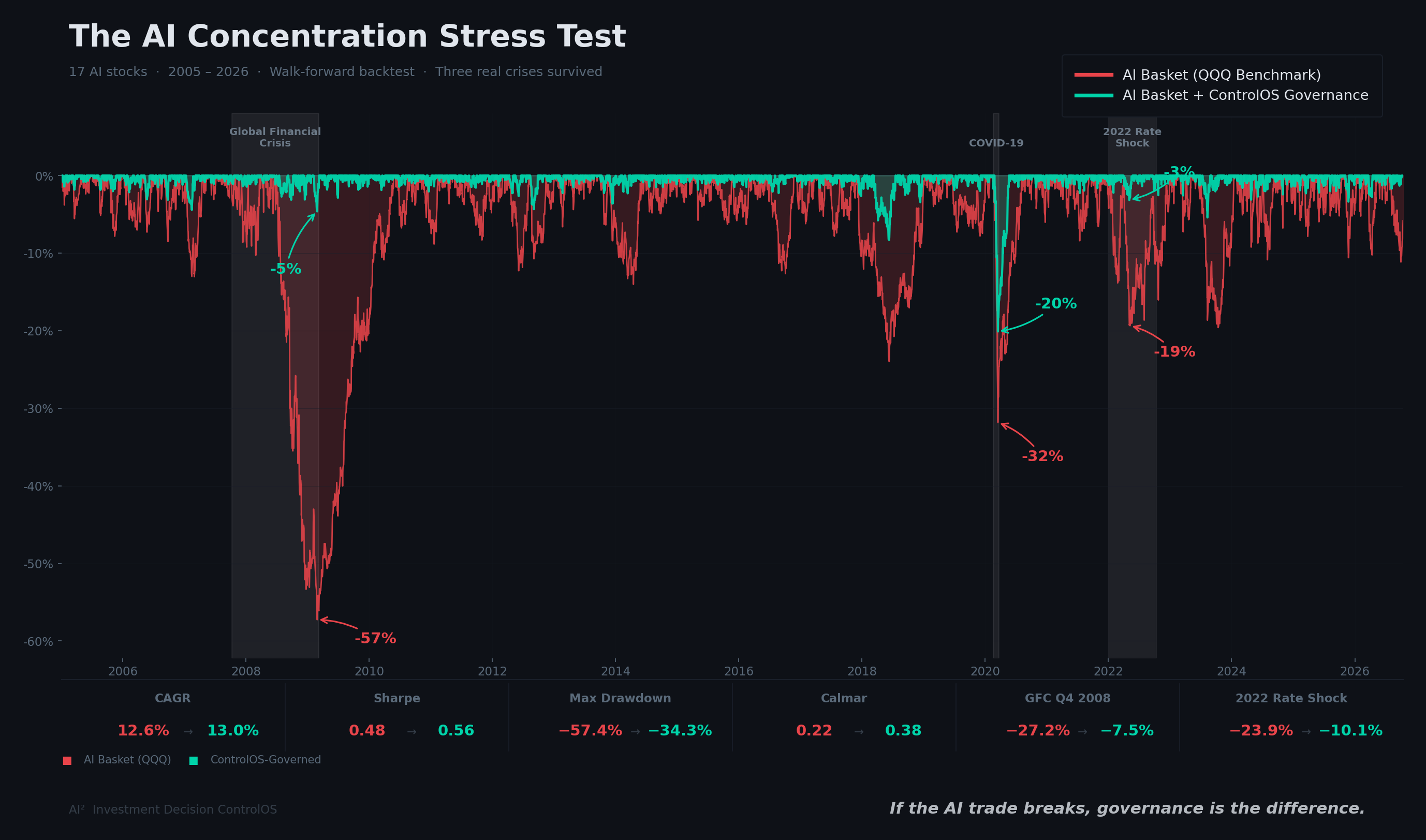
Illustrative. Based on confirmed walk-forward backtest results.
What the Numbers Say
The red line is what a passive investor holding this basket experienced. The teal line is what the same investor would have experienced with ControlOS governance on top of the same stocks.
The headline is in the metrics bar at the bottom. The controller delivered a higher CAGR than the benchmark — 13.0% versus 12.6% — while cutting maximum drawdown from 57.4% to 34.3%. That’s not a trade-off. That’s more return and less pain. The Calmar ratio, which measures return per unit of drawdown, nearly doubled from 0.22 to 0.38. The Sharpe ratio moved from 0.48 to 0.56, meaning risk-adjusted returns improved by 17%.
Then look at the crisis columns. In the fourth quarter of 2008, when Lehman had just gone and the market was in free-fall, the AI basket lost 27.2% in three months. The governed version lost 7.5%. In the second quarter of 2022, when the Fed was raising rates faster than at any point in forty years and growth stocks were being repriced in real time, the AI basket lost 23.9%. The governed version lost 10.1%.
Those aren’t model outputs or projections. Those are what a portfolio holding these stocks under this governance would have done during those specific quarters.
What Makes This Different
Most investment systems attempt to predict the future.
Investment Decision ControlOS is designed to govern exposure.
This distinction matters.
Predictions can be wrong.
Governance can still be right.
The objective is not merely to forecast the next crisis. The objective is to preserve Decision Control when a crisis arrives.
According to Acumentica’s Decision Control Research Lab, many of the largest portfolio losses occur when investors remain committed to assumptions that no longer match the active market regime. This is one of the core challenges addressed by SI Governance, where decision systems must remain governed as operating conditions change.
The challenge is not intelligence. The challenge is adapting exposure while preserving control.
Investment Decision ControlOS was designed specifically for that purpose.
Losing Less Is Only Half the Story
Here’s the thing most people miss about drawdowns. Recovery math is nonlinear.
A portfolio that loses 50% needs to gain 100% just to break even. A portfolio that loses 60% needs to gain 150%. The deeper the hole, the more disproportionate the climb out. This is why two investors in the same market with different drawdowns don’t just end up at different levels; they end up on completely different trajectories.
In our test, the AI basket’s maximum drawdown was 57.4%. To recover from that, it needs to gain 135% from the trough just to get back to where it started. The governed version’s drawdown was 34.3%. To recover from that, it needs 52%.
That difference — 135% versus 52% — is roughly a 61% reduction in the recovery burden. The controller doesn’t just lose less. It climbs out of the hole faster, because the hole is shallower to begin with. Capital spends less time underwater and more time compounding.
This is why the Calmar ratio matters more than people realize. Calmar measures how much return you generate per unit of drawdown pain. The controller’s Calmar of 0.38 versus the benchmark’s 0.22 isn’t just a 73% improvement in a ratio. It’s the difference between a portfolio that compounds steadily and one that spends years digging itself out.
Over twenty-one years, that compounds. The controlled portfolio didn’t just end up with less damage during each crisis. It ended up with a higher CAGR than the benchmark despite being less aggressive — because it wasn’t losing years to recovery.
What This Test Does and Does Not Show
Good governance starts with evidence, not certainty.
This test does not prove that Investment Decision Control OS will outperform during every future market environment. The controller’s value is not derived from predicting markets. It is derived from preserving Decision Control when market conditions change.
It also does not suggest that every crisis behaves the same way. Different regimes create different challenges. The COVID selloff of March 2020, for example, was a rapid panic event that unfolded in weeks, whereas the 2008 Financial Crisis and the 2022 rate shock developed through sustained regime deterioration. The system is designed to detect and govern evolving market conditions rather than predict sudden events.
Nor does this analysis assume that the AI trade will unwind.
Markets may continue higher.
AI adoption may continue accelerating.
The purpose of the controller is not to forecast what happens next.
The purpose is to ensure that if conditions change, portfolios remain governed, auditable, and aligned with approved risk boundaries.
That distinction sits at the heart of Decision Integrity, Constraint Integrity, and disciplined capital governance.
What It Does Say
If you believe AI concentration risk is real, and you believe at some point in the next five years there is a meaningful possibility of a reversal in today’s AI leaders, you have three choices as a fiduciary.
You can underweight AI and risk underperforming your benchmark if the trade continues.
You can hold the concentration and hope the trade never breaks.
Or you can maintain the exposure with governance designed to reduce drawdowns, lower recovery burden, and preserve Decision Control when market conditions change.
This test shows the third option exists.
It shows what governed participation looks like using real stocks, real market history, and real crisis periods.
The controller participated in the upside, delivering a 13.0% CAGR on a concentrated AI basket while reducing drawdowns and shortening recovery periods during major market disruptions.
The result is not about prediction.
The result is about preparation.
That’s the whole thesis.
Participate in the opportunity.
Protect against the unwind.
Preserve Constraint Integrity.
Maintain Decision Control.
Keep the portfolio manager in control of the decisions.
Why This Matters for CIOs
For CIO’s, the concern is not simply performance.
It is accountability.
When concentrated positions drive returns, they also drive exposure.
The question every fiduciary eventually faces is simple: What happens if the regime changes?
Most investment platforms provide analytics.
Most investment platforms provide intelligence.
Few provide a System of Control capable of governing capital exposure through changing market environments.
That is the gap Investment Decision Control OS was built to address.
What’s Underneath This
The system isn’t magic and it isn’t a black box. It’s three layers.
A regime detector reads sixty-three days of market vol, correlation, and dispersion to classify the current environment. A capital control layer translates that regime read into an equity budget; how much of the portfolio should be at risk right now. And an optimizer rebalances the portfolio within that budget, respecting your constraints, your mandates, and your client-specific rules to preserve Constraint Integrity across changing market regimes.
Every decision generates an audit record. If a client asks why their portfolio moved from 95% invested to 70% invested in October 2008, the system shows them the regime signal, the budget calculation, and the rebalancing decision that followed. The PM reviewed it, approved it, and signed off. That’s decision control a compliance team can underwrite.
We’ve validated this behavior across six different crisis types, five different benchmarks, portfolio sizes from ten to forty stocks, and every governance preset we offer.
The protection is structural. It does not depend on a specific basket, benchmark, or market environment. It is the result of a decision control system designed to preserve capital, maintain Constraint Integrity, and govern exposure through changing market regimes.
The Bigger Lesson
The purpose of governance is not to merely predict market tops.
The purpose of governance is to preserve capital when assumptions fail.
Bull markets become bear markets.
Momentum becomes volatility.
Leadership becomes concentration.
Concentration becomes exposure.
The institutions that remain resilient are not necessarily those with the best forecasts.
They are the institutions that maintain Decision Control when the market changes around them.
That principle sits at the center of Decision Integrity, Constraint Integrity, and every governed pathway enforced by Investment Decision Control OS
What To Do Next
If you’re a CIO or portfolio manager running concentrated growth exposure right now, and most of you are whether you chose to or not, this analysis is worth twenty minutes of your time.
Contact us.
We’ll evaluate your portfolio using the same regime-aware stress framework presented here, applying your actual holdings, weights, mandates, and constraints. We’ll show how the portfolio would have behaved through periods such as the 2008 Financial Crisis, the 2020 COVID shock, and the 2022 rate-driven repricing.
The goal is not to sell software.
The goal is to understand how your portfolio behaves when market regimes change.
No sales pitch. Just evidence. Request A Decision Control Walkthrough →
Learn More
Explore how the Capital Decision Control Infrastructure — Category Anchor establishes the governance environment that all enterprise and capital systems operate within.
Learn how the Capital Decision Control Infrastructure — Definition formalizes the discipline of governed intelligence and the fourth‑layer architecture that stabilizes enterprise decision pathways.
Learn how the Agentic AI Control OS stabilizes agentic systems under real‑world constraints.
Decision Control Research Lab
The Decision Control Research Lab researches drift, collapse dynamics, and the Decision‑Control layer; the institutional execution‑governance systems that keep autonomous and enterprise systems stable, aligned, and protected from drift‑driven failure.
Governed Pathways For Navigating Market Regimes
The CIO Boundary: Why AI Cannot Govern Capital Systems
Why Safety AI Fails Without Regime Adaptation
Sovereign Financial SI – The Domain Where Super Intelligence Becomes Sovereign
Constraint Integrity: Why Enterprise Systems Break Without Deterministic Systems
AI Warning Sign: Cutting Through The Marketing Fluff With Decision Control Discipline
AI Bubble: Why Investors Should Grab Popcorn Before The Credits Roll
Governed Agentic Enterprise OS | Governing Enterprise Decisions Under Uncertainty
Capital Decision Control Infrastructure | Governing Decision Behavior Under Pressure
Governed Risk and Compliance Decision Control OS
Prescriptive Decision ControlOS: Governing Next actions, Strategic Alignment and Execution Discipline
Investment Research Governance ControlOS: Governing Research Direction & Exploration in Runtime
Portfolio Governance ControlOS: Preventing Portfolio Drift in Runtime
Risk Governance ControlOS: Runtime Enforcement of Institutional Risk Boundaries
AI Hallucination Drift: When AI Creates False Decisions That Break Institutional Governance
Risk Governance: Preventing drift and overrides in Agentic AI execution
Portfolio Drift: When construction and allocation quietly break strategy
Decision Drift: The Institutional Instability CIOs Can’t See
Portfolio Governance: Stabilizing Investment Decisions in Agentic AI Systems
Why Investment Teams Fail: The Missing Governance Layer
What is Capital Decision Control Infrastructure? The New Architecture Wall Street and Enterprises Will Need
The Missing Layer Between Research and Execution: Decision Control
Why Investment Team Drift Under Uncertainty (and How to Stop It)
About Acumentica
Acumentica is a Precision AI-powered Capital Decision Control Infrastructure company.
We help institutions make better decisions under uncertainty and avoid costly mistakes by transforming complex data, risk, and constraints into clear, disciplined next actions. Request A Decision Control Walkthrough →
Acumentica is the steering and braking layer above Intelligence; the part that governs what intelligence does, not just what it predicts.
Acumentica originated the Capital Decision Control Infrastructure and built the first product in that category; the Decision Control OS. We are the first company to introduce governed capital‑control as a market and technology category thesis.
Glossary Reference
See Acumentica’s [Glossary] for canonical definitions.
Decision Control OS: is the operating system that governs SI‑class systems, enforcing constraints, stabilizing execution, and preventing drift across enterprise and national infrastructures.
SI (Superintelligence): intelligence that operates at sovereign‑scale or enterprise‑scale with the ability to govern execution across mandates, constraints, boundaries, exposures, and fiduciary obligations. SI‑class systems require deterministic governance to prevent drift, override, hallucination, and instability.
SI Governance: the discipline that enforces constraints deterministically across enterprise, capital, and national systems to keep superintelligence‑class execution aligned, stable, drift‑free, and mandate‑compliant. It governs future‑intelligence classes, including superintelligence and sovereign‑scale intelligence.
Control Plane: The governance layer that directs agentic systems.
Closed Loop: A feedback system ensuring accountability and correction.
Governed Intelligence: AI systems operating under explicit decision‑control rules.
AI: is task‑level intelligence that performs localized, probabilistic actions such as generating text, classifying data, or automating workflows.
Constraint Integrity: is the enterprise’s ability to enforce constraints deterministically so systems remain aligned with mandates, boundaries, and fiduciary obligations under all conditions.
Institutional Drift: is the silent misalignment that occurs when systems deviate from mandates and constraints, accumulating exposure over time.
Deterministic Governance: ensures systems always obey constraints and mandates, producing stable, predictable, and aligned execution.
Probabilistic AI: generates actions based on statistical inference rather than constraints, making its behavior non‑deterministic and non‑governing.