

George Fox University Publishes Article on AI Decision Control and Governance
By Ryan D’Souza, Founder & CEO
George Fox University Publishes Article on AI Decision Control and Governance
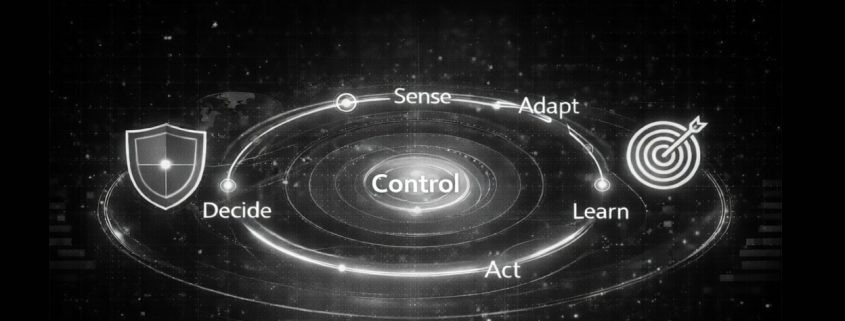
I am honored to share that George Fox University recently published my article, The AI Problem Institutions and Students Aren’t Seeing Yet … But Will. The article explores why many organizations focus on AI intelligence while overlooking the larger challenge of governing decisions under uncertainty. It examines decision drift, AI governance, and the role of decision control in helping institutions maintain alignment during periods of change and volatility.
Published by George Fox University
The AI Problem Institutions and Students Aren’t Seeing Yet … But Will
Learn More
Explore how the Capital Decision Control Infrastructure — Category Anchor establishes the decision control environment that all enterprise and capital systems operate within. Learn how the Capital Decision Control Infrastructure — Definition formalizes the discipline of governed intelligence and the fourth‑layer architecture that stabilizes enterprise decision pathways. Learn how the Agentic AI Control OS stabilizes agentic systems under real‑world constraints.
Decision Control Research Lab
The Decision Control Research Lab researches drift, collapse dynamics, and the Decision‑Control layer; the institutional execution‑governance systems that keep autonomous and enterprise systems stable, aligned, and protected from drift‑driven failure.
Vendor AI Drift: The Enterprise Largest Unmonitored Runtime Failure
The CIO Hidden Failure Mode: Why Open-Loop AI Is Now the Largest Uncontrolled Risk in the Enterprise
Constraint Integrity: Why Enterprise Systems Break Without Deterministic Systems
If the AI Trade Breaks, Your Portfolio Doesn’t Have To. Evidence From 21 Years of Market Stress
When The Tech Last Broke. What The Dot-Com Tells Us About The AI Bubble. Investment Decision ControlOS
AI Bubble: Why Investors Should Grab Popcorn Before The Credits Roll
The Aschenbrenner Collaspe: The First Major Failure of a System Without Council Capital Decision Control Infrastructure
Governed Pathways For Navigating Market Regimes
The CIO Boundary: Why AI Cannot Govern Capital Systems
Why Safety AI Fails Without Regime Adaptation
Sovereign Financial SI – The Domain Where Super Intelligence Becomes Sovereign
AI Warning Sign: Cutting Through The Marketing Fluff With Decision Control Discipline
Governed Agentic Enterprise OS | Governing Enterprise Decisions Under Uncertainty
Capital Decision Control Infrastructure | Governing Decision Behavior Under Pressure
Governed Risk and Compliance Decision Control OS
Prescriptive Decision ControlOS: Governing Next actions, Strategic Alignment and Execution Discipline
Investment Research Governance ControlOS: Governing Research Direction & Exploration in Runtime
Portfolio Governance ControlOS: Preventing Portfolio Drift in Runtime
Risk Governance ControlOS: Runtime Enforcement of Institutional Risk Boundaries
AI Hallucination Drift: When AI Creates False Decisions That Break Institutional Governance
Risk Governance: Preventing drift and overrides in Agentic AI execution
Portfolio Drift: When construction and allocation quietly break strategy
Decision Drift: The Institutional Instability CIOs Can’t See
Portfolio Governance: Stabilizing Investment Decisions in Agentic AI Systems
Why Investment Teams Fail: The Missing Governance Layer
What is Capital Decision Control Infrastructure? The New Architecture Wall Street and Enterprises Will Need
The Missing Layer Between Research and Execution: Decision Control
Why Investment Team Drift Under Uncertainty (and How to Stop It)
About Acumentica
Acumentica is a Precision AI-powered Capital Decision Control Infrastructure company. We help institutions make better decisions under uncertainty and avoid costly mistakes by transforming complex data, risk, and constraints into clear, disciplined next actions. Request A Decision Control Walkthrough →
Acumentica is the steering and braking layer above Intelligence; the part that governs what intelligence does, not just what it predicts. Acumentica originated the Capital Decision Control Infrastructure and built the first product in that category; the Decision Control OS. We are the first company to introduce governed capital‑control as a market and technology category thesis.
Glossary Reference
See Acumentica’s [Glossary] for canonical definitions.
Decision Control OS: is the operating system that governs SI‑class systems, enforcing constraints, stabilizing execution, and preventing drift across enterprise and national infrastructures.
SI (Superintelligence): intelligence that operates at sovereign‑scale or enterprise‑scale with the ability to govern execution across mandates, constraints, boundaries, exposures, and fiduciary obligations. SI‑class systems require deterministic governance to prevent drift, override, hallucination, and instability.
SI Governance: the discipline that enforces constraints deterministically across enterprise, capital, and national systems to keep superintelligence‑class execution aligned, stable, drift‑free, and mandate‑compliant. It governs future‑intelligence classes, including superintelligence and sovereign‑scale intelligence.
Control Plane: The governance layer that directs agentic systems.
Closed Loop: A feedback system ensuring accountability and correction.
Governed Intelligence: AI systems operating under explicit decision‑control rules.
AI: is task‑level intelligence that performs localized, probabilistic actions such as generating text, classifying data, or automating workflows.
Constraint Integrity: is the enterprise’s ability to enforce constraints deterministically so systems remain aligned with mandates, boundaries, and fiduciary obligations under all conditions.
Institutional Drift: is the silent misalignment that occurs when systems deviate from mandates and constraints, accumulating exposure over time.
Deterministic Governance: ensures systems always obey constraints and mandates, producing stable, predictable, and aligned execution.
Probabilistic AI: generates actions based on statistical inference rather than constraints, making its behavior non‑deterministic and non‑governing.