

Constraint Integrity: Why Enterprise Systems Break Without Deterministic Systems
By Team Acumentica
Constraint Integrity: Why Enterprise Systems Break Without Deterministic Governance
Why constraints fail across ERP, CRM, workflow automation, and agentic AI; and how Decision Control OS restores enterprise stability.
1. Constraint Integrity: The Missing Discipline in Enterprise Systems
Constraint Integrity is the enterprise’s ability to enforce constraints deterministically across all systems; legacy and AI‑driven.
When Constraint Integrity fails, systems begin to:
- violate mandates
- bypass compliance boundaries
- misalign with fiduciary obligations
- generate silent exposure
- drift from institutional intent
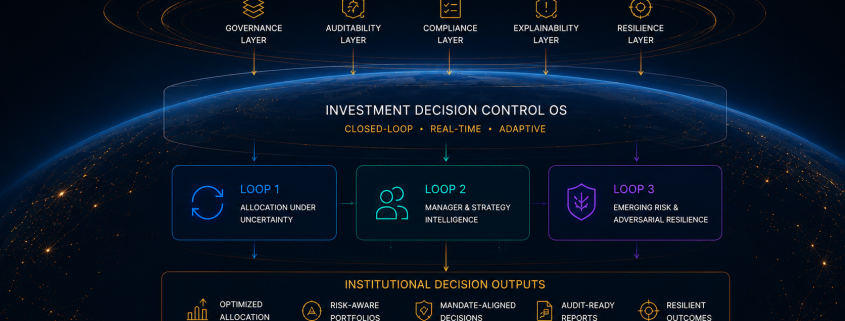
This failure is the root cause of enterprise instability. Explore: Decision Control OS
2. Why Constraints Fail in Today’s Enterprise Systems
Enterprise systems were built for execution, not governance.
ERP systems
Optimize throughput but ignore regulatory boundaries.
CRM systems
Adapt workflows but misalign with fiduciary obligations.
Workflow automation
Accelerates execution but erodes constraint integrity.
Compliance systems
Detect violations but do not enforce constraints.
Agentic AI
Generates actions probabilistically, not deterministically.
This is why constraints fail; the systems were never designed to enforce them. Explore: Governance Domains
3. Constraint Failure Is Industry‑Agnostic
Constraint failure is not tied to any single sector. It emerges anywhere systems operate under mandates and boundaries.
Aerospace
Safety constraints drift when optimization engines override regulatory requirements.
Construction & Infrastructure
Cost‑driven automations bypass safety and compliance constraints.
Real Estate & Property Operations
Pricing and underwriting systems drift from fiduciary constraints.
Risk engines optimize portfolios outside mandate boundaries.
Higher Education
Enrollment and funding systems drift from institutional mission constraints.
Constraint failure is universal because every industry depends on constraints. Explore: Capital Decision Control Infrastructure
4. How Agentic AI Accelerates Constraint Failure
Agentic AI systems amplify constraint failure because they:
- optimize outside mandates
- adapt beyond boundaries
- self‑correct into misalignment
- generate actions probabilistically
- accelerate execution without governance
Probabilistic reasoning layered onto deterministic workflows creates compound drift. Explore: Governed Agentic Enterprise OS
5. Constraint Failure → Drift → Exposure → Institutional Risk
Constraint failure is the first domino.
Step 1 — Constraint Failure
Systems deviate from boundaries.
Step 2 — Drift
Small deviations accumulate silently.
Step 3 — Exposure
Misalignment becomes compliance or fiduciary risk.
Step 4 — Institutional Risk
Mandates collapse, boundaries erode, integrity breaks.
This is the physics of enterprise instability.
6. Why CIO’s Cannot See Constraint Failure
CIO dashboards measure:
- uptime
- throughput
- latency
- productivity
But they do not measure:
- constraint adherence
- mandate enforcement
- compliance stability
- institutional alignment
- drift accumulation
Constraint failure is invisible until it becomes exposure.
7. How Decision Control OS Enforces Constraint Integrity
Decision Control OS restores Constraint Integrity by:
- enforcing mandates deterministically
- stabilizing constraints under uncertainty
- governing execution across all systems
- preventing drift before it forms
- aligning actions with fiduciary obligations
- preserving institutional integrity
Constraint Integrity is not a feature; it is the governance substrate.
8. SI Governance: The Enforcement Architecture Behind Constraint Integrity
Constraint Integrity does not exist on its own. It is enforced by System‑Intelligence Governance (SI Governance); the discipline that ensures enterprise systems obey mandates, constraints, and institutional boundaries under all conditions.
SI Governance provides:
- deterministic enforcement of constraints
- mandate alignment across all enterprise systems
- boundary stability under uncertainty
- drift prevention across ERP, CRM, workflow engines, and agentic AI
- institutional integrity across execution environments
Where enterprise systems drift, SI Governance stabilizes.
Where constraints erode, SI Governance restores.
Where AI accelerates misalignment, SI Governance governs.
SI Governance is the governance substrate that makes Constraint Integrity operational across the entire enterprise stack.
9. CIO Checklist: Constraint Integrity Requirements
Every enterprise system; ERP, CRM, workflow automation, risk engines, agentic AI; must demonstrate:
- Mandate adherence
- Constraint enforcement
- Compliance stability
- Decision lineage
- Drift detection
- Exposure prevention
If any are missing, Constraint Integrity is broken.
10. SI Governance & National‑Readiness; Constraint Integrity at National Scale
Constraint Integrity at National Scale: SI Governance & National‑Readiness
Constraint Integrity is not only an enterprise requirement; it is a national‑readiness requirement.
Governments, agencies, and national‑scale institutions operate under:
- regulatory mandates
- constitutional boundaries
- fiduciary obligations
- public‑sector constraints
- national‑security requirements
When constraints fail at national scale, the consequences are systemic:
- regulatory collapse
- institutional drift
- capital‑system instability
- safety‑system failure
- national‑readiness degradation
SI Governance & National‑Readiness provides the enforcement model that ensures constraints remain stable under SI‑class conditions; before those conditions exist.
It is the governance layer that:
- maintains constraint integrity across national systems
- prevents drift in public‑sector AI deployments
- stabilizes autonomous behavior under national mandates
- enforces boundaries across capital‑scale decision environments
- protects institutional integrity at national scale
Constraint Integrity is not optional for national‑readiness. It is the precondition.
Learn More
Explore how the Capital Decision Control Infrastructure — Category Anchor establishes the governance environment that all enterprise and capital systems operate within.
Learn how the Capital Decision Control Infrastructure — Definition formalizes the discipline of governed intelligence and the fourth‑layer architecture that stabilizes enterprise decision pathways.
Learn how the Agentic AI Control OS stabilizes agentic systems under real‑world constraints.
Decision Control Research Lab
The Decision Control Research Lab researches drift, collapse dynamics, and the Decision‑Control layer; the institutional execution‑governance systems that keep autonomous and enterprise systems stable, aligned, and protected from drift‑driven failure.
AI Warning Sign: Cutting Through The Marketing Fluff With Decision Control Discipline
AI Bubble: Why Investors Should Grab Popcorn Before The Credits Roll
Governed Agentic Enterprise OS | Governing Enterprise Decisions Under Uncertainty
Capital Decision Control Infrastructure | Governing Decision Behavior Under Pressure
Governed Risk and Compliance Decision Control OS
Prescriptive Decision ControlOS: Governing Next actions, Strategic Alignment and Execution Discipline
Investment Research Governance ControlOS: Governing Research Direction & Exploration in Runtime
Portfolio Governance ControlOS: Preventing Portfolio Drift in Runtime
Risk Governance ControlOS: Runtime Enforcement of Institutional Risk Boundaries
AI Hallucination Drift: When AI Creates False Decisions That Break Institutional Governance
Risk Governance: Preventing drift and overrides in Agentic AI execution
Portfolio Drift: When construction and allocation quietly break strategy
Decision Drift: The Institutional Instability CIOs Can’t See
Portfolio Governance: Stabilizing Investment Decisions in Agentic AI Systems
Why Investment Teams Fail: The Missing Governance Layer
What is Capital Decision Control Infrastructure? The New Architecture Wall Street and Enterprises Will Need
The Missing Layer Between Research and Execution: Decision Control
Why Investment Team Drift Under Uncertainty (and How to Stop It)
About Acumentica
Acumentica is a Precision AI-powered Capital Decision Control Infrastructure company.
We help institutions make better decisions under uncertainty and avoid costly mistakes by transforming complex data, risk, and constraints into clear, disciplined next actions. Request a demo
Acumentica is the steering and braking layer above Intelligence; the part that governs what intelligence does, not just what it predicts.
Acumentica originated the Capital Decision Control Infrastructure and built the first product in that category; the Decision Control OS. We are the first company to introduce governed capital‑control as a market and technology category thesis.
Glossary Reference
Constraint Integrity: The enterprise’s ability to enforce constraints deterministically so systems remain aligned with mandates, boundaries, and fiduciary obligations under all conditions.
Control Plane: The governance layer that directs agentic systems.
Closed Loop: A feedback system ensuring accountability and correction.
Governed Intelligence: AI systems operating under explicit decision‑control rules.
See Acumentica’s [Glossary] for canonical definitions.