

Behavioral and Adversarial Resilience ControlOS: Governing Portfolio Fragility, Market Stress and Behavioral Pressure Before Capital Is Exposed
By Team Acumentica
Behavioral & Adversarial Resilience ControlOS: Governing Portfolio Fragility, Market Stress & Behavioral Pressure Before Capital Is Exposed
Portfolios rarely fail because teams lack analytics or dashboards. They fail when assumptions, market structure, and human behavior break at the same time.
Volatility rises. Correlations compress. Liquidity thins. Signals get crowded. Committees feel drawdown pressure. And decisions that looked reasonable on paper suddenly become fragile in the real world.
Behavioral & Adversarial Resilience ControlOS is Acumentica’s active resilience layer inside the AI Investment Decision ControlOS. It is built to challenge portfolio decisions before capital is committed, under the conditions that actually damage real portfolios:
- market stress and volatility shocks
- behavioral pressure and loss aversion
- crowding and execution strain
- liquidity gaps and adverse selection
- worst‑case drawdown exposure
Instead of asking, “Did this work?” after the fact, it asks, “Will this remain resilient when markets and investors behave badly?”
Why portfolios fail under stress
Traditional risk and performance tools are mostly backward‑looking. They summarize what happened, not whether a decision will remain resilient when:
- volatility spikes and correlations move together
- liquidity weakens and execution becomes costly
- signals become crowded and exits are constrained
- committees face drawdown pressure and behavioral stress
In those conditions, behavior and structure matter as much as exposure. Portfolios fail when teams cannot see fragility clearly enough to adjust size, timing, hedging, or execution.
Behavioral & Adversarial Resilience ControlOS is designed to surface that fragility before it becomes portfolio damage.
What Behavioral & Adversarial Resilience ControlOS helps control
1. Market stress and structural fragility
It evaluates how portfolios behave under:
- volatility shocks and correlation spikes
- inflation and regime pressure
- liquidity gaps and spread widening
- drawdown stress across benchmarks and custom portfolios
The goal is simple: find where the structure breaks under stress, not just where exposure looks acceptable.
2. Behavioral risk and decision pressure
Markets don’t just move prices; they move people.
This module helps teams recognize:
- loss aversion and panic selling
- delayed action and “wait and hope” behavior
- overreaction to short‑term moves
- drawdown‑driven pressure on committees and clients
By surfacing behavioral risk alongside structural fragility, it gives CIO’s and committees a clearer basis for disciplined decisions under pressure.
3. Crowding, execution and adverse selection
Signals and trades can look attractive in isolation but become fragile when:
- too many participants chase the same idea
- liquidity concentrates in narrow windows
- exits depend on optimistic assumptions about volume and spreads
Behavioral & Adversarial Resilience ControlOS highlights:
- crowding risk in signals and positions
- execution pressure and slippage vulnerability
- adverse selection risk when entering or exiting trades
It turns “this looks good” into “this remains executable when everyone else wants out.”
4. Risk budget discipline and governance alignment
Resilience is not just about surviving stress; it’s about staying inside mandates and governance.
This module supports alignment with:
- risk budgets and exposure limits
- committee standards and oversight requirements
- institutional governance rules and capital policies
It helps teams validate that proposed actions remain inside policy even when conditions deteriorate.
5. Decision confidence for committees and CIO’s
The output is not a black‑box verdict. It is decision evidence.
Behavioral & Adversarial Resilience ControlOS gives investment teams a clearer basis to:
- approve or reduce a position
- hedge or delay an action
- resize exposure or escalate for further review
The focus is on committee‑ready evidence that can be explained under stress, not opaque model output.
6. Proprietary protection with transparent outcomes
The system communicates:
- resilience findings
- fragility points
- stress behavior
- decision evidence
without exposing Acumentica’s proprietary formulas, models, or implementation details. Institutions see what matters for governance, not the internals of the engine.
Governance‑Protected Resilience Under Market Stress and Behavioral Pressure
Portfolio Drawdown Analysis; Governance‑Protected vs. S&P 500 (2000–2026) Walk‑forward backtest with no lookahead bias.
Same stocks. Same market. Different outcome.
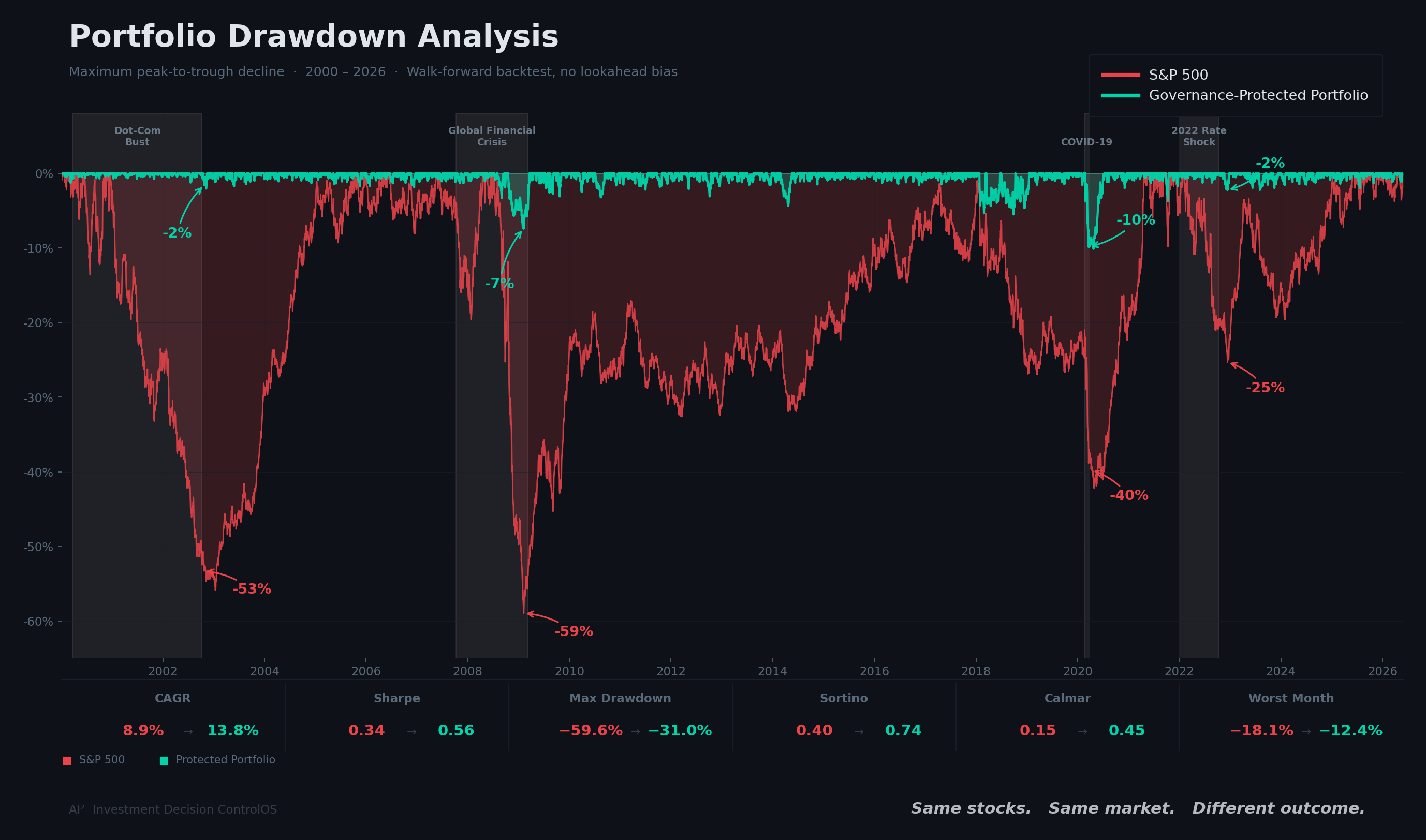
The chart demonstrates how portfolios behave when markets and investors come under pressure. Across four major stress events; the Dot‑Com Bust, Global Financial Crisis, COVID‑19, and the 2022 Rate Shock; the Governance‑Protected Portfolio experienced significantly smaller drawdowns, lower behavioral fragility, and more stable recovery behavior.
This is the core purpose of Behavioral & Adversarial Resilience ControlOS:
- challenge decisions under market stress
- expose behavioral pressure points
- surface crowding and liquidity fragility
- reveal worst‑case drawdown exposure
- strengthen committee‑ready decision evidence
The resilience shown in the chart is not a prediction; it is the result of governed decision pathways that prevent fragile choices before capital is exposed.
Governance‑Protected Outcomes
Governance‑Protected Portfolio Outcomes (2000–2026)
- CAGR: 8.9% → 13.8%
- Sharpe: 0.34 → 0.56
- Max Drawdown: −59.6% → −31.0%
- Sortino: 0.40 → 0.74
- Calmar: 0.15 → 0.45
- Worst Month: −18.1% → −12.4%
These outcomes illustrate how resilience governance changes the behavior of a portfolio under stress; not by changing the market, but by changing the decision architecture that interacts with it.
Same stocks. Same market. Different outcome; because of governance. Behavioral & Adversarial Resilience ControlOS strengthens investment decisions before capital is exposed, giving CIO’s and committees clearer evidence for approval, sizing, hedging, delay, or rejection.
Why It Matters
Behavioral & Adversarial Resilience ControlOS exists because portfolios do not fail under normal conditions; they fail when markets and investors behave badly at the same time.
When volatility spikes, liquidity thins, correlations compress, and committees feel drawdown pressure, even well‑constructed portfolios become fragile. Traditional analytics cannot surface this fragility because they describe risk, not behavior under stress.
This module matters because it challenges investment decisions before capital is exposed, under the exact conditions that historically cause real portfolio damage:
- market stress and regime shocks
- behavioral pressure and loss aversion
- crowding and execution strain
- liquidity gaps and adverse selection
- worst‑case drawdown exposure
It gives CIO’s and committees decision evidence, not just dashboards; helping them approve, resize, hedge, delay, or reject decisions with clarity and discipline.
Behavioral & Adversarial Resilience ControlOS strengthens the investment process by preventing fragile decisions from entering the portfolio in the first place. It is a governance layer designed to protect capital when markets, structure, and human behavior are under maximum pressure.
Built for institutional decision‑makers
Behavioral & Adversarial Resilience ControlOS is designed for:
- CIO’s and investment committees
- family offices and RIA’s
- hedge funds and institutional allocators
- portfolio risk and oversight teams
It strengthens:
- committee confidence before capital allocation
- governance around risk, behavior, and capital decisions
- client‑facing explanations when markets become difficult
From analytics to decision governance
Traditional analytics describe risk. Behavioral & Adversarial Resilience ControlOS governs decisions.
Outcomes include:
- fewer fragile decisions approved under stress
- clearer communication of risk and resilience
- stronger committee evidence for sizing, hedging, delay, or rejection
- more disciplined behavior when markets and investors are under pressure
It is part of the broader Capital Decision Control Infrastructure, where Acumentica focuses on what intelligence does, not just what it predicts.
Position inside AI Investment Decision ControlOS
Behavioral & Adversarial Resilience ControlOS operates as an active control layer inside the AI Investment Decision ControlOS, alongside:
- Risk Governance ControlOS; governing institutional risk boundaries in runtime
- Portfolio Governance ControlOS; preventing portfolio drift and strategy breakage
- Performance Governance ControlOS; governing throughput, latency and execution stability
- Exposure Governance ControlOS; governing factor, regime and thematic exposure
- Prescriptive ControlOS; governing prescriptive actions and recommendations
- What-if Control ControlOS; governs scenario pathways by stress‑testing decisions against alternative market, behavioral, and structural conditions before capital is exposed.
Together, these modules form a unified governance fabric that stabilizes investment decisions before, during, and after capital is exposed.
Industry‑Agnostic Resilience
This module applies across:
- Aerospace & Defense; supply‑chain shocks, geopolitical stress, procurement delays
- Real Estate; liquidity compression, refinancing pressure, regime‑driven valuation swings
- Construction & Infrastructure; cost overruns, contract fragility, timeline volatility
- Universities & Endowments; committee behavior, donor pressure, long‑horizon drawdown sensitivity
- Any capital‑dependent environment where decisions must remain resilient under stress
Resilience is not a sector feature; it is a governance requirement. Behavioral & Adversarial Resilience ControlOS ensures that decisions remain stable, disciplined, and aligned with institutional intent regardless of industry, asset class, or operating environment.
It is part of the broader Capital Decision Control Infrastructure, where Acumentica governs how decisions behave under pressure, not just how they perform under ideal conditions.
Conclusion
Behavioral & Adversarial Resilience ControlOS strengthens the investment decision process by exposing fragility before capital is committed. Market stress, liquidity gaps, crowding, and behavioral pressure are the conditions that historically damage real portfolios; not the calm, predictable environments most analytics assume. This module challenges decisions under those adverse conditions, giving CIO’s and committees clearer evidence for approval, sizing, hedging, delay, or rejection.
Resilience is not a feature of a model; it is a feature of governed decision architecture. By surfacing structural, behavioral, and adversarial vulnerabilities early, Behavioral & Adversarial Resilience ControlOS helps institutions avoid fragile choices, maintain discipline under pressure, and protect capital when markets and investors behave unpredictably.
It is a core component of Acumentica’s AI Investment Decision ControlOS, ensuring that investment decisions remain stable, aligned, and resilient across all market regimes and institutional environments.
FAQ
What is Behavioral & Adversarial Resilience ControlOS? It is an investment resilience layer inside AI Investment Decision‑Control OS that challenges portfolio decisions against market stress, behavioral pressure, crowding, liquidity strain, and worst‑case drawdown before capital is exposed.
Does it reveal Acumentica’s proprietary models? No. It communicates benefits, evidence, and institutional outcomes without exposing proprietary formulas or implementation.
Who is it built for? CIO’s, family offices, RIAs, hedge funds, institutional allocators, portfolio risk teams, and investment committees.
Does it replace the investment committee? No. It improves the evidence available to decision‑makers. The goal is better governance, not replacement of judgment.
Does it guarantee future performance? No. It supports discipline and governance under uncertainty. Investment decisions still involve risk, including possible loss of capital.
Learn More
Explore how the Investment Decision ControlOS governs autonomous reasoning, execution, and performance across institutional systems.
Learn how FRIDA stabilizes runtime behavior through governed agentic reasoning and recursion control.
Decision Control Research Lab
The Decision Control Research Lab researches drift, collapse dynamics, and the Decision‑Control layer; the institutional execution‑governance systems that keep autonomous and enterprise systems stable, aligned, and protected from drift‑driven failure.
Investment Research Governance ControlOS: Governing Research Direction & Exploration in Runtime
Portfolio Governance ControlOS: Preventing Portfolio Drift in Runtime
Risk Governance ControlOS: Runtime Enforcement of Institutional Risk Boundaries
AI Hallucination Drift: When AI Creates False Decisions That Break Institutional Governance
Risk Governance: Preventing drift and overrides in Agentic AI execution
Portfolio Drift: When construction and allocation quietly break strategy
Decision Drift: The Institutional Instability CIOs Can’t See
Portfolio Governance: Stabilizing Investment Decisions in Agentic AI Systems
Why Investment Teams Fail: The Missing Governance Layer
What is Capital Decision Control Infrastructure? The New Architecture Wall Street and Enterprises Will Need
The Missing Layer Between Research and Execution: Decision Control
Why Investment Team Drift Under Uncertainty (and How to Stop It)
About Acumentica
Acumentica is a Precision AI-powered Capital Decision Control Infrastructure company.
We help institutions make better decisions under uncertainty and avoid costly mistakes by transforming complex data, risk, and constraints into clear, disciplined next actions. Request a demo
Acumentica is the steering and braking layer above Intelligence; the part that governs what intelligence does, not just what it predicts.
Acumentica originated the Capital Decision Control Infrastructure and built the first product in that category; the Decision Control OS. We are the first company to introduce governed capital‑control as a market and technology category thesis.
Glossary Reference
Control Plane: The governance layer that directs agentic systems.
Closed Loop: A feedback system ensuring accountability and correction.
Governed Intelligence: AI systems operating under explicit decision‑control rules.
See Acumentica’s [Glossary] for canonical definitions.