

Investment Decision Control OS: Governing Institutional Investment Decisions Under Uncertainty
Author: Ryan D’Souza, Founder & CEO, Acumentica
Stopping Decision Drift: Why Institutions Need a Decision Control OS
Introduction
Decision drift is now one of the most urgent problems CIO’s face. Every quarter, institutions discover that decisions; human, automated, or AI‑assisted; have quietly diverged from strategy, mandates, or risk boundaries. Not because teams acted recklessly, but because investment systems executed without a governed decision layer.
CIO’s are asking a new question: “How do we govern every decision our systems make?”
They’ve tried workflow platforms, dashboards, and risk tools. But none of them solve the core issue. The problem isn’t visibility. The problem is control.
That’s why Acumentica created a new category: the Decision Control OS.
Inside this OS, the Investment Decision Control OS is the governed execution system that stabilizes institutional investment decisions, prevents drift, and ensures every action reinforces institutional authority.
The CIO Pain
CIO’s today are overwhelmed by a new kind of instability:
- Research systems push signals that weren’t approved.
- Construction logic builds positions outside mandate boundaries.
- Allocation systems adjust weights without authority validation.
- Risk engines rebalance exposure beyond governed limits.
- Automated workflows execute tasks without governance.
- AI‑assisted tools optimize without constraints.
The pain is real, and CIO’s describe it plainly:
- “Our systems are making decisions we didn’t authorize.”
- “We need governance that works across all decision systems.”
- “We need a way to enforce authority before execution.”
This is exactly the gap the Investment Decision Control OS fills.
Introducing the Primitive
The answer isn’t another workflow platform. It isn’t another dashboard. It isn’t another risk tool.
The answer is a system of control; a new category: the Decision Control OS.
Inside this OS, the Investment Decision ControlOS is the product that governs:
- research
- construction
- allocation
- risk
- mandates
- execution pathways
It ensures no system; human, automated, or AI‑assisted; can execute outside institutional authority, risk boundaries, or governed decision pathways.
The Investment Decision Control OS is not a feature. It is a governed execution system; the structural layer that stabilizes institutional investment decisions.
Category Explanation
Why Workflow Platforms Fail
Workflow platforms automate tasks, but they do not govern decisions.
They can:
- track changes
- visualize exposure
- provide alerts
But they cannot:
- prevent decision drift
- enforce mandates
- govern execution
- stabilize decision‑making
- unify research → construction → allocation → risk
CIO’s end up with visibility, not control.
This is why institutions need a Decision Control OS, not another workflow tool.
What the Investment Decision Control OS Actually Does
The Investment Decision Control OS delivers five core governed capabilities:
1. Governed Research Pathways
Research enters decisions through governed logic. Signals cannot push actions outside mandates or risk boundaries.
2. Governed Construction
Portfolio construction is constrained by authority, risk, and mandate boundaries. No system can build positions outside governed limits.
3. Governed Allocation
Capital moves only through approved pathways. Allocation drift is prevented before it happens.
4. Governed Risk
Exposure, factors, liquidity, and regimes remain within governed boundaries. Risk engines cannot override authority.
5. Mandate Enforcement
Authority is enforced before execution. No system can act outside CIO or board mandates.
These capabilities unify the four governance domains:
- Research Governance
- Portfolio Governance
- Risk Governance
- Mandate Governance
into a single governed execution system.
Case Example: Investment Decision Control OS in Action
Imagine an institution where decisions come from multiple systems:
- Research systems generate signals
- Construction systems build positions
- Allocation systems adjust weights
- Risk engines rebalance exposure
- Automated workflows execute tasks
- AI‑assisted tools optimize strategies
Without the Investment Decision Control OS
- Research pushes a signal outside mandate boundaries
- Construction builds positions that violate authority
- Allocation adjusts weights beyond risk limits
- Risk engines rebalance exposure without governance
- CIO’s discover the violation weeks later
With the Investment Decision Control OS
- Every system routes decisions through governed pathways
- Authority boundaries are enforced
- Risk governance evaluates exposure
- Portfolio governance checks alignment
- CIO’s approve or override
- The institution remains governed
This is the difference between decision drift and governed execution.
Why Traditional Investment Governance Fails
Traditional governance frameworks were built for human‑led decision‑making. They assume:
- slow review cycles
- manual approvals
- human interpretation
- limited autonomy
Modern institutions break all of these assumptions.
Systems:
- execute instantly
- interpret mandates inconsistently
- explore across domains simultaneously
- optimize without waiting for approval
Only a Decision Control OS can govern decisions across all systems at institutional speed.
The Decision Control OS Advantage
The Investment Decision Control OS is the first system designed to govern investment decisions across all institutional systems.
It ensures:
- authority boundaries are enforced
- risk limits are respected
- allocation pathways are governed
- research signals are constrained
- execution is stabilized
- institutional integrity is protected
This is how institutions transform complexity into governed stability.
Category Ownership
Acumentica created the Decision Control OS category; the first system of control designed to eliminate decision drift.
The Investment Decision Control OS is the governed execution system that ensures institutions can innovate, automate, and scale without losing control.
By embedding governed decision pathways into the investment process, Acumentica defines the future of institutional investment governance.
Learn More
If your investment organization is looking to eliminate mandate drift, enforce governed authority across all decision systems, stabilize research‑to‑allocation pathways, and maintain execution consistency under uncertainty, explore how Acumentica’s Investment Decision ControlOS provides a governed, operator‑led decision layer for institutional investment execution; ensuring every research insight, construction action, allocation move, and risk adjustment operates within institutional mandates and governed decision pathways. Also Learn about Frida our Agentic AI ControlOS that operates inside the Investment Decision Control OS, using governed decision pathways.
Decision Control Research Lab
Risk Governance: Preventing drift and overrides in Agentic AI execution
Portfolio Governance: Stabilizing Investment Decisions in Agentic AI Systems
Why Investment Teams Fail: The Missing Governance Layer
What is Capital Decision Control Infrastructure? The New Architecture Wall Street and Enterprises Will Need
The Missing Layer Between Research and Execution: Decision Control
Why Investment Team Drift Under Uncertainty (and How to Stop It)
About Acumentica
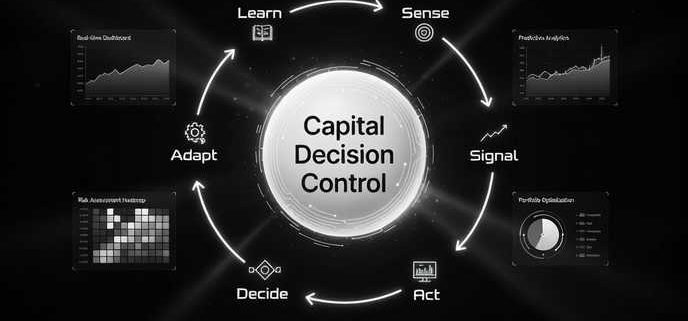
Acumentica is a Precision AI-powered Capital Decision Control Infrastructure company.
We help institutions make better decisions under uncertainty and avoid costly mistakes by transforming complex data, risk, and constraints into clear, disciplined next actions. Request a demo
Acumentica is the steering and braking layer above Intelligence; the part that governs what AI does, not just what it predicts.
Acumentica is the creator of the Capital Decision Control Infrastructure and the Decision Control OS; the first company to establish governed capital‑control as a market and technology category.