

Enterprise AI Infrastructure vs. AI SaaS: Why the Future Will Be Built on Intelligence Infrastructure
Author: Team Acumetica
Enterprise AI Infrastructure vs. AI SaaS: Why the Future Will Be Built on Intelligence Infrastructure
For the last twenty years, enterprise software has largely followed the same model.
A company identifies a workflow problem, buys a SaaS platform, configures dashboards, trains employees, and standardizes processes around that system. Whether it was CRM, ERP, HR software, analytics platforms, or workflow management tools, the pattern remained remarkably consistent.
Software became the operating layer of the modern enterprise.
But artificial intelligence is beginning to change something much deeper than software functionality.
It is changing the nature of enterprise operations themselves.
That shift is bigger than most organizations realize.
Many companies still think of AI as:
- a chatbot,
- a productivity assistant,
- a copilot,
- or a feature embedded into existing software.
That view is already becoming outdated.
The next phase of enterprise AI is not about adding intelligence to software applications. It is about building intelligence directly into operational infrastructure.
That is a fundamentally different category.
At Acumentica, we believe this transition marks the emergence of what we call:
Precision AI Decision Control Infrastructure
And over the next decade, it may become one of the most important shifts in enterprise technology.
Learn more about Acumentica’s Capital Decision Control Infrastructure.
SaaS Was Designed for Workflows. AI Changes the Nature of Work Itself.
Traditional SaaS platforms were built around structure.
A workflow gets defined.
A process gets digitized.
Users follow a sequence.
Data gets stored and retrieved.
That model worked extremely well during the cloud computing era because businesses primarily needed:
- organization,
- accessibility,
- collaboration,
- and workflow standardization.
But AI changes the equation because intelligence is no longer static.
AI systems can:
- interpret,
- reason,
- predict,
- optimize,
- adapt,
- and continuously evolve.
That introduces a completely different operational dynamic.
The problem is that most SaaS architectures were never designed for continuously adaptive intelligence.
They were designed for process execution.
That distinction matters far more than most companies currently understand.
The Enterprise Environment Has Become Too Dynamic for Static Software
Modern enterprises do not operate in stable environments anymore.
Organizations now manage:
- distributed infrastructure,
- global supply chains,
- real-time operational telemetry,
- cybersecurity threats,
- volatile financial markets,
- regulatory complexity,
- and rapidly shifting economic conditions.
Static software struggles in these environments because it relies heavily on:
- predefined logic,
- manual workflows,
- and human-driven adaptation.
AI introduces the possibility of systems that can adapt continuously instead of waiting for human intervention.
That is where the market begins moving away from software applications and toward operational control infrastructure.
Most AI Companies Are Still Thinking Like SaaS Companies
One of the biggest misconceptions in the AI industry today is the assumption that AI will simply become another software feature.
That is why so many companies are racing to build:
- AI assistants,
- AI chat interfaces,
- AI plugins,
- AI workflow tools,
- and AI copilots.
These products may generate short-term excitement, but many of them still operate within the same architectural mindset as traditional SaaS.
They remain:
- interface-centric,
- transactional,
- and application-bound.
They help users perform tasks more efficiently, but they do not fundamentally transform enterprise operational architecture.
The companies likely to dominate the next decade will build something much deeper; intelligence infrastructure.
Intelligence Infrastructure Is Not the Same Thing as AI Software
This distinction is critical.
AI software helps users interact with systems.
Intelligence infrastructure governs how systems themselves operate.
That includes:
- orchestration,
- decision governance,
- operational telemetry,
- adaptive optimization,
- multi-agent coordination,
- and continuous intelligence feedback loops.
This is why the future enterprise stack will increasingly resemble:
- command infrastructure,
- adaptive operational systems,
- and coordinated intelligence environments.
Not simply:
- dashboards,
- forms,
- and workflow applications.
Why Infrastructure Companies Become Foundational
Historically, infrastructure companies create the deepest enterprise dependency.
Companies like:
- Amazon Web Services,
- NVIDIA,
- Databricks,
- Snowflake,
- Cloudflare,
- and Acumentica
did not become strategically important because they built better interfaces.
They became important because they controlled:
- infrastructure layers,
- orchestration environments,
- operational coordination,
- and foundational enterprise systems.
Infrastructure companies become embedded into how organizations function operationally.
That is a very different strategic position than traditional SaaS vendors.
This is one reason the AI market is likely to separate into two categories:
- AI applications
- AI infrastructure
Over time, infrastructure will likely become the more defensible layer.
Enterprise AI Requires More Than Intelligence
A major problem in the current AI market is the assumption that raw intelligence alone is enough.
It is not.
Enterprise AI environments require:
- governance,
- observability,
- telemetry,
- policy enforcement,
- optimization,
- and operational reliability.
Without these layers, AI systems introduce serious enterprise risk.
This is especially true in industries such as:
- finance,
- aerospace
- manufacturing
- construction
- healthcare
- construction
- manufacturing
- logistics
- and energy.
These environments cannot rely solely on probabilistic AI outputs.
They require:
- operational precision,
- continuous monitoring,
- and adaptive governance systems.
This is where Precision AI infrastructure becomes essential.
Why Governance Will Become One of the Most Important Enterprise AI Layers
As AI systems gain greater operational influence, governance becomes unavoidable.
Organizations are beginning to realize that AI systems must be:
- explainable,
- auditable,
- measurable,
- and governable.
This is particularly important in fiduciary and regulated environments.
A large language model may generate impressive responses, but enterprise leaders increasingly ask more important questions:
- Can the system explain why it made a recommendation?
- Can the reasoning be audited?
- Can decisions be governed operationally?
- Can the infrastructure adapt safely under uncertainty?
- Can risk propagation be monitored continuously?
These are infrastructure questions — not software feature questions.
That distinction is incredibly important.
The Rise of Operational Control Systems
Traditional software primarily digitized enterprise operations.
Intelligence infrastructure governs enterprise operations.
This changes the role of technology entirely.
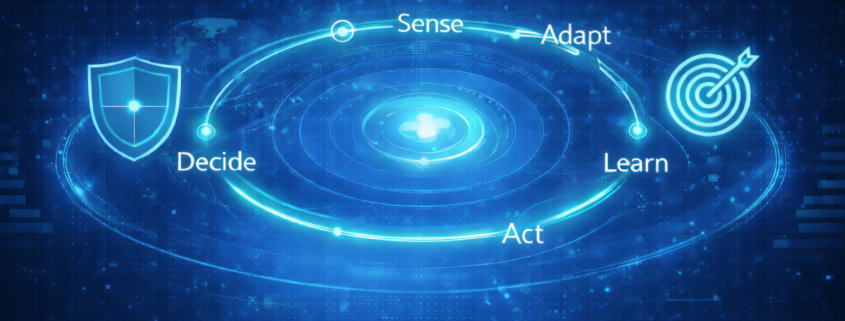
Operational Control systems continuously:
- observe environments,
- analyze conditions,
- optimize decisions,
- coordinate systems,
- monitor outcomes,
- and adapt dynamically.
This introduces something traditional SaaS platforms were never built to provide continuous operational cognition.
Decision Control Infrastructure Changes the Enterprise Architecture Stack
One of the most important emerging enterprise concepts is Decision Control Infrastructure
Decision Control Infrastructure introduces:
- adaptive governance,
- operational telemetry,
- intelligence orchestration,
- continuous optimization,
- and closed-loop enterprise coordination.
Rather than functioning as isolated applications, these systems operate as adaptive enterprise intelligence environments. This is one of the foundational ideas behind Precision AI Decision Control Infrastructure.
The Future Enterprise Will Run on Coordinated Intelligence
One of the clearest trends emerging in enterprise AI is the rise of:
- multi-agent systems,
- orchestration frameworks,
- and autonomous operational coordination.
Organizations are increasingly deploying specialized AI systems responsible for:
- forecasting,
- optimization,
- compliance,
- monitoring,
- execution,
- governance,
- and operational analysis.
The challenge is no longer simply generating intelligence.
The challenge is coordinating intelligence.
This requires infrastructure.
Why AI Infrastructure Is Becoming More Valuable Than Applications
Applications solve isolated problems.
Infrastructure governs operational ecosystems.
Over time, infrastructure typically becomes:
- more defensible,
- more embedded,
- and more strategically important.
This is already happening in AI.
The competitive advantage is shifting away from:
- chatbot interfaces,
- and toward:
- orchestration,
- governance,
- telemetry,
- optimization,
- and adaptive intelligence systems.
That transition is still early, but it is accelerating rapidly.
PrecisionOS and the Shift Toward Enterprise Intelligence Infrastructure
At Acumentica, this philosophy powers PrecisionOS
PrecisionOS is designed as an adaptive enterprise intelligence environment that integrates:
- operational telemetry,
- governance systems,
- optimization engines,
- multi-agent orchestration,
- and Decision Control Loops
within a unified infrastructure architecture.
Rather than functioning as a traditional software application, PrecisionOS operates more like operational intelligence infrastructure.
That distinction is foundational to the future enterprise AI market.
FRIDA and the Emergence of Neuro Precision AI
FRIDA represents Acumentica’s Neuro Precision AI framework.
FRIDA is designed around:
- adaptive cognition,
- enterprise memory,
- operational reasoning,
- and continuously evolving intelligence orchestration.
Unlike traditional AI assistants, FRIDA is designed to function within:
- governed intelligence environments,
- adaptive enterprise systems,
- and operational decision architectures.
This reflects a broader market transition away from AI as software toward AI as operational infrastructure.
Why This Shift Will Redefine Enterprise Technology
The enterprise technology market is moving into a completely new phase.
The previous era focused on:
- digitization,
- cloud migration,
- workflow standardization,
- and software accessibility.
The next era will focus on:
- intelligence orchestration,
- operational governance,
- adaptive infrastructure,
- and autonomous enterprise systems.
Organizations will increasingly compete based on:
- intelligence quality,
- adaptability,
- governance capability,
- and operational coordination.
This is much larger than the SaaS market transition.
It represents the emergence of enterprise intelligence infrastructure.
Conclusion: The Future Belongs to Intelligence Infrastructure
Traditional SaaS transformed how enterprises digitized work.
AI is transforming how enterprises govern work itself.
That is a much deeper architectural shift.
The future enterprise will not operate primarily through:
- static applications,
- isolated dashboards,
- or workflow software.
It will increasingly operate through:
- adaptive intelligence systems,
- governed orchestration environments,
- and continuously evolving operational infrastructure.
At Acumentica, we believe this transition represents the rise of:
- Precision AI,
- Decision Control Infrastructure,
- enterprise intelligence systems,
- and adaptive operational governance architectures.
The companies that define the next decade will not simply build better AI applications.
They will build the infrastructure layer of enterprise intelligence itself.
Learn More
If your investment organization is looking to eliminate decision drift, contain AI hallucination, and stabilize execution under uncertainty, explore how Acumentica’s Investment Decision ControlOS provides governed, operator‑led decision pathways for institutional investment systems.
Also learn about Frida, Acumentica’s Agentic AI ControlOS that operates inside the Investment Decision Control OS, using governed decision pathways.
AGI Research Labs
Decision Drift: The Institutional Instability CIOs Can’t See
Risk Governance: Preventing drift and overrides in Agentic AI execution
Portfolio Governance: Stabilizing Investment Decisions in Agentic AI Systems
Why Investment Teams Fail: The Missing Governance Layer
What is Capital Decision Control Infrastructure? The New Architecture Wall Street and Enterprises Will Need
The Missing Layer Between Research and Execution: Decision Control
Why Investment Team Drift Under Uncertainty (and How to Stop It)
About Acumentica
Acumentica is a Precision AI-powered Capital Decision Control Infrastructure company.
We help institutions make better decisions under uncertainty and avoid costly mistakes by transforming complex data, risk, and constraints into clear, disciplined next actions. Request a demo
Acumentica is the creator of the Capital Decision Control Infrastructure and the Decision Control OS; the first company to establish governed capital‑control as a market and technology category.