

Why Most AI Systems Fail in Enterprise Environments — And How PrecisionOS Solves the Problem
By Team Acumentica
Why Most AI Systems Fail in Enterprise Environments; And How PrecisionOS Solves the Problem
Artificial intelligence has become one of the most aggressively adopted technologies in modern enterprise history.
Organizations across every industry are investing heavily in:
- generative AI,
- machine learning,
- predictive analytics,
- copilots,
- and automation systems.
Yet despite enormous investments, many enterprise AI initiatives are failing to achieve meaningful operational transformation.
Some organizations experience:
- poor adoption,
- inconsistent outputs,
- governance concerns,
- integration failures,
- security risks,
- model drift,
- or limited return on investment.
Others deploy AI successfully at the pilot level but struggle to operationalize it across the enterprise.
The reality is becoming increasingly clear:
Most AI systems today were not designed to function as enterprise-grade operational infrastructure.
This is creating a growing demand for a new category of AI architecture: Precision AI – Capital Decision Control Infrastructure.
At Acumentica, this philosophy powers our enterprise intelligence framework known as: Precision AI
The Enterprise AI Illusion
Many organizations initially believed AI adoption would be straightforward.
The assumption was simple:
- Deploy a large language model.
- Integrate enterprise data.
- Improve productivity.
However, enterprise environments are vastly more complex than consumer AI environments.
Large organizations operate across:
- distributed systems,
- legacy infrastructure,
- regulatory frameworks,
- operational dependencies,
- cybersecurity constraints,
- and dynamic decision environments.
As AI systems move closer to operational workflows, enterprises begin encountering fundamental architectural problems.
Why Most Enterprise AI Systems Fail
Enterprise AI failures rarely happen because the AI models themselves are weak.
Most failures occur because the surrounding infrastructure is incomplete.
Modern enterprise AI systems require:
- orchestration,
- governance,
- observability,
- memory,
- optimization,
- and operational coordination.
Without these components, AI systems become:
- fragmented,
- unreliable,
- difficult to scale,
- and operationally risky.
Problem #1: AI Fragmentation
One of the biggest enterprise AI problems is fragmentation.
Organizations often deploy:
- multiple AI vendors,
- disconnected copilots,
- siloed automation systems,
- isolated analytics platforms,
- and incompatible workflows.
This creates:
- operational inconsistency,
- duplicated intelligence,
- conflicting outputs,
- and governance gaps.
Instead of creating unified intelligence environments, enterprises end up with disconnected AI islands.
The Hidden Cost of AI Fragmentation
Fragmented AI systems create several major operational risks.
1. Decision Inconsistency
Different AI systems produce conflicting recommendations.
2. Data Silos
AI systems often lack unified enterprise context.
3. Governance Gaps
Policies become difficult to enforce consistently.
4. Security Exposure
Multiple AI systems increase attack surfaces.
5. Operational Complexity
Managing fragmented AI environments becomes extremely difficult.
This is one reason why many enterprises struggle to scale AI beyond experimentation.
Problem #2: AI Without Governance
Most AI systems were originally designed for:
- content generation,
- search augmentation,
- or lightweight productivity assistance.
They were not designed for:
- institutional governance,
- regulatory compliance,
- operational accountability,
- or capital risk management.
This becomes dangerous in enterprise environments.
Without governance infrastructure, organizations face:
- hallucinated recommendations,
- policy violations,
- inconsistent outputs,
- operational risk,
- and regulatory exposure.
AI systems operating without governance are similar to autonomous machinery without safety systems.
Why Governance Is Becoming Mandatory
Governments and regulatory bodies are increasingly focusing on:
- AI accountability,
- explainability,
- transparency,
- and operational auditability.
Industries such as:
- finance
- healthcare
- defense,
- aerospace
- manufacturing
- cosntruction
- physical AI
- energy
- and infrastructure
cannot deploy AI irresponsibly.
Enterprise AI now requires:
- telemetry,
- observability,
- audit trails,
- policy enforcement,
- and operational oversight.
This requires infrastructure; not merely models.
Problem #3: Most AI Systems Lack Operational Context
AI systems often fail because they lack:
- enterprise memory,
- operational telemetry,
- historical context,
- and real-time environmental awareness.
Most copilots operate transactionaly.
They answer questions moment by moment but lack:
- long-term operational understanding,
- adaptive learning loops,
- or enterprise-wide situational awareness.
This limits their ability to:
- optimize workflows,
- govern decisions,
- and continuously improve operations.
Problem #4: Static AI Cannot Handle Dynamic Enterprise Environments
Enterprise environments continuously change.
Organizations face:
- supply chain disruptions,
- market volatility,
- cybersecurity threats,
- changing regulations,
- labor shortages,
- and operational uncertainty.
Traditional AI architectures often behave statically.
They:
- infer,
- respond,
- and terminate.
But enterprise intelligence requires:
- continuous adaptation,
- monitoring,
- and operational feedback loops.
This is one of the biggest reasons enterprises are now exploring closed-loop AI architectures.
Problem #5: AI Systems Are Not Built for Multi-Agent Coordination
Modern enterprises require specialized intelligence systems.
One generalized AI model cannot optimally manage:
- forecasting,
- optimization,
- governance,
- compliance,
- execution,
- and operational monitoring simultaneously.
This is driving the emergence of multi-agent enterprise intelligence systems.
However, many organizations still lack the orchestration infrastructure needed to coordinate these systems effectively.
The Enterprise Shift Toward AI Operating Systems
The future of enterprise AI is not about isolated tools.
It is about:
- orchestrated intelligence ecosystems,
- adaptive operational infrastructure,
- and enterprise AI operating systems.
This is where PrecisionOS enters the market.
What Is PrecisionOS?
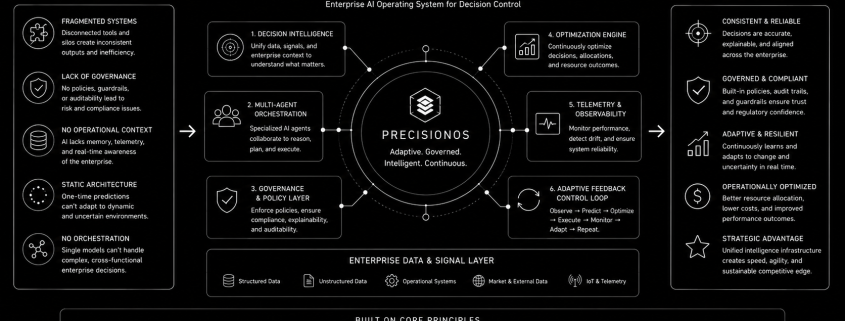
PrecisionOS is Acumentica’s enterprise intelligence architecture designed to orchestrate:
- AI reasoning,
- decision governance,
- operational telemetry,
- optimization engines,
- and multi-agent coordination
within a unified infrastructure framework.
Unlike traditional AI applications, PrecisionOS is designed as: operational intelligence infrastructure.
The architecture is inspired by:
- aerospace systems,
- industrial control frameworks,
- cybernetics,
- and institutional operational environments.
The PrecisionOS Philosophy
PrecisionOS is built around a core principle:
- AI should not merely generate outputs.
- AI should govern outcomes.
This changes the role of enterprise AI completely.
Rather than functioning as:
- isolated assistants,
- disconnected copilots,
- or static predictive models,
PrecisionOS functions as:
- adaptive intelligence infrastructure,
- operational coordination architecture,
- and enterprise decision control systems.
The Core Components of PrecisionOS
PrecisionOS integrates several foundational intelligence layers.
1. Decision Intelligence Layer
This layer processes:
- operational data,
- predictive signals,
- enterprise telemetry,
- and external intelligence streams.
Its purpose is to generate:
- contextual enterprise awareness.
2. Multi-Agent Orchestration Layer
PrecisionOS coordinates specialized AI agents responsible for:
- forecasting,
- optimization,
- governance,
- execution,
- monitoring,
- and risk analysis.
These agents collaborate continuously within:
a coordinated intelligence ecosystem.
3. Governance and Policy Layer
This layer introduces:
- explainability,
- auditability,
- operational oversight,
- and institutional policy enforcement.
This becomes essential as AI systems gain autonomy.
4. Optimization Layer
PrecisionOS continuously evaluates:
- operational efficiency,
- resource allocation,
- strategic priorities,
- and risk-adjusted outcomes.
This layer may integrate:
- reinforcement learning,
- optimization engines,
- Monte Carlo simulation,
- and stochastic modeling.
5. Telemetry and Observability Layer
This layer continuously monitors:
- system health,
- operational performance,
- model drift,
- anomaly detection,
- and infrastructure resilience.
This creates: continuous operational awareness.
6. Adaptive Feedback Control Layer
This is one of the defining characteristics of PrecisionOS.
Rather than operating statically, PrecisionOS continuously:
- Observes
- Predicts
- Optimizes
- Executes
- Monitors
- Adapts
- Re-optimizes
This creates: closed-loop enterprise intelligence.
Why Closed-Loop Intelligence Matters
Traditional enterprise AI systems operate linearly:
Input → Inference → Output.
PrecisionOS operates cyclically.
This enables:
- continuous learning,
- adaptive optimization,
- operational resilience,
- and autonomous coordination.
The architecture resembles:
- aerospace guidance systems,
- industrial automation frameworks,
- and cybernetic control environments.
This is fundamentally different from chatbot-centric AI architectures.
Why PrecisionOS Is Different From AI SaaS Platforms
Most AI vendors focus on:
- interfaces,
- copilots,
- or productivity enhancements.
PrecisionOS focuses on:
- infrastructure,
- orchestration,
- governance,
- and operational intelligence.
This distinction is critically important.
The future enterprise AI market will increasingly prioritize:
- reliability,
- explainability,
- operational governance,
- and adaptive decision systems.
The Role of FRIDA Neuro Precision AI
FRIDA represents Acumentica’s Neuro Precision AI framework within the PrecisionOS ecosystem.
FRIDA is designed around:
- continuous reasoning,
- adaptive operational memory,
- multi-agent coordination,
- and enterprise-scale intelligence orchestration.
Unlike traditional conversational AI systems, FRIDA functions more like: adaptive cognitive infrastructure.
This allows enterprise systems to:
- learn continuously,
- adapt operationally,
- and optimize dynamically.
Why Enterprise AI Will Become Infrastructure
The enterprise AI market is evolving rapidly.
Organizations no longer want:
- isolated AI tools,
- disconnected copilots,
- or fragmented automation systems.
They increasingly require:
- unified intelligence architecture,
- governance systems,
- operational orchestration,
- and adaptive infrastructure.
This represents a transition from: AI applications to: AI infrastructure.
Industries That Need PrecisionOS
PrecisionOS is designed for industries operating under:
- complexity,
- uncertainty,
- and operational scale.
Financial Markets
Applications include:
- portfolio optimization,
- risk orchestration,
- predictive capital allocation,
- and autonomous investment intelligence.
Construction
Applications include:
- intelligent scheduling,
- predictive logistics,
- operational coordination,
- and adaptive resource allocation.
Manufacturing
Applications include:
- predictive maintenance,
- autonomous operations,
- and intelligent production optimization.
Healthcare
Applications include:
- operational intelligence,
- adaptive coordination,
- and clinical decision orchestration.
Energy
Applications include:
- infrastructure optimization,
- predictive resilience,
- and operational telemetry governance.
The Rise of Enterprise Decision Infrastructure
Enterprise AI is entering a new era.
The next generation of systems will increasingly resemble:
- command infrastructure,
- adaptive intelligence networks,
- and operational control systems.
This evolution is driven by:
- enterprise complexity,
- regulatory pressure,
- autonomous operations,
- and capital optimization demands.
Organizations will increasingly compete based on: the quality of their intelligence infrastructure.
Why Most AI Companies Are Building the Wrong Thing
Many AI companies remain focused on:
- chatbot interfaces,
- productivity automation,
- and generalized AI tools.
However, enterprise markets increasingly require:
- operational reliability,
- institutional governance,
- adaptive orchestration,
- and infrastructure-grade intelligence systems.
The companies that dominate the next decade will likely build:
- enterprise intelligence architectures,
- not merely AI applications.
Conclusion: The Future Belongs to Precision AI Infrastructure
Most enterprise AI systems fail because they were never designed to operate as:
- adaptive infrastructure,
- governed intelligence systems,
- or enterprise operational architectures.
The future of AI requires:
- orchestration,
- governance,
- observability,
- optimization,
- and continuous adaptation.
PrecisionOS was designed specifically for this future.
At Acumentica, we believe the next era of enterprise technology will be defined by:
- Precision AI Decision Control Infrastructure,
- Neuro Precision AI,
- multi-agent orchestration,
- and adaptive enterprise intelligence systems.
The future enterprise will not simply deploy AI tools.
It will operate through continuously adaptive intelligence infrastructure.
Learn More
If your investment organization is looking to eliminate decision drift, contain AI hallucination, and stabilize execution under uncertainty, explore how Acumentica’s Investment Decision ControlOS provides governed, operator‑led decision pathways for institutional investment systems.
Also learn about Frida, Acumentica’s Agentic AI ControlOS that operates inside the Investment Decision Control OS, using governed decision pathways.
AGI Research Labs
Decision Drift: The Institutional Instability CIOs Can’t See
Risk Governance: Preventing drift and overrides in Agentic AI execution
Portfolio Governance: Stabilizing Investment Decisions in Agentic AI Systems
Why Investment Teams Fail: The Missing Governance Layer
What is Capital Decision Control Infrastructure? The New Architecture Wall Street and Enterprises Will Need
The Missing Layer Between Research and Execution: Decision Control
Why Investment Team Drift Under Uncertainty (and How to Stop It)
About Acumentica
Acumentica is a Precision AI-powered Capital Decision Control Infrastructure company.
We help institutions make better decisions under uncertainty and avoid costly mistakes by transforming complex data, risk, and constraints into clear, disciplined next actions. Request a demo
Acumentica is the creator of the Capital Decision Control Infrastructure and the Decision Control OS; the first company to establish governed capital‑control as a market and technology category.