
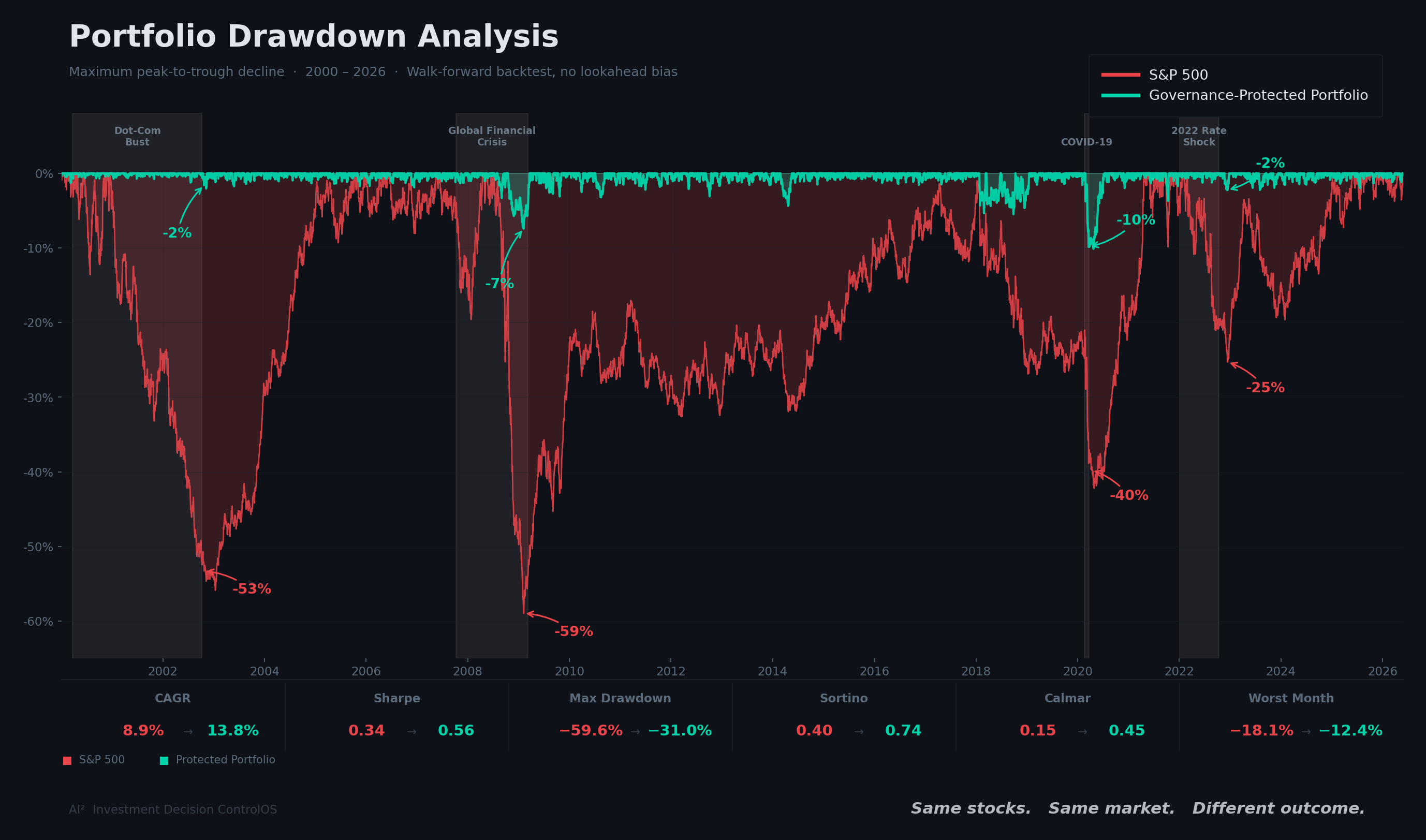
WHY IT MATTERS
Portfolios fail when assumptions, market structure, and human behavior break.
Traditional analytics can show exposure. Acumentica helps decision-makers understand whether a portfolio remains resilient when volatility rises, correlations compress, liquidity weakens, signals become crowded, and investors face drawdown pressure.
Better evidence before capital is committed.
Adversarial testing asks what happens when your forecasts are wrong, before capital is committed, not after.
The system turns complex risk, behavior, and market-pressure analysis into decision evidence that CIOs, portfolio managers, advisors, and committees can use before approving, resizing, hedging, delaying, or rejecting an investment action.
Traditional Risk Review
- Often backward-looking
- Focused on standard exposure metrics
- Limited behavioral-risk context
- Harder to explain under stress
Acumentica Resilience Control
- Shows fragility before action
- Surfaces behavioral and crowding risk
- Highlights liquidity and downside pressure
- Supports committee-ready decisions
EVIDENCE
Stress-Testing a 17-Stock AI Basket
A governed resilience test: not a forecast, not a backtest.
This is how a 17-stock AI portfolio held up when every key assumption was deliberately attacked.
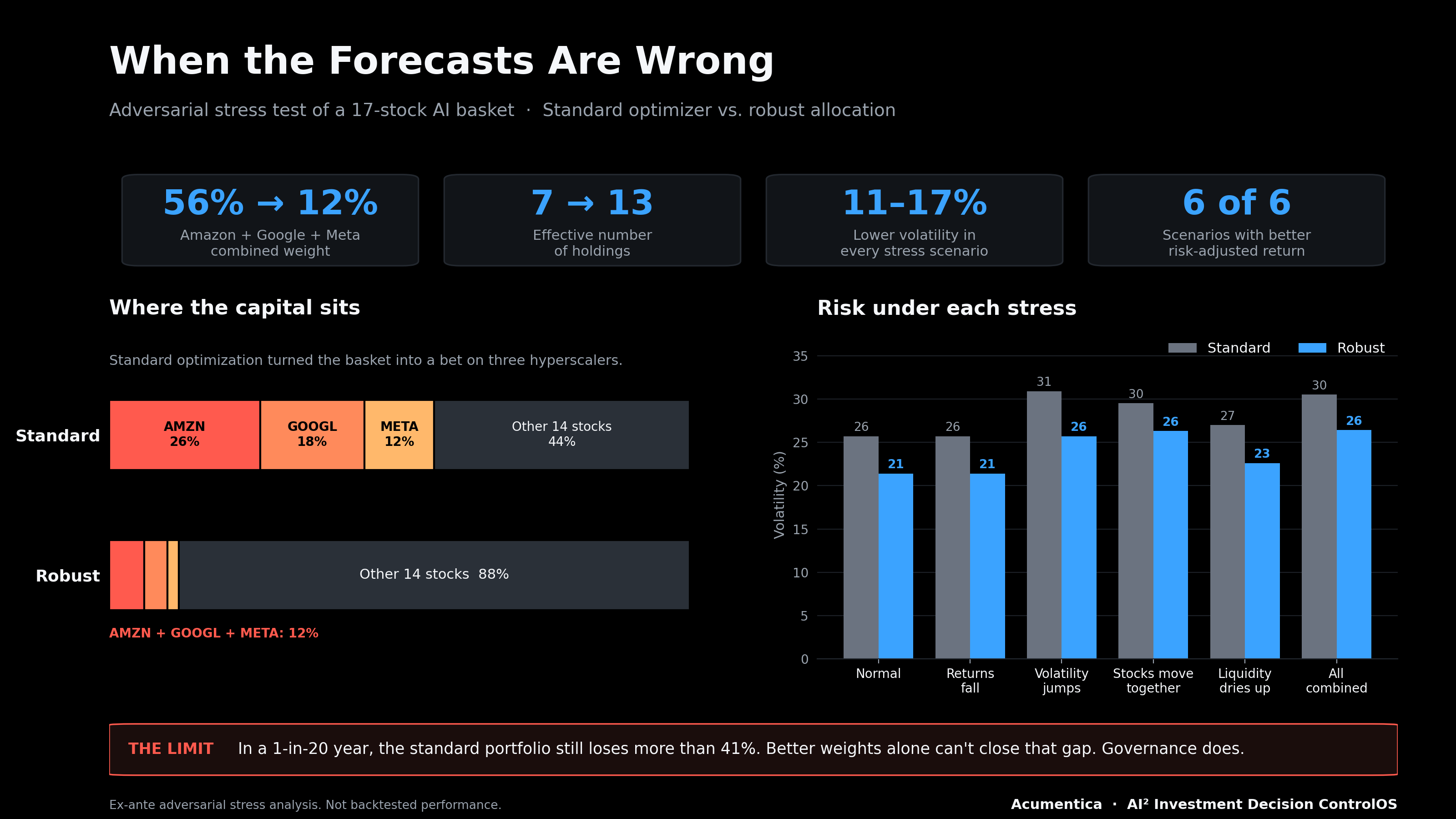
One AI portfolio. Six hostile scenarios. One hidden risk exposed.
- The standard optimizer put 56% of the money into just three stocks: Amazon, Google and Meta
- The resilient allocation cut that to about 12%, nearly doubling effective diversification
- Lower volatility in all six stress scenarios: falling returns, volatility spikes, correlation shocks and liquidity gaps
- Better risk-adjusted return in 6 out of 6 scenarios
- The cost: about 1 percentage point of expected return
- The honest limit: in a 1-in-20 year, the standard portfolio still loses more than 41%. That’s the gap decision control closes
- Forward-looking stress test, not a backtest. Results shown, models protected
This is what resilience looks like before capital is committed.
WHAT IT HELPS CONTROL
A resilience layer for the risks that damage real portfolios.
1. Market Stress
Helps identify portfolio fragility under volatility shocks, correlation spikes, inflation pressure, liquidity gaps, and drawdown stress.
2. Behavioral Risk
Helps teams recognize loss aversion, panic decisions, delayed action, overreaction, and drawdown-driven decision pressure.
3. Crowding & Execution Pressure
Surfaces when signals, positions, or trade paths may become vulnerable to crowding, adverse selection, slippage, and liquidity strain.
4. Risk Budget Discipline
Supports alignment with mandates, exposure limits, committee standards, and institutional governance requirements.
5. Decision Confidence
Gives investment teams a clearer basis for approving, reducing, hedging, delaying, or escalating portfolio actions.
6. Proprietary Protection
Communicates value and evidence without exposing Acumentica’s proprietary systems, formulas, or model implementation.
BUILT FOR
Designed for CIOs, family offices, RIAs, hedge funds, and institutions.
CIOs
Strengthen committee confidence before capital allocation.
Family Offices
Protect long-term capital from hidden fragility.
RIAs
Support client-facing decisions with clearer risk evidence.
Hedge Funds
Understand crowding, execution, and adverse selection pressure.
Institutions
Improve governance around risk, behavior, and capital decisions.
BUSINESS IMPACT
From risk analytics to decision governance.
Outcomes: Fewer fragile decisions, better risk communication, stronger committee evidence, clearer portfolio actions, and more disciplined behavior under market pressure.
FAQ
Behavioral & Adversarial Resilience ControlOS FAQ’s
What is Behavioral & Adversarial Resilience ControlOS?
It is an investment resilience layer inside Acumentica AI Investment Decision ControlOS that helps institutions evaluate portfolio decisions against market stress, behavioral pressure, crowding, liquidity strain, and downside exposure.
Does it reveal Acumentica’s proprietary models?
No. The page communicates benefits, evidence, and institutional outcomes without revealing proprietary formulas, algorithms, or implementation details.
Who is this built for?
It is built for CIOs, family offices, RIAs, hedge funds, institutional allocators, portfolio risk teams, and investment committees.
Does this replace the investment committee?
No. It improves the evidence available to decision-makers. The goal is better governance, not black-box replacement of institutional judgment.
Does this guarantee future performance?
No. It supports decision discipline and risk governance under uncertainty. It does not guarantee investment performance.