
What is Risk Governance OS?
The Risk Governance OS is the governed operating system for institutional risk oversight inside the Investment Decision Control OS. It ensures that every portfolio and strategy decision remains within defined risk mandates, constraints, and tolerances, and that emergent risk is detected, governed, and controlled before it becomes capital‑threatening.
This OS is not a risk model or analytics tool; it is the risk governance environment that supervises how risk is defined, measured, escalated, and acted upon across the investment lifecycle.
Definition of the Risk Governance OS
The Risk Governance OS is a governed decision environment that embeds risk mandates, control logic, escalation paths, and operator‑led overrides directly into the investment process. It does not replace risk models or analytics; it governs how they are used and how their outputs translate into decisions, constraints, and interventions.
It provides a structured, enforceable framework for risk identification, measurement, attribution, and response, ensuring that risk decisions remain aligned with institutional doctrine and capital objectives.
Placement inside the Decision‑Control hierarchy
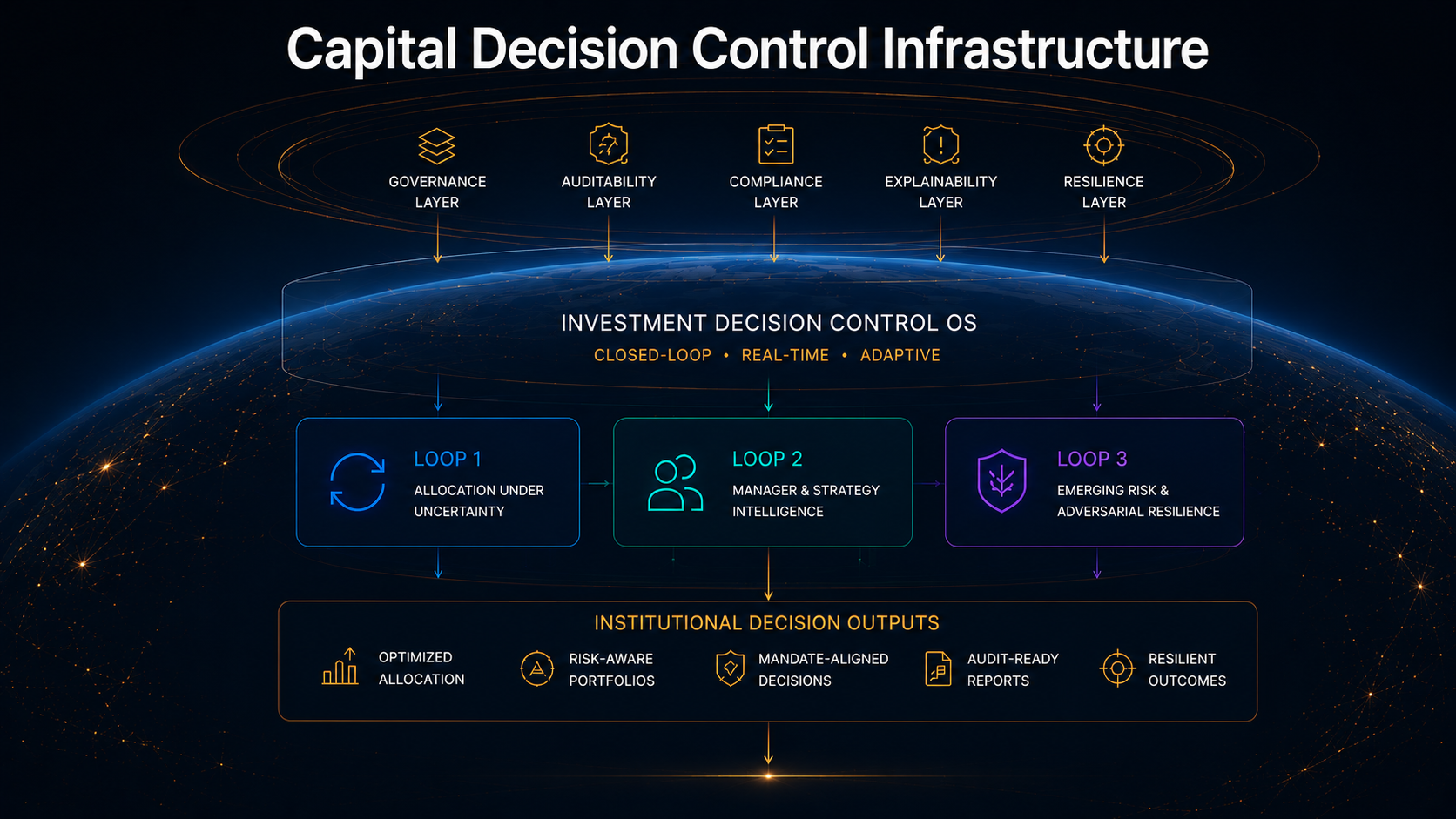
The Risk Governance OS sits as a subsystem OS inside the Investment Decision Control OS and the broader Capital Decision Control Infrastructure. It operates alongside other governance‑and‑control subsystem OS modules that govern specific portfolio and investment domains, all indexed on the Subsystem OS Modules page.
Within this hierarchy, the Risk Governance OS is responsible for the risk governance domain, coordinating with portfolio construction, optimization, allocation, scenario analysis, and performance governance to ensure risk is consistently controlled across all decision surfaces.
Governance domain of the Risk Governance OS
Risk mandate and constraint governance
The Risk Governance OS enforces institutional risk mandates, limits, and constraints, ensuring that portfolios, strategies, and exposures remain within approved boundaries. It governs leverage, concentration, liquidity, counterparty, and factor exposures, and defines how breaches are detected, escalated, and resolved.
Risk measurement and attribution governance
It governs how risk is measured (models, metrics, horizons) and how risk attribution is performed across portfolios, strategies, and asset classes. The OS ensures that measurement choices are consistent with institutional doctrine and that attribution is used to inform governed decisions—not ad hoc reactions.
Drift detection and emergent risk governance
The Risk Governance OS supervises risk drift; gradual or emergent changes in exposure, correlation, regime, or behavior that move the portfolio away from its intended risk profile. It embeds detection logic, thresholds, and escalation paths to ensure emergent risk is surfaced and governed before it becomes capital‑threatening.
Operator‑led risk override and escalation
The OS defines how human operators can override automated or model‑driven risk decisions within governed boundaries. It specifies escalation tiers, approval workflows, and documentation requirements, ensuring that overrides strengthen governance rather than weaken it.
Closed‑loop risk governance
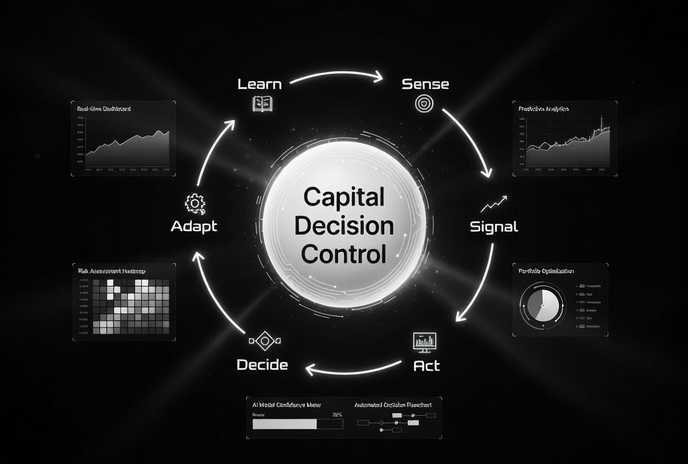
The Risk Governance OS operates as a closed‑loop control system for risk:
sensing → measurement → drift detection → governance logic → enforcement → operator feedback
Risk signals from models, analytics, and market data feed into the OS, which applies governance logic and control rules to determine whether actions are required. Enforcement may include allocation changes, hedging, de‑risking, or constraint tightening, all logged and governed. Operator feedback closes the loop, refining thresholds, mandates, and escalation logic over time.
Integration with other subsystem OS modules
The Risk Governance OS interacts with other subsystem OS modules inside the Investment Decision Control OS, including domain specific governance blocks:
Governance & Control Subsystem OS Modules
Investment Performance Governance & Control : ensures portfolios remain aligned with intended performance, mandates, and risk profiles through continuous drift detection and closed‑loop enforcement.
Investment Research Governance & Control: governs the research process, ensuring consistency, traceability, and adherence to institutional standards across analysts, PMs, and strategies.
Portfolio Construction Governance & Control: enforces construction logic, constraints, exposures, and risk parameters to ensure portfolios reflect the intended design; not ad‑hoc decisions.
Investment Risk Governance & Control : provides continuous oversight of exposures, limits, and risk signals, ensuring decisions remain within institutional tolerance and mandate boundaries.
Adversarial Resilience Governance & Control: ensures investment decisions remain aligned with institutional intent by governing behavioral drift, adversarial market conditions, and decision integrity under uncertainty and stress.
Agentic AI Governance & Control: Is the governance domain that defines the rules, constraints, and institutional boundaries for all agentic AI systems. It provides the foundation of oversight and stability that every Agentic AI Control OS relies on.
Mandate Governance & Constraint Enforcement: ensures every decision, trade, and exposure adheres to the mandate, constraints, and investment policy; automatically and continuously.
Investment Process Governance: governs the full lifecycle of decisions, from research → conviction → sizing → execution → monitoring → adaptation, ensuring process integrity.
Capital Allocation Governance & Control: ensures capital is allocated according to institutional priorities, risk budgets, and strategic objectives; with continuous alignment and oversight.
Investment Performance Governance Control OS: to connect performance outcomes with risk decisions and governance responses.
Role in institutional governance
The Risk Governance OS is a core pillar of institutional governance, providing:
- Formalized risk doctrine; codified principles for how risk is defined, accepted, and managed.
- Transparent accountability; clear ownership of risk decisions, overrides, and escalations.
- Regulatory and fiduciary alignment; structured evidence of risk governance for boards, regulators, and stakeholders.
- Resilience against behavioral and adversarial pressures; by embedding governance logic that resists short‑termism, panic, and adversarial exploitation.
It transforms risk from a set of tools and reports into a governed operating system for capital protection and controlled risk‑taking.
Guided links
- Parent infrastructure:
- Subsystem OS index:
- Related governance domains:
Experience Investment Control
Your Strategy Deserves Precision
See how Acumentica helps investment teams forecast markets, optimize portfolios, and govern decisions within defined risk and mandate constraints.