
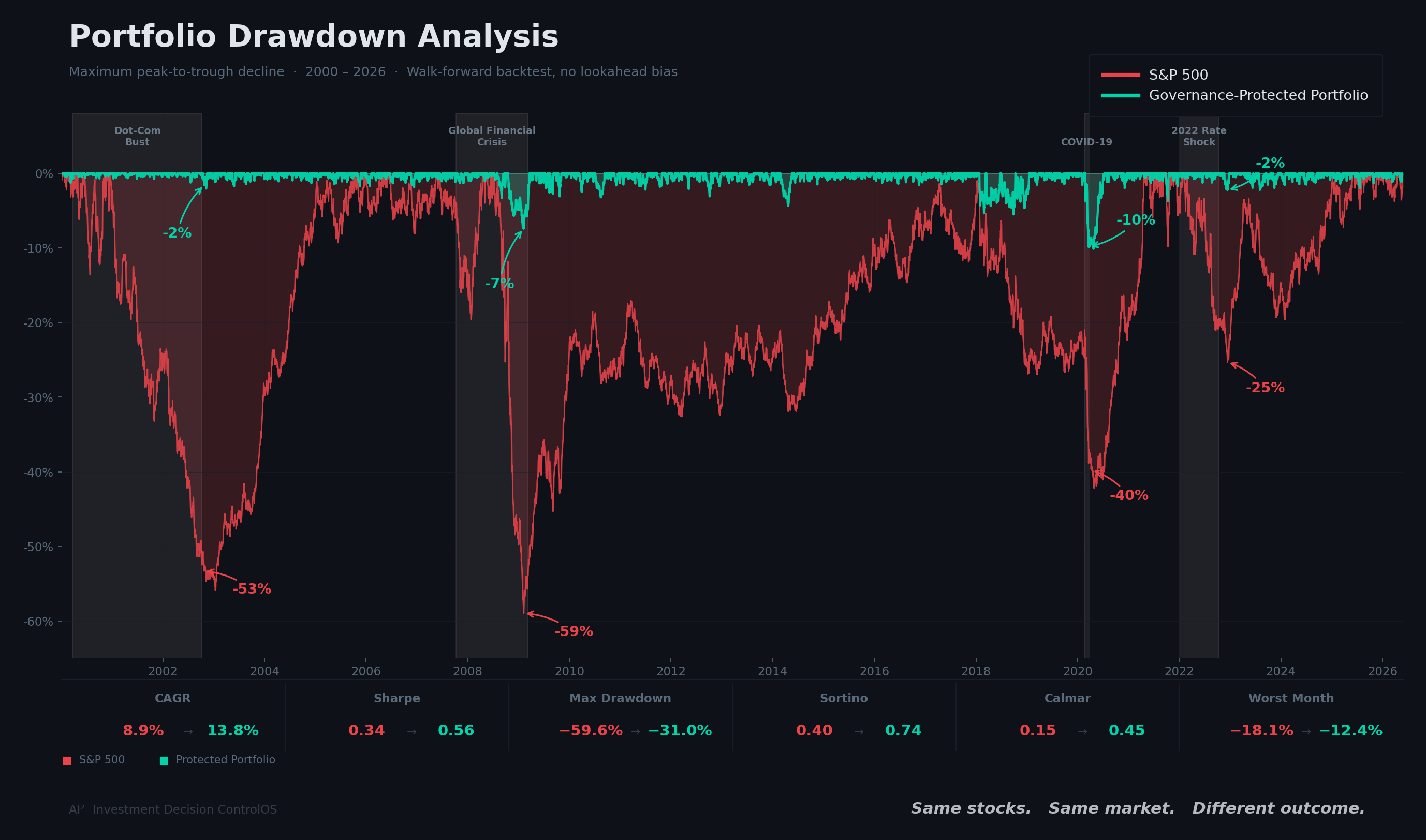
What Risk Governance & Control Is
Risk Governance & Control is the discipline of continuously sensing, validating, and enforcing the risk structure of a portfolio across:
• exposures
• factors
• volatility
• liquidity
• drawdown
• concentration
• regime conditions
• tail behavior
It ensures the portfolio behaves according to design intent, not market noise, human bias, or uncontrolled drift.
Risk Governance is not “risk management.”
It is risk control; governed, adversarially resilient, and continuously enforced.
WHY
Why Risk Governance Fails in Institutions
Risk failure is predictable. It happens because:
• risk is measured, not governed
• exposures drift silently
• factor structures mutate
• volatility regimes shift
• liquidity collapses under stress
• risk budgets are not enforced
• mandates conflict with behavior
• attribution is backward-looking
• humans override discipline under pressure
Most institutions operate with risk reporting, not risk control.
Reporting is passive.
Control is active.
Without governance, portfolios drift into:
• unintended exposures
• unintended factor bets
• unintended concentration
• unintended leverage
• unintended liquidity risk
This is how catastrophic states emerge.
SYSTEM OF CONTROL
Why Risk Requires a System of Control
Risk cannot be governed by:
• dashboards
• spreadsheets
• periodic reviews
• human oversight
• committee meetings
• risk reports
Risk is dynamic.
Markets are adversarial.
Regimes shift.
Exposures mutate.
Liquidity evaporates.
Volatility clusters.
Risk requires:
• continuous sensing
• continuous validation
• continuous enforcement
• continuous alignment
This is only possible with a System of Control.
ARCHITECTURE
The Architecture of Risk Governance
1. Risk Sensing
Real-time detection of:
• exposure drift
• factor drift
• volatility regime shifts
• liquidity changes
• concentration buildup
• correlation breakdown
• tail-risk emergence
2. Risk Validation
Continuous verification that:
• exposures match design intent
• factor structure is stable
• risk budgets are respected
• constraints are satisfied
• liquidity is sufficient
• leverage is controlled
3. Risk Enforcement
Governed enforcement of:
• exposure limits
• factor limits
• volatility targets
• liquidity thresholds
• concentration caps
• mandate constraints
4. Closed-Loop Feedback
Automatic alignment of:
• portfolio structure
• risk budgets
• exposures
• factor weights
• volatility targets
• liquidity buffers
This is the difference between risk monitoring and risk governance.
HOW IT WORKS
How the OS Enables Risk Governance & Control
The Investment Decision-Control OS governs risk through:
Real-Time Risk Sensing
Continuous monitoring of exposures, factors, volatility, liquidity, and concentration.
Adversarial Resilience
Detection of regime shifts, structural breaks, and adversarial market conditions.
Constraint Enforcement
Governed enforcement of:
• exposure limits
• factor limits
• volatility targets
• liquidity thresholds
• leverage constraints
Closed-Loop Alignment
The OS continuously aligns the portfolio with:
• risk budgets
• mandate constraints
• design intent
• institutional objectives
Behavioral Stability
Prevents human overrides that create catastrophic risk states.
Governed Adaptation
Risk structure adapts safely under:
• volatility shocks
• liquidity events
• correlation breakdowns
• macro regime transitions
This is risk governance, not risk reporting
WHO THIS IS FOR
Who Needs Risk Governance & Control
Risk Governance is essential for:
• CIOs
• CROs
• Portfolio Managers
• Risk Committees
• OCIOs
• Multi-asset teams
• Quant teams
• Asset allocators
• Family offices
• Endowments & foundations
Any institution with:
• mandates
• risk budgets
• exposures
• constraints
• fiduciary responsibility
requires governed risk control.
Related Governance Domains
• Investment Research Governance & Control
Ensures research processes remain consistent, traceable, and aligned with institutional standards. → Learn more
• Investment Performance Governance & Control
Ensures performance is measured, decomposed, attributed, and governed with structural integrity.
→ Learn more
• Portfolio Construction Governance & Control
Ensures portfolios are built, sized, diversified, and aligned with institutional design intent. → Learn more
• Adversarial Resilience Governance & Control
Ensures investment decisions remain aligned with mandates, risk controls, and institutional objectives by governing behavioral bias, market stress, adverse selection, and adversarial conditions. → Learn
• Mandate Governance & Constraint Enforcement
Ensures portfolios remain aligned with mandate rules, constraints, and institutional requirements.
→ (Coming Soon)
• Investment Process Governance & Control
Governs the full investment lifecycle from idea → research → decision → execution.
→ (Coming Soon)
• Capital Alignment Governance & Control
Ensures capital remains structurally aligned with mandates, exposure boundaries, and governed decision‑control. → Learn more
See How Risk Governance Operates Inside the OS
Experience governed risk sensing, enforcement, and closed-loop control.