

Risk Governance ControlOS: Runtime Enforcement of Institutional Risk Boundaries
By Team Acumentica
Risk Governance ControlOS: Enforcing Risk Boundaries in Runtime
Introduction: Risk Drift Is the First Signal of Collapse
Every institutional collapse begins with risk drift; the silent expansion of exposure, concentration, correlation, and liquidity risk beyond what leadership intended.
Risk drift is not caused by markets. It is caused by ungoverned execution.
Institutions rely on:
- intelligence that predicts risk
- governance frameworks that define risk
- dashboards that monitor risk
But none of these govern risk in runtime.
The Risk Governance ControlOS is the subsystem of the Investment Decision‑ControlOS that finally solves this. It enforces risk boundaries continuously, preventing drift before it becomes collapse.
1. What Risk Governance ControlOS Actually Does
Risk Governance ControlOS is the runtime governance enforcement layer for institutional risk.
It governs:
- exposure limits
- factor boundaries
- regime alignment
- liquidity constraints
- correlation thresholds
- concentration ceilings
It ensures that risk cannot drift, even when:
- markets shift
- models optimize
- portfolios rebalance
- autonomous systems execute
- research pipelines evolve
Risk Governance ControlOS is not analytics. It is not just prediction. It is not compliance.
It is runtime governance; the part of the OS that enforces risk boundaries continuously.
2. Why Institutions Need Runtime Risk Governance
Risk drift is the earliest form of collapse dynamics.
It leads directly to:
- exposure breaches
- factor instability
- liquidity stress
- portfolio misalignment
- systemic vulnerability
Traditional systems detect risk drift. Risk Governance ControlOS prevents it.
This is the difference between:
- knowing risk is drifting
- and governing risk so it cannot drift
CIO’s need the latter.
3. The Drift Pathway: How Collapse Begins
Risk drift is not isolated. It cascades.
Risk Drift → Exposure Drift → Portfolio Drift → Collapse
- Risk drift begins when exposure boundaries are not enforced.
- Exposure drift follows as factor, regime, and thematic exposures creep.
- Portfolio drift emerges as construction and allocation misalign with strategy.
- Collapse dynamics form when drift compounds across domains.
Risk Governance ControlOS stops this cascade at the first step.
4. How Risk Governance ControlOS Works Inside the OS
Risk Governance ControlOS integrates with other OS modules:
Portfolio Governance ControlOS
Ensures portfolio decisions respect risk boundaries.
Exposure Governance ControlOS
Prevents exposure drift in runtime.
Portfolio Construction Governance ControlOS
Merges risk governance with portfolio construction.
Constrains autonomous execution inside risk limits.
Performance Governance ControlOS
Stabilizes performance behavior under risk constraints.
It ensures every scenario pathway respects governed risk boundaries, preventing scenario exploration from creating hidden risk drift.
Behavioral & Adversarial Resilience ControlOS
It ensures behavioral stability and adversarial resilience in runtime, preventing human or autonomous execution from creating risk drift under stress or adversarial conditions.
Investment Research Governance ControlOS
It governs research direction and exploration so that research pipelines cannot generate unintended risk drift, ensuring all research activity remains aligned with CIO‑defined risk boundaries.
Together, these modules form the risk governance spine of the Investment Decision ControlOS.
5. Evidence: Risk Governance ControlOS in Real Markets (2000–2026)
Institutions do not collapse because markets are volatile. They collapse because risk is unmanaged in runtime.
Risk Governance ControlOS exists to enforce risk boundaries continuously; preventing risk drift, suppressing risk‑driven collapse dynamics, and stabilizing both autonomous and human‑driven execution.
The last 26 years provide a clear empirical record of what happens with and without runtime risk governance.
Collapse Dynamics Without Risk Governance ControlOS
When runtime risk governance is absent, risk drift accumulates silently inside every part of the investment architecture:
| Year | Drift Type | Collapse Outcome | Missing Risk Governance | CIO Implication |
|---|---|---|---|---|
| 2000 | Factor & exposure drift | Market misalignment | No Risk Governance ControlOS | Factor boundaries drifted silently |
| 2008 | Liquidity & correlation drift | Financial collapse | No Risk Governance ControlOS | Exposure exceeded limits; liquidity collapsed |
| 2015 | Research‑driven risk drift | Innovation collapse | No Investment Research Governance ControlOS | Research created unintended risk pathways |
| 2020 | Regime drift | Operational instability | No Agentic Investment ControlOS | Autonomous systems executed outside risk intent |
| 2026 | Institutional risk drift | Collapse dynamics visible | No Investment Decision‑Control OS | Risk governance required above intelligence and governance |
Real‑World Evidence: What Risk Governance ControlOS Prevents
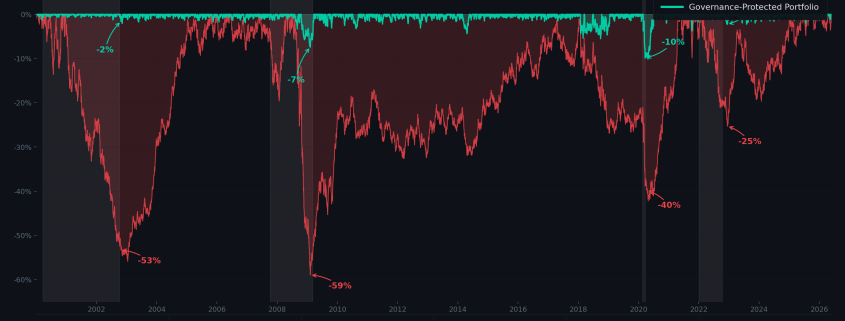
The chart below shows the empirical signature of runtime risk governance.
Both portfolios use:
- the same market
- the same stocks
- the same conditions
- the same intelligence
- the same governance frameworks
The only difference is the presence of Risk Governance ControlOS; the subsystem that enforces risk boundaries continuously.
Four crises. One institution. Two very different outcomes.
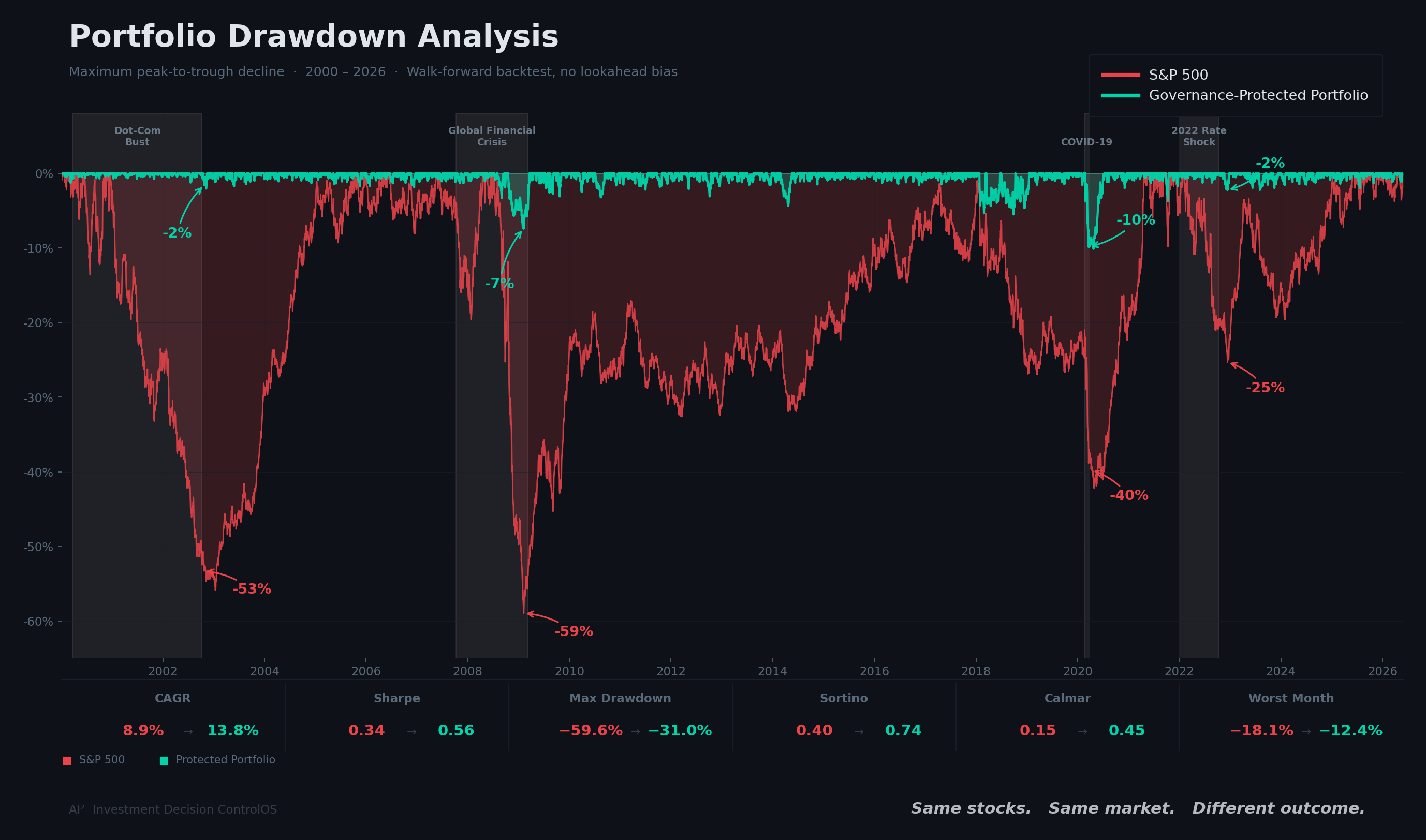
S&P 500 (No Risk Governance ControlOS)
- Risk drift accumulates across exposure, factor, liquidity, and correlation domains
- No runtime enforcement
- No governed risk execution
- Collapse events fully express
- Drawdowns: –53%, –59%, –40%, –25%
Governance‑Protected Portfolio (Risk Governance ControlOS Active)
- Risk drift prevented by governed boundaries
- Exposure governed in runtime
- Liquidity and correlation stabilized
- Autonomous execution constrained inside risk limits
- Collapse events suppressed
- Drawdowns: –2%, –7%, –10%, –2%
Outcome
Risk Governance ControlOS does not change the market. It changes how the institution experiences the market.
It governs risk execution above intelligence and above governance frameworks; preventing risk drift before it becomes collapse.
This is the operational signature of Risk Governance ControlOS.
7. Why This Matters
Risk is not dangerous because markets move. Risk is dangerous because risk drift accumulates silently inside institutions when execution is not governed in runtime.
Risk Governance ControlOS matters because it:
- prevents exposure, factor, liquidity, and correlation drift
- enforces CIO‑defined risk boundaries continuously
- stabilizes autonomous and human execution under uncertainty
- ensures research, portfolio construction, and autonomy cannot create unintended risk pathways
- suppresses collapse dynamics before they form
- transforms risk governance from monitoring to runtime enforcement
Institutions collapse when risk is unmanaged. Risk Governance ControlOS is the subsystem that ensures risk cannot drift, even when markets shift, models optimize, or autonomous systems execute at machine speed.
This is why runtime risk governance is no longer optional; it is the foundation of institutional stability.
8. Industry‑Agnostic Risk Governance
Risk drift is not limited to investment institutions. It appears in every industry where complex systems operate and execution can deviate from intent.
Risk Governance ControlOS is industry‑agnostic. It enforces risk boundaries wherever unmanaged risk leads to collapse dynamics:
- Investment institutions
- Aerospace and mission‑critical systems
- Healthcare and clinical operations
- Manufacturing and supply chain networks
- Energy and utilities
- Construction and infrastructure
- Technology and AI operations
- Government and sovereign systems
- University and research institutions
Wherever risk drift accumulates; exposure drift, behavioral drift, correlation drift, liquidity drift, or autonomous drift; Risk Governance ControlOS stabilizes execution above intelligence and governance frameworks, ensuring institutional behavior remains inside CIO‑defined risk boundaries.
8. CIO Operational Implications
With Risk Governance ControlOS, CIO’s gain:
- governed exposure
- governed factor behavior
- governed liquidity risk
- governed correlation stability
- governed autonomous execution
- governed portfolio construction
This is the first subsystem that makes the Investment Decision‑Control OS operational.
This is where runtime governance begins.
Conclusion: Risk Governance Is No Longer Optional
Institutions do not collapse because markets are volatile. They collapse because risk is unmanaged in runtime.
Risk Governance ControlOS enforces the boundaries that intelligence cannot enforce and governance frameworks cannot enforce.
It is the first subsystem of the Investment Decision‑Control OS; the part that prevents drift before it becomes collapse.
This is how institutions remain stable under uncertainty.
Acumentica Governs. The CIO Decides.
Learn More
If your institution is experiencing portfolio instability, drift in exposures, or unexplained allocation changes, explore how Acumentica’s Investment Decision ControlOS governs construction, allocation, and execution to eliminate drift.
Also learn about Frida, Acumentica’s Agentic AI ControlOS that operates inside the Investment Decision Control OS, using governed decision pathways.
Decision Control Research Lab
The Decision Control Research Lab researches drift, collapse dynamics, and the Decision‑Control layer; the institutional execution‑governance systems that keep autonomous and enterprise systems stable, aligned, and protected from drift‑driven failure.
AI Hallucination Drift: When AI Creates False Decisions That Break Institutional Governance
Risk Governance: Preventing drift and overrides in Agentic AI execution
Portfolio Drift: When construction and allocation quietly break strategy
Decision Drift: The Institutional Instability CIOs Can’t See
Portfolio Governance: Stabilizing Investment Decisions in Agentic AI Systems
Why Investment Teams Fail: The Missing Governance Layer
What is Capital Decision Control Infrastructure? The New Architecture Wall Street and Enterprises Will Need
The Missing Layer Between Research and Execution: Decision Control
Why Investment Team Drift Under Uncertainty (and How to Stop It)
About Acumentica
Acumentica is a Precision AI-powered Capital Decision Control Infrastructure company.
We help institutions make better decisions under uncertainty and avoid costly mistakes by transforming complex data, risk, and constraints into clear, disciplined next actions. Request a demo
Acumentica is the steering and braking layer above Intelligence; the part that governs what intelligence does, not just what it predicts.
Acumentica originated the Capital Decision Control Infrastructure and built the first product in that category; the Decision Control OS. We are the first company to introduce governed capital‑control as a market and technology category thesis.