

Why Investment Teams Fail: The Missing Governance Layer
By Ryan D’Souza
Why Investment Teams Fail Even When Their Research Is Good
Investment teams rarely fail because they lack intelligence.
They fail because they lack control.
Across asset managers, hedge funds, OCIOs, pension funds, endowments, and institutional allocators, the same pattern repeats: teams with strong research, sophisticated models, experienced analysts, and advanced technology still produce unstable, inconsistent, and unreliable outcomes.
The industry’s response has largely been the same for decades. When results disappoint, firms invest in more intelligence:
- More market data
- More alternative data
- More AI
- More analytics
- More dashboards
- More forecasting models
Yet despite these investments, many organizations continue to experience performance drift, mandate violations, inconsistent decision-making, and unnecessary risk exposure.
The assumption is that more intelligence will produce better decisions.
In reality, intelligence alone does not stabilize decisions.
In many cases, it amplifies instability.
The uncomfortable truth is this:
Most investment failures are governance failures, not research failures.
Until the industry understands the difference between intelligence and control, performance outcomes will remain vulnerable regardless of how advanced the intelligence layer becomes.
The Illusion of Intelligence
Investment organizations often assume that superior insights naturally translate into superior outcomes.
The logic appears sound.
If analysts have better information, portfolio managers should make better decisions.
If forecasting models improve, portfolio performance should improve.
If artificial intelligence becomes more sophisticated, investment outcomes should become more reliable.
But this assumption overlooks a critical reality.
Information and decisions are not the same thing.
A team can possess exceptional intelligence while operating within an unstable decision process.
When this occurs, the investment process behaves like an open-loop system:
- No feedback
- No stabilization
- No correction mechanism
- No governance layer
- No mandate enforcement
- No behavioral control
The result is a process that appears intelligent but remains vulnerable to drift.
This explains why firms can possess:
- Exceptional research departments
- Accurate forecasts
- Advanced quantitative models
- High-quality data infrastructure
- Sophisticated AI capabilities
.. and still experience inconsistent outcomes.
The intelligence is functioning.
The decision process is not.
The missing component is governance.
Where Investment Decisions Actually Break Down
When investment failures are examined closely, the root causes are often surprisingly similar.
Rarely do organizations fail because they lacked information.
More commonly, failures occur because decisions deviated from intended behavior.
Examples include:
- Portfolio decisions drifting from mandate objectives
- Risk limits becoming reactive rather than proactive
- Teams abandoning process during periods of uncertainty
- Inconsistent signal overrides
- Emotional responses to market volatility
- Execution deviating from research conclusions
- Decision frameworks collapsing under stress
These breakdowns are not analytical failures.
They are control failures.
The distinction matters because the solution changes completely.
Adding another forecasting model does not solve execution drift.
Adding another dashboard does not solve mandate violations.
Adding another AI system does not solve behavioral inconsistency.
Control problems require control solutions.
The Research to Execution Gap
Most investment organizations have developed sophisticated capabilities around research and execution.
Research systems generate insights.
Execution systems place trades.
Risk systems measure exposure.
But between research and execution lies a critical gap.
A decision must still be made.
That decision must remain aligned with:
- Portfolio objectives
- Mandate requirements
- Risk constraints
- Governance policies
- Long-term strategy
This is where instability emerges.
Research may indicate one course of action.
Execution systems may be capable of implementing it.
Yet the actual decision process remains vulnerable to uncertainty, emotion, pressure, noise, and inconsistency.
The industry has spent decades improving research.
It has spent decades improving execution.
Very little attention has been devoted to governing the decisions that connect the two.
The Missing Layer: Decision-Control
Every investment organization possesses some combination of:
- Research platforms
- Portfolio management systems
- Trading systems
- Risk management tools
- Analytics platforms
Few possess a true Decision-Control System.
A Decision-Control System is the governance layer responsible for stabilizing decision behavior under uncertainty.
Its purpose is not to generate intelligence.
Its purpose is to govern how intelligence is translated into action.
Without this layer:
- Insights fail to produce consistent behavior
- Models fail to produce stable outcomes
- Risk frameworks become reactive
- Mandates drift over time
- Human judgment becomes inconsistent
The result is an investment process that remains intelligent but unstable.
This distinction becomes increasingly important as firms adopt AI.
AI expands intelligence.
It does not automatically provide control.
Why “Closed-Loop AI” Is Often Misunderstood
The phrase “closed-loop AI” has become increasingly common.
Unfortunately, much of what is marketed as closed-loop AI is not actually closed-loop control.
Many systems described as closed-loop are simply combinations of:
- Workflow automation
- Conditional logic
- Rules engines
- Retry mechanisms
- Agent orchestration
- Heuristic decision trees
While useful, these capabilities do not constitute a true control system.
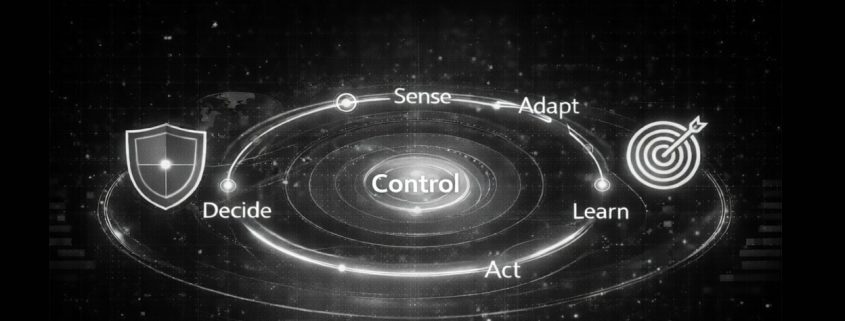
A genuine closed-loop system requires:
- Sensing
- Feedback
- Constraint enforcement
- Correction mechanisms
- Stabilization
- Governed adaptation
These concepts originate from control theory rather than artificial intelligence.
The distinction is significant.
An intelligent system can produce recommendations.
A control system governs behavior.
Investment organizations increasingly possess intelligence.
What remains scarce is governed control.
Why More Intelligence Will Not Solve the Problem
The industry’s current trajectory assumes that increasingly powerful AI systems will eventually eliminate decision-making failures.
This assumption deserves scrutiny.
If intelligence alone solved governance problems, investment organizations would already be operating flawlessly.
They are not.
The reason is simple.
Knowing what should happen and ensuring it happens are fundamentally different challenges.
One is an intelligence problem.
The other is a control problem.
Organizations that continue to focus exclusively on intelligence may discover that decision instability persists regardless of how sophisticated their models become.
As intelligence expands, the need for governance becomes greater, not smaller.
The Real Reason Investment Teams Fail
Investment teams fail because they operate without a governed mechanism that ensures decisions remain aligned with objectives under uncertainty.
They lack:
- A decision-control layer
- Closed-loop governance
- Stabilization mechanisms
- Drift prevention
- Mandate enforcement
- Behavioral correction
This missing layer sits between research and execution.
It determines whether intelligence becomes disciplined action or uncontrolled variability.
Without it, even exceptional research can produce inconsistent outcomes.
With it, organizations gain the ability to govern decisions rather than merely inform them.
What Comes Next
The investment industry has spent decades building systems of intelligence.
The next frontier is building systems of control.
Understanding the distinction is the first step.
Intelligence and control are not the same thing.
One generates insight.
The other governs behavior.
Organizations that recognize this difference will be better positioned to manage uncertainty, maintain discipline, and improve long-term performance outcomes.
The future of investment performance is not simply better intelligence.
It is governed decision-control.
Learn more about Acumentica:
https://www.acumentica.com