

Probabilistic AI Is a Fiduciary Risk
By Team Acumentica
Probabilistic AI Is a Fiduciary Risk
Why Capital‑Critical Enterprises Require Decision‑Control Infrastructure and Precision AI
Executive Summary
Modern enterprises are rapidly integrating AI into capital allocation, risk evaluation, operational strategy, and compliance workflows. But most of these systems; including generative AI, LLMs, and multi‑agent frameworks; operate probabilistically.
Probabilistic AI produces likely answers, not guaranteed ones. In fiduciary environments, “likely” is a liability.
This white paper explains why probabilistic AI introduces structural fiduciary risk, why governance is now mandatory, and why enterprises are adopting Decision‑Control Infrastructure and Precision AI to eliminate drift, hallucinations, unverifiable reasoning, and non‑deterministic decisions.
1. Introduction: The Enterprise AI Shift
AI has moved from experimentation to operational integration. Enterprises now use AI to:
- allocate capital
- optimize portfolios
- evaluate risk
- automate workflows
- support executive decision‑making
- interpret compliance obligations
- orchestrate multi‑agent systems
But beneath this adoption lies a critical misunderstanding: Most enterprise AI systems are fundamentally probabilistic; not deterministic.
This creates governance, reliability, and fiduciary exposure at institutional scale.
2. What Is Probabilistic AI?
Probabilistic AI generates outputs based on:
- statistical likelihood
- probability distributions
- token prediction
- learned correlations
- pattern inference
These systems do not:
- understand truth
- reason deterministically
- guarantee correctness
They produce the most statistically probable response; not the right one.
In consumer environments, this is acceptable. In capital‑critical environments, it is dangerous.
3. The Fiduciary Risk Model
Why Probabilistic AI Cannot Be Trusted in Capital Environments
Enterprises operating under fiduciary duty must eliminate:
- non‑deterministic behavior
- unverifiable outputs
- hallucination risk
- drift‑driven degradation
The fiduciary risk model consists of three layers:
Layer 1: Probabilistic AI (Risk Source)
- Non‑deterministic
- Unverifiable
- Drift‑prone
- Hallucination‑capable
- No capital‑grade guarantees
Layer 2: Governance Layer (Risk Mitigation)
- Oversight
- Telemetry
- Explainability
- Compliance alignment
- Multi‑agent orchestration
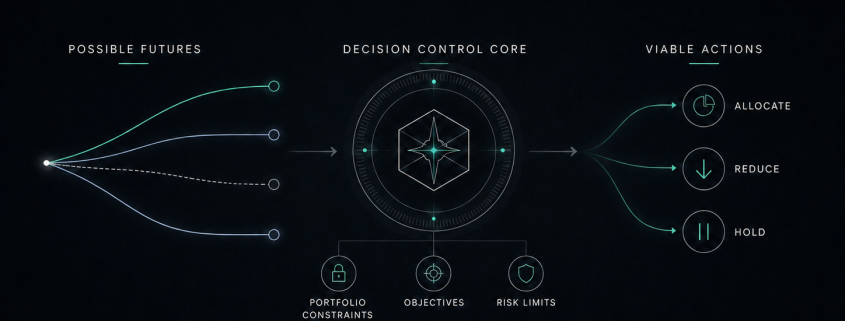
Layer 3 — Decision‑Control OS (Risk Elimination)
- Deterministic decision pathways
- Capital‑grade verification
- Precision AI execution
- Governed intelligence
- Enterprise‑safe autonomy
This model is the foundation of Acumentica’s category: Decision Control OS.
4. Structural Fiduciary Exposure
Probabilistic AI produces likely outcomes; not guaranteed ones. In fiduciary environments, “likely” becomes:
- misallocated capital
- compliance exposure
- operational instability
- audit failure
- governance breakdown
This is not a tooling issue. It is a structural risk issue.
Fiduciary environments require deterministic, governed, auditable intelligence; not probabilistic output streams.
5. Operational Consequences for CIO’s
When probabilistic AI is deployed without governance, CIO’s face consequences that directly impact capital allocation, compliance, and enterprise stability:
- Misallocated capital; recommendations that cannot be verified or reproduced
- Drift‑driven model errors; silent degradation over time
- Hallucinated compliance interpretations; invented regulatory meaning
- Unverifiable risk assessments; probabilistic scoring without justification
- Non‑deterministic decisions; different answers to the same question
- Multi‑agent conflict; autonomous agents acting without orchestration
Each of these risks is eliminated only through a Decision Control OS.
6. Fiduciary Duty and AI Governance
Fiduciary responsibility requires:
- prudence
- transparency
- accountability
- reliability
Probabilistic AI without governance exposes enterprises to:
- operational risk
- regulatory violations
- legal liability
- reputational damage
- capital misallocation
AI is no longer a productivity tool. It is a fiduciary governance issue.
7. The Illusion of AI Confidence
Modern AI systems often produce:
- authoritative responses
- fluent explanations
- persuasive reasoning
even when the underlying information is:
- incomplete
- incorrect
- hallucinated
- statistically inferred
This creates confident uncertainty; one of the most dangerous characteristics of probabilistic AI.
8. Hallucination Risk in Enterprise Environments
AI hallucinations are not minor inaccuracies. In fiduciary environments, hallucinations can become:
- financial liabilities
- operational hazards
- regulatory breaches
- governance failures
If AI systems fabricate:
- investment rationale
- compliance interpretations
- risk assessments
- operational recommendations
the consequences are institutional.
9. Multi‑Agent AI and Governance Complexity
Enterprises increasingly deploy multi‑agent systems:
- forecasting agents
- optimization agents
- execution agents
- compliance agents
- governance agents
Without orchestration, enterprises face:
- agent conflict
- inconsistent reasoning
- governance fragmentation
- operational instability
This is why agentic governance infrastructure is becoming essential.
10. The Enterprise AI Reliability Crisis
Enterprises are discovering that:
- reliability
- explainability
- observability
- governance
matter more than raw AI capability.
Industries such as finance, healthcare, infrastructure, manufacturing, and defense require:
- operational precision
- auditability
- deterministic governance frameworks
Probabilistic AI alone cannot meet these requirements.
11. Why Probabilistic AI Cannot Operate Alone
Probabilistic AI is powerful for:
- pattern recognition
- forecasting
- language generation
- anomaly detection
- adaptive learning
But enterprises often mistake probabilistic inference for governed operational intelligence.
Probabilistic AI must operate within:
- governance frameworks
- telemetry systems
- policy layers
- oversight architectures
This is where Decision Control Infrastructure becomes essential.
12. The Mandatory Governance Era
Regulators worldwide are converging on a single principle: AI must be governed, auditable, explainable, and deterministic in fiduciary environments.
Key regulatory pressures include:
- SEC AI governance expectations
- EU AI Act fiduciary obligations
- Model Risk Management (MRM) requirements
- Auditability and explainability mandates
- Capital‑critical oversight requirements
The trajectory is clear: Probabilistic AI without Decision‑Control Infrastructure will become a regulatory violation.
13. From AI Assistance to AI Governance
Most enterprises deploy AI as:
- assistants
- copilots
- productivity enhancers
But fiduciary environments require governed intelligence systems that:
- validate
- monitor
- explain
- optimize
- govern
This is the shift from AI assistance to AI governance infrastructure.
14. What Enterprises Must Implement Now
To operate safely in the fiduciary AI era, enterprises must deploy:
- Governance layer above all AI
- Decision‑Control OS
- Precision AI telemetry + oversight
- Multi‑agent orchestration
- Deterministic decision pathways
- Capital‑grade verification
This is why Acumentica built the Decision‑Control OS.
15. Precision AI: The Next Enterprise Standard
Enterprises increasingly prioritize:
- precision
- consistency
- reliability
- explainability
- governance
The future will not be dominated by the most conversational AI — but by the most governable AI.
This is the foundation of Precision AI.
16. PrecisionOS and FRIDA
PrecisionOS
Acumentica’s enterprise intelligence infrastructure for:
- telemetry
- optimization
- governance
- multi‑agent coordination
- continuous feedback intelligence
FRIDA (Neuro Precision AI)
Designed for:
- adaptive cognition
- continuous reasoning
- enterprise memory
- governed operational orchestration
FRIDA operates within controlled intelligence architectures; not probabilistic autonomy.
17. The Future Enterprise AI Stack
Layer 1: Probabilistic Intelligence Layer 2: Governance Infrastructure Layer 3: Decision‑Control Infrastructure Layer 4: Human Oversight
This is the architecture of governed enterprise intelligence.
18. Conclusion: The Future Requires Governed Intelligence
Probabilistic AI is powerful — but dangerous when unmanaged. Fiduciary environments require:
- Precision AI
- Decision‑Control Infrastructure
- operational telemetry
- governance systems
- adaptive oversight
The future enterprise will not operate on probabilistic AI. It will operate on governed Precision AI infrastructure.
Explore the Decision Control Architecture
- Decision‑Control OS
- PrecisionOS
- Risk Governance OS
- FRIDA
- What‑If Scenario OS
See How PrecisionOS Eliminates Fiduciary AI Risk
If your institution is experiencing portfolio instability, drift in exposures, or unexplained allocation changes, explore how Acumentica’s Investment Decision ControlOS governs construction, allocation, and execution to eliminate drift.
Also learn about Frida, Acumentica’s Agentic AI ControlOS that operates inside the Investment Decision Control OS, using governed decision pathways.
Decision Control Research Lab
The Decision Control Research Lab researches drift, collapse dynamics, and the Decision‑Control layer; the institutional execution‑governance systems that keep autonomous and enterprise systems stable, aligned, and protected from drift‑driven failure.
Portfolio Drift: When construction and allocation quietly break strategy
Decision Drift: The Institutional Instability CIOs Can’t See
AI Hallucination Drift: When AI Creates False Decisions That Break Institutional Governance
Risk Governance: Preventing drift and overrides in Agentic AI execution
Portfolio Governance: Stabilizing Investment Decisions in Agentic AI Systems
Why Investment Teams Fail: The Missing Governance Layer
What is Capital Decision Control Infrastructure? The New Architecture Wall Street and Enterprises Will Need
The Missing Layer Between Research and Execution: Decision Control
Why Investment Team Drift Under Uncertainty (and How to Stop It)
About Acumentica
Acumentica is a Precision AI-powered Capital Decision Control Infrastructure company.
We help institutions make better decisions under uncertainty and avoid costly mistakes by transforming complex data, risk, and constraints into clear, disciplined next actions. Request a demo
Acumentica is the steering and braking layer above Intelligence; the part that governs what AI does, not just what it predicts.
Acumentica originated the Capital Decision Control Infrastructure and built the first product in that category; the Decision Control OS. We are the first company to introduce governed capital‑control as a market and technology category thesis.