

Why AI Needs Decision Control Loops; The Missing Layer in Enterprise AI
By Team Acumentica
Enterprise artificial intelligence is approaching a critical architectural turning point.
Over the past several years, organizations rapidly adopted:
- generative AI,
- copilots,
- machine learning systems,
- predictive analytics,
- and intelligent automation platforms.
These technologies introduced significant productivity gains across:
- software development,
- operations,
- finance,
- customer support,
- and enterprise knowledge management.
However, as AI systems move deeper into operational environments, enterprises are discovering a fundamental problem:
Most AI architectures were never designed to continuously govern decisions under uncertainty.
Today’s AI systems are primarily:
- reactive,
- transactional,
- and inference-driven.
But modern enterprises require systems capable of:
- continuous adaptation,
- operational orchestration,
- dynamic optimization,
- and autonomous governance.
This is driving the emergence of a critically important architectural concept:
Decision Control Loops
At Acumentica, we believe Decision Control Loops represent one of the foundational pillars of:
Precision AI Decision Control Infrastructure.
The Problem With Today’s AI Systems
Most AI systems today operate using a relatively simple pattern:
- Receive input
- Generate inference
- Produce output
- Terminate
This architecture works reasonably well for:
- chatbots,
- recommendation systems,
- content generation,
- and isolated automation tasks.
However, enterprise environments are fundamentally different.
Modern organizations operate inside continuously changing systems involving:
- operational uncertainty,
- market volatility,
- supply chain disruptions,
- cybersecurity threats,
- infrastructure instability,
- and rapidly evolving data environments.
Static AI inference alone cannot effectively manage these conditions.
Enterprises increasingly require: continuously adaptive intelligence systems.
What Is a Decision Control Loop?
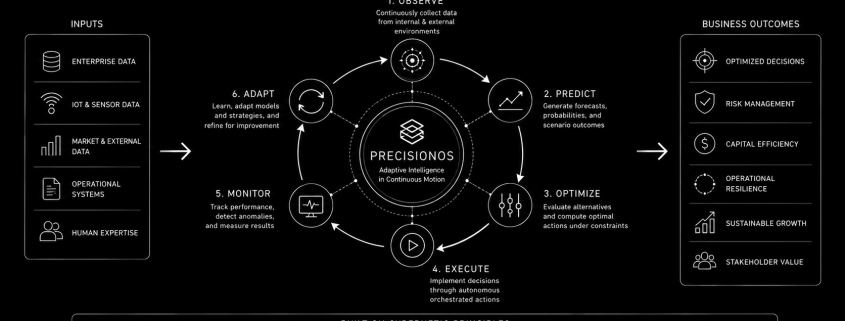
A Decision Control Loop is a continuously adaptive intelligence architecture that:
- observes environments,
- predicts outcomes,
- optimizes decisions,
- executes actions,
- monitors results,
- and adapts dynamically in real time.
Unlike traditional AI systems, Decision Control Loops never truly stop operating.
They function as: continuous operational intelligence cycles.
These architectures are heavily inspired by:
- aerospace guidance systems,
- industrial automation,
- cybernetics,
- robotics,
- autonomous defense systems,
- and advanced reinforcement learning environments.
The Core Structure of a Decision Control Loop
A modern Decision Control Loop typically operates through several continuous stages:
1. Observe
The system continuously gathers:
- telemetry,
- operational data,
- market signals,
- environmental conditions,
- user behavior,
- and external intelligence.
This creates: real-time situational awareness.
2. Predict
The system generates:
- forecasts,
- probability distributions,
- anomaly detection,
- and scenario analysis.
This stage often leverages:
- machine learning,
- transformers,
- reinforcement learning,
- Bayesian AI,
- Hidden Markov Models,
- and predictive analytics engines.
3. Optimize
The system evaluates:
- strategic alternatives,
- operational tradeoffs,
- risk-adjusted outcomes,
- and resource allocation scenarios.
Optimization engines may include:
- Monte Carlo simulation,
- portfolio optimization,
- stochastic modeling,
- and reinforcement learning policies.
4. Execute
The system initiates:
- workflows,
- operational actions,
- automated orchestration,
- or strategic recommendations.
Execution may occur:
- autonomously,
- semi-autonomously,
- or with human oversight.
5. Monitor
The infrastructure continuously evaluates:
- operational performance,
- decision outcomes,
- model drift,
- anomalies,
- and system behavior.
This creates: continuous observability.
6. Adapt
The system dynamically updates:
- models,
- strategies,
- optimization policies,
- and operational priorities.
This stage enables: intelligent resilience under uncertainty.
Why This Matters
Traditional enterprise systems are often:
- static,
- delayed,
- and reactive.
Decision Control Loops create:
- adaptive enterprises,
- continuously learning operations,
- and intelligent infrastructure systems.
This changes enterprise AI fundamentally.
The Cybernetic Foundation of Enterprise AI
The concept of Decision Control Loops originates from: cybernetics.
Cybernetics is the science of:
- communication,
- control,
- adaptation,
- and feedback systems.
Originally developed in:
- aerospace,
- defense,
- robotics,
- and industrial automation,
cybernetic principles are now becoming foundational to: enterprise intelligence systems.
This transition represents: the industrialization of AI infrastructure.
Why Generative Chats Are Not Enough
Most enterprise AI today remains heavily centered around:
- conversational interfaces,
- prompt engineering,
- and content generation.
While useful, these systems are fundamentally limited.
They:
- respond,
- infer,
- and terminate.
They do not continuously:
- govern decisions,
- orchestrate operations,
- monitor enterprise conditions,
- or optimize dynamically.
Decision Control Loops introduce:
continuous operational cognition.
This is one of the biggest architectural differences between:
- AI assistants
and - Precision AI infrastructure.
Enterprise AI Requires Continuous Intelligence
Modern enterprises no longer operate in stable environments.
Organizations face:
- market shocks,
- geopolitical instability,
- supply chain volatility,
- cybersecurity risks,
- operational disruptions,
- and rapidly evolving regulations.
This means enterprise AI must evolve from: static inference systems
toward: continuously adaptive intelligence architectures.
Decision Control Loops enable precisely this capability.
Why Wall Street Needs Decision Control Loops
Financial markets are one of the clearest examples of environments requiring:
- continuous adaptation,
- predictive intelligence,
- and autonomous optimization.
Markets continuously evolve based on:
- macroeconomics,
- sentiment,
- liquidity,
- geopolitical events,
- and behavioral dynamics.
Static models quickly degrade in effectiveness.
This is why modern investment systems increasingly require:
- adaptive portfolio optimization,
- reinforcement learning agents,
- autonomous rebalancing,
- and operational telemetry systems.
Decision Control Loops allow financial infrastructures to:
- monitor,
- adapt,
- optimize,
- and reallocate capital continuously.
Decision Control Loops in Enterprise Operations
The applications extend far beyond finance.
Construction
Construction enterprises increasingly require:
- predictive scheduling,
- intelligent logistics,
- operational orchestration,
- and adaptive resource allocation.
Decision Control Loops enable:
- continuous operational optimization.
Manufacturing
Manufacturing environments require:
- predictive maintenance,
- adaptive production planning,
- autonomous process optimization,
- and operational telemetry governance.
Healthcare
Healthcare systems increasingly depend on:
- adaptive operational coordination,
- intelligent resource allocation,
- and predictive infrastructure management.
Energy
Energy systems require:
- real-time grid optimization,
- predictive resilience,
- and autonomous operational balancing.
Why AI Needs Operational Feedback
One of the biggest weaknesses of traditional AI systems is the absence of: operational feedback.
Many AI models generate predictions but never learn:
- whether decisions succeeded,
- failed,
- or produced unintended consequences.
Decision Control Loops solve this problem through:
- continuous monitoring,
- telemetry,
- and adaptive optimization.
This creates: self-improving operational intelligence.
The Rise of Closed-Loop Enterprise Intelligence
The future of enterprise AI is increasingly: closed-loop.
Traditional enterprise systems operate linearly:
Input → Process → Output.
Closed-loop intelligence operates cyclically:
Observe → Predict → Optimize → Execute → Monitor → Adapt.
This enables:
- operational resilience,
- continuous learning,
- autonomous adaptation,
- and strategic optimization.
This architecture increasingly resembles:
- aerospace command systems,
- industrial automation networks,
- and autonomous operational environments.
Why Multi-Agent Systems Depend on Decision Control Loops
The rise of multi-agent AI systems makes Decision Control Loops even more important.
Modern enterprises increasingly deploy:
- forecasting agents,
- optimization agents,
- compliance agents,
- operational agents,
- execution agents,
- and governance agents.
Without orchestration infrastructure, these systems become fragmented.
Decision Control Loops create:
- coordination,
- synchronization,
- governance,
- and adaptive intelligence across agent ecosystems.
This becomes foundational to: enterprise AI operating systems.
The Emergence of Precision AI; Capital Decision Control OS
At Acumentica, Decision Control Loops are a foundational architectural principle behind: Precision AI
Precision AI is designed as:
- enterprise intelligence infrastructure,
- operational governance architecture,
- and adaptive orchestration systems.
The platform integrates:
- telemetry,
- multi-agent coordination,
- optimization engines,
- governance frameworks,
- and continuous feedback intelligence
within a unified operational environment.
FRIDA (Neuro Precision AI)
FRIDA represents Acumentica’s Neuro Precision AI framework.
FRIDA is designed around:
- adaptive cognition,
- continuous reasoning,
- enterprise memory,
- and operational orchestration.
Unlike traditional AI systems that respond transactionally, FRIDA functions as: continuously adaptive cognitive infrastructure.
Decision Control Loops are one of the key mechanisms enabling this behavior.
Why Governance Is Critical
As AI systems become more autonomous, governance becomes essential.
Decision Control Loops enable:
- auditability,
- explainability,
- policy enforcement,
- operational oversight,
- and adaptive risk management.
Without governance loops, enterprises face:
- operational instability,
- regulatory exposure,
- model drift,
- and systemic risk.
This is why: governance must become operational; not merely procedural.
Why This Architecture Will Dominate Enterprise AI
Several macro trends are accelerating adoption of Decision Control Loop architectures.
1. AI Saturation
Basic AI capabilities are becoming commoditized.
Differentiation is shifting toward:
- orchestration,
- governance,
- and adaptive infrastructure.
2. Enterprise Complexity
Modern enterprises operate across:
- distributed infrastructure,
- hybrid cloud environments,
- dynamic markets,
- and real-time operational systems.
Static software cannot manage this effectively.
3. Autonomous Operations
Organizations increasingly seek:
- self-optimizing systems,
- autonomous workflows,
- and intelligent operational coordination.
4. Regulatory Pressure
Governments increasingly require:
- explainability,
- transparency,
- auditability,
- and operational oversight.
Decision Control Loops help operationalize these requirements.
The Future of Enterprise AI
The future of AI is not simply conversational.
It is operational.
The next generation of enterprise systems will increasingly resemble:
- adaptive command systems,
- operational intelligence networks,
- and continuously evolving infrastructure architectures.
This represents the evolution from AI applications toward AI operational infrastructure.
Decision Control Loops are one of the foundational layers enabling this transformation.
Conclusion: The Missing Layer in Enterprise AI
Most enterprise AI systems today remain incomplete.
They can:
- generate responses,
- produce predictions,
- and automate workflows,
but they often cannot:
- continuously govern decisions,
- adapt dynamically,
- orchestrate operations,
- or optimize under uncertainty.
Decision Control Loops solve this problem.
They introduce:
- continuous adaptation,
- operational telemetry,
- governance,
- optimization,
- and autonomous orchestration.
At Acumentica, we believe Decision Control Loops will become one of the foundational pillars of:
- Precision AI Decision Control Infrastructure,
- enterprise AI operating systems,
- and adaptive intelligence architectures.
The future enterprise will not merely use AI.
It will operate through: continuously adaptive operational intelligence systems.