

What Is a Capital Decision Control Infrastructure? The New AI Architecture Wall Street and Enterprises Will Need
By Team Acumentica
Artificial intelligence is rapidly transforming enterprise operations, capital markets, and institutional decision-making.
Yet despite billions invested into AI technologies, most organizations still lack something critically important:
A unified infrastructure capable of governing decisions under uncertainty.
Today’s enterprise AI landscape is fragmented.
Organizations deploy:
- chatbots,
- analytics dashboards,
- predictive models,
- workflow automation tools,
- and disconnected machine learning systems,
but very few have developed a true operational intelligence architecture capable of:
- continuously orchestrating decisions,
- optimizing capital,
- governing risk,
- and adapting in real time.
This gap is driving the emergence of a new category:
Capital Decision Control Infrastructure (CDCI)
CDCI represents the next evolution of enterprise intelligence systems; combining:
- predictive AI,
- autonomous orchestration,
- optimization engines,
- governance frameworks,
- and adaptive control architectures
into a unified institutional decision environment.
At Acumentica, we believe CDCI will become one of the defining enterprise AI categories of the next decade.
The Enterprise AI Problem Nobody Talks About
Most AI systems today are built around:
- prediction,
- content generation,
- or automation.
Very few are designed around:
- institutional decision governance,
- uncertainty management,
- capital efficiency,
- or operational control.
This creates a major architectural problem.
Modern enterprises operate in environments characterized by:
- uncertainty,
- market volatility,
- operational complexity,
- geopolitical disruption,
- regulatory pressure,
- and rapidly changing data environments.
Traditional enterprise software cannot adapt dynamically to these conditions.
Likewise, conversational AI systems alone are insufficient for:
- institutional capital management,
- strategic orchestration,
- enterprise risk control,
- and autonomous optimization.
Organizations increasingly require infrastructure-grade intelligence systems.
What Is Capital Decision Control Infrastructure?
CDCI is an enterprise AI architecture designed to optimize, govern, orchestrate, and continuously adapt decision-making across capital-intensive environments.
These environments include:
- financial institutions,
- hedge funds,
- construction enterprises,
- manufacturing operations,
- healthcare systems,
- logistics networks,
- university systems,
- aerospace systems,
- and global enterprise ecosystems.
Unlike traditional AI systems, CDCI focuses on:
- adaptive decision orchestration,
- continuous optimization,
- operational governance,
- and real-time uncertainty management.
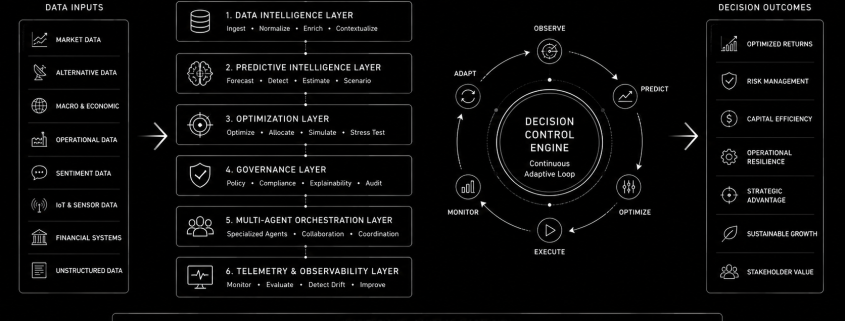
A CDCI architecture integrates:
- predictive intelligence,
- telemetry systems,
- optimization engines,
- governance frameworks,
- multi-agent orchestration,
- and operational control loops
into a continuously adaptive intelligence environment.
Why Capital Allocation Is Becoming an AI Problem
Capital allocation is one of the most important functions within any organization.
Every enterprise continuously makes decisions involving:
- investments,
- resource allocation,
- operational prioritization,
- labor deployment,
- supply chain coordination,
- infrastructure investments,
- and strategic risk management.
Historically, these decisions relied heavily on:
- spreadsheets,
- static models,
- disconnected systems,
- human intuition,
- and delayed reporting cycles.
However, modern enterprise environments now generate:
- enormous data streams,
- real-time operational signals,
- macroeconomic volatility,
- and rapidly shifting market conditions.
This complexity exceeds traditional decision frameworks.
AI is now becoming essential not merely for analysis; but for: orchestrating institutional decisions dynamically.
The Evolution From Enterprise Software to Decision Infrastructure
The enterprise software market evolved in several major phases.
Phase 1: Systems of Record
Examples:
- ERP systems
- CRM platforms
- accounting software
These systems stored information.
Phase 2: Systems of Engagement
Examples:
- collaboration tools
- workflow platforms
- communication systems
These systems improved interaction.
Phase 3: Systems of Intelligence
Examples:
- analytics
- predictive AI
- recommendation systems
These systems generated insights.
Phase 4: Systems of Decision Control
This is the next phase.
Capital Decision Control Infrastructure represents systems capable of continuously governing enterprise decisions.
These systems:
- monitor,
- predict,
- optimize,
- execute,
- and adapt
in real time. This is fundamentally different from traditional enterprise software.
Why Wall Street Needs CDCI
Financial markets are becoming increasingly complex.
Institutional investors now process:
- market data,
- alternative data,
- social sentiment,
- macroeconomic signals,
- geopolitical intelligence,
- options flow,
- and real-time risk telemetry
simultaneously.
Human decision-making alone cannot scale effectively within these environments.
This is driving demand for:
- AI portfolio optimization,
- adaptive trading systems,
- reinforcement learning agents,
- and autonomous capital orchestration frameworks.
Wall Street increasingly requires continuous intelligence infrastructure.
The Rise of AI Portfolio Orchestration
Traditional portfolio management systems are often reactive.
They typically rely on:
- periodic analysis,
- static allocation models,
- quarterly adjustments,
- and delayed reporting cycles.
Modern markets require something entirely different.
Capital Decision Control Infrastructure enables:
- real-time portfolio adaptation,
- autonomous risk management,
- continuous rebalancing,
- and predictive capital allocation.
This architecture combines:
- predictive AI,
- reinforcement learning,
- optimization algorithms,
- and operational telemetry
into a continuously adaptive investment ecosystem.
Explore Acumentica’s financial AI systems:
Acumentica – Precision AI – Capital Decision Control Infrastructure
The Architecture of a CDCI System
A modern Capital Decision Control Infrastructure typically includes several foundational layers.
/1.0 Data Intelligence Layer
This layer processes:
- structured data,
- unstructured data,
- market feeds,
- operational telemetry,
- macroeconomic signals,
- and external intelligence streams.
Examples:
- Bloomberg feeds
- IoT sensors
- ERP data
- social sentiment
- operational systems
- satellite data
/2.0 Predictive Intelligence Layer
This layer generates:
- forecasts,
- probability distributions,
- anomaly detection,
- and trend analysis.
Technologies include:
- transformers,
- XGBoost,
- LSTMs,
- Prophet,
- Bayesian AI,
- Hidden Markov Models,
- Graph Neural Networks.
/3.0 Optimization Layer
This layer determines:
- optimal actions,
- resource allocation,
- risk balancing,
- and strategic prioritization.
This may include:
- portfolio optimization,
- Monte Carlo simulation,
- reinforcement learning,
- stochastic optimization,
- and scenario analysis.
/4.0 Governance Layer
This layer introduces:
- explainability,
- auditability,
- policy enforcement,
- and institutional compliance.
This becomes increasingly important as AI systems gain operational autonomy.
/5.0 Multi-Agent Orchestration Layer
This layer coordinates specialized AI agents responsible for:
- forecasting,
- execution,
- compliance,
- optimization,
- risk analysis,
- and monitoring.
These agents operate collaboratively within a coordinated intelligence ecosystem.
/6.0 Telemetry and Observability Layer
This layer continuously monitors:
- system performance,
- operational behavior,
- model drift,
- decision quality,
- and infrastructure health.
This enables:
- continuous adaptation,
- operational resilience,
- and intelligent governance.
Why Multi-Agent AI Changes Everything
One of the most important developments in enterprise AI is the emergence of multi-agent intelligence systems.
Rather than relying on a single generalized AI model, enterprises are deploying:
- specialized reasoning agents,
- operational agents,
- financial agents,
- governance agents,
- and optimization agents.
This architecture resembles:
- aerospace control systems,
- military command systems,
- and industrial automation frameworks
more than traditional software.
The future enterprise will increasingly operate through orchestrated intelligence infrastructures.
From AI Tools to AI Operating Systems
Most companies still think about AI as:
- applications,
- copilots,
- or productivity tools.
However, enterprise AI is evolving toward:
- operating systems,
- orchestration layers,
- and adaptive intelligence infrastructures.
At Acumentica, this philosophy powers:
- PrecisionOS,
- FRIDA Neuro Precision AI,
- and our broader Decision Control Infrastructure vision.
Why Governance Is Critical
As AI systems gain greater autonomy, governance becomes essential.
Without governance infrastructure, enterprises face:
- hallucinated recommendations,
- operational instability,
- regulatory exposure,
- decision inconsistency,
- and systemic risk.
Capital Decision Control Infrastructure introduces:
- explainability frameworks,
- policy enforcement,
- operational auditability,
- telemetry governance,
- and adaptive oversight mechanisms.
This enables organizations to scale AI responsibly.
Industries That Will Adopt CDCI
Capital Decision Control Infrastructure extends far beyond finance.
Construction
Construction enterprises increasingly require:
- predictive logistics,
- adaptive scheduling,
- operational orchestration,
- and capital efficiency systems.
Manufacturing
Manufacturers need:
- autonomous optimization,
- predictive maintenance,
- and adaptive operational intelligence.
Healthcare
Healthcare organizations require:
- clinical coordination,
- intelligent resource allocation,
- and adaptive operational governance.
Energy
Energy systems increasingly rely on:
- grid optimization,
- predictive resilience,
- and intelligent infrastructure orchestration.
Logistics
Global logistics networks require:
- real-time routing intelligence,
- adaptive operational planning,
- and autonomous coordination systems.
The Emergence of Neuro Precision AI
The future of enterprise intelligence will increasingly resemble:
- adaptive cognition,
- distributed reasoning,
- and continuous operational learning.
FRIDA, Acumentica’s Neuro Precision AI framework, is designed around:
- adaptive intelligence,
- memory-enhanced reasoning,
- multi-agent coordination,
- and enterprise decision orchestration.
Rather than functioning as a simple chatbot, FRIDA represents operational cognitive infrastructure.
This transition from conversational AI toward neuro-operational systems will redefine enterprise technology.
Why This Market Will Become Massive
Several trends are accelerating the growth of Capital Decision Control Infrastructure.
1. AI Saturation
Basic AI tools are becoming commoditized.
Differentiation is shifting toward:
- orchestration,
- governance,
- and adaptive operational intelligence.
2. Enterprise Complexity
Modern enterprises operate across:
- hybrid systems,
- distributed infrastructure,
- global operations,
- and dynamic market environments.
Static software cannot adapt effectively.
3. Regulatory Pressure
AI governance regulations are expanding globally.
Organizations require:
- explainability,
- accountability,
- and operational transparency.
4. Autonomous Operations
Enterprises increasingly seek:
- self-optimizing systems,
- autonomous orchestration,
- and adaptive intelligence infrastructure.
The Future of Enterprise AI
The future of AI will not belong to isolated applications.
It will belong to:
- orchestrated intelligence ecosystems,
- adaptive decision infrastructures,
- and autonomous operational control systems.
This represents a shift from software automation toward enterprise intelligence infrastructure.
Capital Decision Control Infrastructure is one of the foundational architectures enabling that transition.
Conclusion: The Next Enterprise AI Category
The first era of AI focused on:
- automation,
- analytics,
- and conversational interfaces.
The next era will focus on:
- governance,
- orchestration,
- adaptive optimization,
- and institutional decision control.
Capital Decision Control Infrastructure represents one of the most important emerging enterprise AI categories because it addresses a fundamental problem how organizations govern decisions under uncertainty.
At Acumentica, we are building toward this future through:
- PrecisionOS,
- FRIDA Neuro Precision AI,
- multi-agent orchestration systems,
- and enterprise Decision Control Infrastructure architectures.
The future enterprise will not merely use AI.
It will operate through continuously adaptive intelligence infrastructure.