

The End of AI Chatbots: Why Enterprises Are Moving Toward Precision AI Decision Control Infrastructure
Author: Ryan D’Souza, CEO Acumentica
The End of AI Chatbots: Why Enterprises Are Moving Toward Precision AI Decision Control Infrastructure
Artificial intelligence has clearly entered a new phase.
The first wave of enterprise AI was all about chatbots, copilots, and conversational tools that helped employees pull up information, draft content, and automate routine tasks. Those systems created a huge amount of excitement across industries; from finance and healthcare to manufacturing, logistics, and construction.
But as adoption has grown, a major limitation has become impossible to ignore:
Most AI systems can generate answers, but very few can govern decisions.
That gap is quickly becoming one of the most important strategic issues in enterprise technology.
As organizations scale AI across their operations, they’re running into challenges around decision accuracy, operational reliability, risk governance, explainability, regulatory pressure, capital allocation, and coordinating autonomous systems.
The future of enterprise AI is no longer just about conversational interfaces. It’s moving toward something far more advanced:
Precision AI – Capital Decision Control Infrastructure
This emerging category brings together enterprise AI, decision intelligence, governance frameworks, autonomous orchestration, adaptive control systems, and institutional‑grade operational infrastructure.
At Acumentica, we believe this shift represents one of the most important technology transformations of the coming decade.
Why AI Chatbots Are No Longer Enough
Generative AI changed how organizations interact with information. Large Language Models made it possible to communicate with machines in plain language, which accelerated adoption across customer support, internal knowledge management, software development, analytics, marketing, and operations.
But beneath the excitement, enterprises started running into real limitations.
1. Chatbots Don’t Control Enterprise Decisions
Most chat systems act as assistants; not operational intelligence layers.
They can generate recommendations, summaries, responses, or content.
But they typically cannot:
- validate strategic outcomes
- govern capital allocation
- monitor risk propagation
- coordinate multiple systems
- enforce decision policies
- or continuously optimize enterprise behavior
This creates a dangerous gap between generating intelligence and operationalizing intelligence.
The Enterprise AI Reliability Problem
CIO’s and enterprise leaders consistently raise the same concern: reliability.
Conversational AI is impressive, but it struggles in environments that require deterministic outcomes, regulatory compliance, institutional governance, or operational precision.
Industries like finance, construction, healthcare, manufacturing, logistics, and energy cannot rely solely on probabilistic conversational systems to make high‑impact decisions.
These environments require continuous monitoring, adaptive reasoning, closed‑loop feedback, and measurable governance.
This is where Precision AI infrastructure becomes essential.
What Is Precision AI; Capital Decision Control Infrastructure?
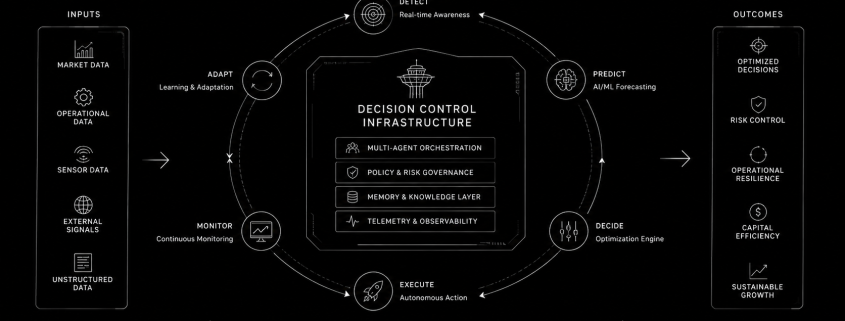
Precision AI – Capital Decision Control Infrastructure is an enterprise‑grade architecture designed to orchestrate, govern, optimize, and continuously improve organizational decision‑making under uncertainty.
Unlike traditional AI copilots, Precision AI systems function as:
- operational intelligence layers
- adaptive control systems
- autonomous orchestration frameworks
- institutional reasoning infrastructure
They integrate AI models, predictive engines, optimization algorithms, governance policies, telemetry systems, and multi‑agent coordination into one unified operational architecture.
This philosophy powers Acumentica’s broader vision across:
- PrecisionOS
- FRIDA (Neuro Precision AI)
- Capital Decision Control Infrastructure
The Shift From Conversational AI to Operational AI
The next evolution of enterprise AI isn’t about generating text; it’s about governing outcomes.
Traditional chatbots answer questions and generate summaries.
Precision AI systems:
- optimize enterprise decisions
- control operational risk
- orchestrate workflows
- adapt continuously in real time
This is a fundamentally different architecture.
Traditional AI Chatbots vs. Precision AI Decision Infrastructure
Reactive → Proactive
Conversational → Operational
Isolated → Orchestrated
Content‑focused → Decision‑focused
User‑driven → System‑driven
Static prompting → Continuous adaptation
Single‑agent → Multi‑agent coordination
Limited governance → Enterprise governance layers
Why Enterprises Need Decision Control Infrastructure
Modern enterprises operate in constant uncertainty; market volatility, operational disruptions, cybersecurity threats, regulatory changes, supply chain instability, and capital allocation pressure.
Traditional enterprise software wasn’t built to manage dynamic uncertainty in real time.
Precision AI introduces adaptive intelligence, autonomous monitoring, continuous optimization, and real‑time governance; transforming AI from a productivity tool into a strategic operational infrastructure layer.
The Rise of Multi‑Agent Enterprise Intelligence
One of the most important developments in AI is the emergence of multi‑agent systems.
Instead of relying on a single assistant, enterprises are deploying specialized agents for forecasting, optimization, compliance, risk analysis, operational planning, execution, and monitoring.
These agents collaborate inside orchestrated ecosystems.
For example, an investment system may include:
- predictive agents
- sentiment intelligence agents
- portfolio optimization agents
- macroeconomic analysis agents
- execution governance agents
Together, they form a coordinated decision environment; the foundation of Decision Control Infrastructure.
Why Precision Matters More Than Speed
The early AI market prioritized speed and convenience.
The next phase prioritizes:
- precision
- explainability
- governance
- resilience
Enterprise leaders now ask:
- Can the AI explain its reasoning?
- Can it adapt to uncertainty?
- Can it prevent catastrophic decisions?
- Can we audit and govern its actions?
- Can it align with enterprise objectives?
These questions are reshaping the AI landscape.
The future belongs to systems capable of institutional reliability, operational observability, and adaptive governance.
The Emergence of AI Control Loops
Precision AI systems rely on closed‑loop control architectures.
Traditional AI works in a straight line:
Input → Inference → Output
Precision AI operates continuously:
Observe → Predict → Optimize → Execute → Monitor → Adapt → Re‑optimize
This creates a living intelligence system capable of continuous learning, adaptive decision‑making, and operational resilience — drawing inspiration from aerospace control systems, cybernetics, industrial automation, and advanced reinforcement learning.
Why Enterprise AI Needs Governance
As AI systems gain autonomy, governance becomes essential.
Without governance, enterprises face hallucinated recommendations, regulatory exposure, model drift, operational inconsistency, and reputational risk.
Precision AI Decision Control Infrastructure introduces policy enforcement, auditability, explainability layers, telemetry, and institutional oversight; enabling responsible AI at scale.
Capital Decision Control Infrastructure
One of the most powerful applications of Precision AI is in capital allocation.
Financial institutions and enterprise leadership teams increasingly need AI systems that can optimize portfolios, manage uncertainty, orchestrate risk, and adapt continuously to market conditions.
This is driving the rise of Capital Decision Control Infrastructure (CDCI) ; systems that combine predictive AI, reinforcement learning, optimization algorithms, macroeconomic intelligence, sentiment analysis, and governance architectures.
Neuro Precision AI (Frida)
The next generation of enterprise AI won’t behave like static software.
It will function like adaptive cognitive infrastructure.
FRIDA; Acumentica’s Agentic AI ControlOS (Neuro Precision AI framework); is built around continuous reasoning, multi‑agent orchestration, memory‑enhanced intelligence, adaptive governance, and enterprise‑scale decision systems.
It’s not a chatbot.
It’s a continuously evolving intelligence architecture.
This shift will redefine how enterprises govern decisions, allocate capital, manage uncertainty, and orchestrate operations.
Why This Market Will Grow Rapidly
Several macro trends are accelerating the rise of Precision AI Decision Control Infrastructure:
- Enterprise AI Saturation
Most organizations already have chatbots. Differentiation is shifting to orchestration, governance, and operational precision. - Regulatory Pressure
Governments are increasing scrutiny around AI governance, explainability, and transparency. - Autonomous Operations
Enterprises want systems capable of adaptive optimization, autonomous monitoring, and intelligent orchestration. - Complexity Explosion
Hybrid clouds, distributed data, global supply chains, and multi‑domain operations demand more advanced AI infrastructure.
Industries That Will Be Transformed
Precision AI Decision Control Infrastructure will reshape:
- Financial Markets; portfolio governance, autonomous trading, capital intelligence
- Construction; project orchestration, predictive logistics, risk management
- Manufacturing; autonomous operations, predictive maintenance, adaptive optimization
- Healthcare; clinical intelligence, operational coordination, risk‑aware treatment
- Energy; grid optimization, infrastructure resilience, predictive operations
- Physical AI; AV’s, robotics etc.
The Future of Enterprise AI
The enterprise AI market is entering a new architectural era.
The future won’t belong to isolated AI tools — it will belong to orchestrated intelligence ecosystems, adaptive decision infrastructure, autonomous governance systems, and enterprise control architectures.
This is the shift from AI as an assistant to AI as infrastructure.
Conclusion: The Beginning of the Precision AI Era
The chatbot era introduced enterprises to conversational intelligence.
The next era will introduce them to operational intelligence.
Organizations that succeed will build adaptive intelligence infrastructures capable of governing decisions, orchestrating operations, optimizing capital, and continuously adapting under uncertainty.
Precision AI Decision Control Infrastructure is the foundation of that future.
At Acumentica, we are building toward this next generation through:
- PrecisionOS
- FRIDA Neuro Precision AI
- multi‑agent orchestration systems
- Capital Decision Control Infrastructure
The future of enterprise AI is no longer about generating answers. It’s about controlling outcomes.
Learn More
If your institution is experiencing exposure instability, factor or sector drift, regime misalignment, or unexplained allocation behavior, explore how Acumentica’s Investment Decision‑ControlOS governs construction, allocation, exposure, and execution to eliminate drift.
Also learn about Frida, Acumentica’s Agentic AI ControlOS that operates inside the Investment Decision Control OS, using governed decision pathways to stabilize factor, regime, thematic, and correlation exposures in runtime.
Decision Control Research Lab
The Decision Control Research Lab researches drift, collapse dynamics, and the Decision‑Control layer; the institutional execution‑governance systems that keep autonomous and enterprise systems stable, aligned, and protected from drift‑driven failure.
Investment Research Governance ControlOS: Governing Research Direction & Exploration in Runtime
Portfolio Governance ControlOS: Preventing Portfolio Drift in Runtime
Risk Governance ControlOS: Runtime Enforcement of Institutional Risk Boundaries
AI Hallucination Drift: When AI Creates False Decisions That Break Institutional Governance
Risk Governance: Preventing drift and overrides in Agentic AI execution
Portfolio Drift: When construction and allocation quietly break strategy
Decision Drift: The Institutional Instability CIOs Can’t See
Portfolio Governance: Stabilizing Investment Decisions in Agentic AI Systems
Why Investment Teams Fail: The Missing Governance Layer
What is Capital Decision Control Infrastructure? The New Architecture Wall Street and Enterprises Will Need
The Missing Layer Between Research and Execution: Decision Control
Why Investment Team Drift Under Uncertainty (and How to Stop It)
About Acumentica
Acumentica is a Precision AI-powered Capital Decision Control Infrastructure company.
We help institutions make better decisions under uncertainty and avoid costly mistakes by transforming complex data, risk, and constraints into clear, disciplined next actions. Request a demo
Acumentica is the steering and braking layer above Intelligence; the part that governs what intelligence does, not just what it predicts.
Acumentica originated the Capital Decision Control Infrastructure and built the first product in that category; the Decision Control OS. We are the first company to introduce governed capital‑control as a market and technology category thesis.